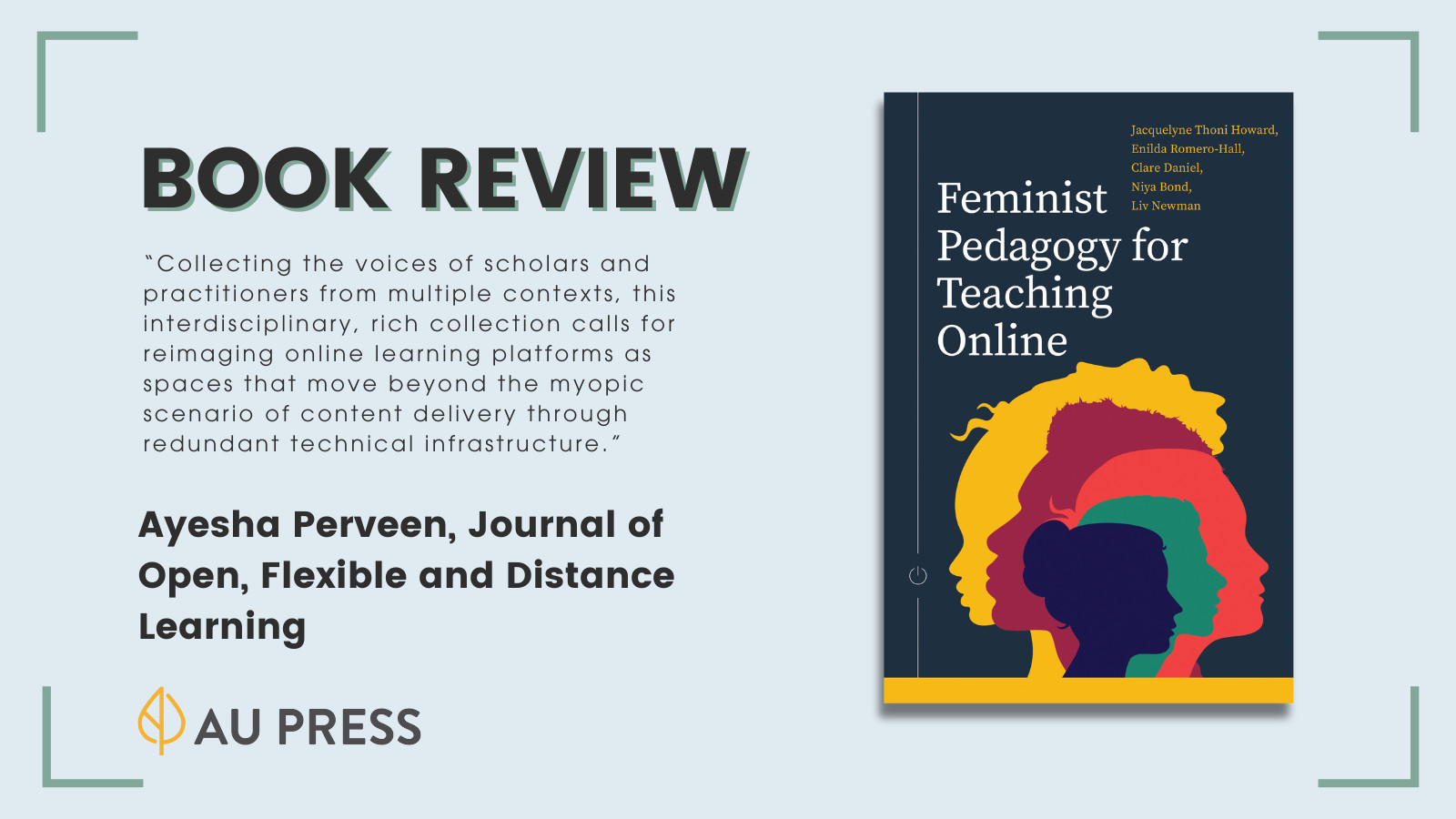
A thoughtful review of “Feminist Pedagogy for Teaching Online” by Dr. Perveen

A book review of Feminist Pedagogy for Teaching Online authored by Dr. Ayesha Perveen was published in the Journal of Open, Flexible and Distance Learning. Thank you Dr. Perveen for taking the time to review our book and your praise as well as thoughtful feedback!

The abstract:
“This book review critically examines Feminist Pedagogy for Teaching Online (Howard et al., 2025), identifying it as a crucial intervention that bridges a significant gap in contemporary scholarship by envisioning online learning through the lens of feminist pedagogy. The collection challenges dominant instructional design norms and technological culture, underscoring fundamental values of care, equity, reflexivity, and social justice.

Structured into four thematic parts, the book consistently emphasises praxis, showcasing practical tools like social annotation and cryptoparties to foster equity and collaboration in e-spaces. Its primary strength lies in modelling feminist pedagogical principles through collaborative and student-centred approaches. While praised for its diverse contributions, the review notes some chapters could benefit from more analytical engagement with structural barriers to feminist agency in institutional settings. It acknowledges potential conceptual repetitions for novice readers. Nevertheless, the book is considered a vital resource for all e-learning stakeholders, promoting value-driven, ethical, and transformative online learning environments.”

The review is available open access and you can read it here:

Perveen, A. (2025). Book Review: Feminist Pedagogy for Teaching Online. Journal of Open, Flexible and Distance Learning, 29(1), 151–158. https://doi.org/10.61468/jofdl.v29i1.731

Online Ready: Designing Culturally Competent K-12 Online Learning

“Online Ready: Designing Culturally Competent and Impactful K-12 Online Learning” (funded by the Institute of Museum and Library Services, #RE-250017-OLS-21) was a three-year design-based exploratory study led by Lucy Santos Green (University of Iowa) in partnership with Kristin Fontichiaro, University of Michigan, and Melissa P. Johnston, University of West Georgia. The project assessed and addressed school librarianship knowledge gaps in the design and delivery of targeted and culturally competent online learning.

As part of this grant project, I collaborated with Lucy, Kristin, and Melissa in the design and developed of the Online Ready curriculum. I also taught one of the three online asynchronous mini-courses, titled Culturally-Competent Design Mini Course. I feel so incredibly honored to have been part of this project. The Online Ready course was instrumental in allowing K-12 school librarians to reflect on their practice and their schools context while also advancing their learning design and online learning knowledge and skills.

You can explore all the mini-courses from this project by accessing the Online Ready platform available for free through the UI Learn Catalog. Please share widely with your school librarians colleagues and friends!

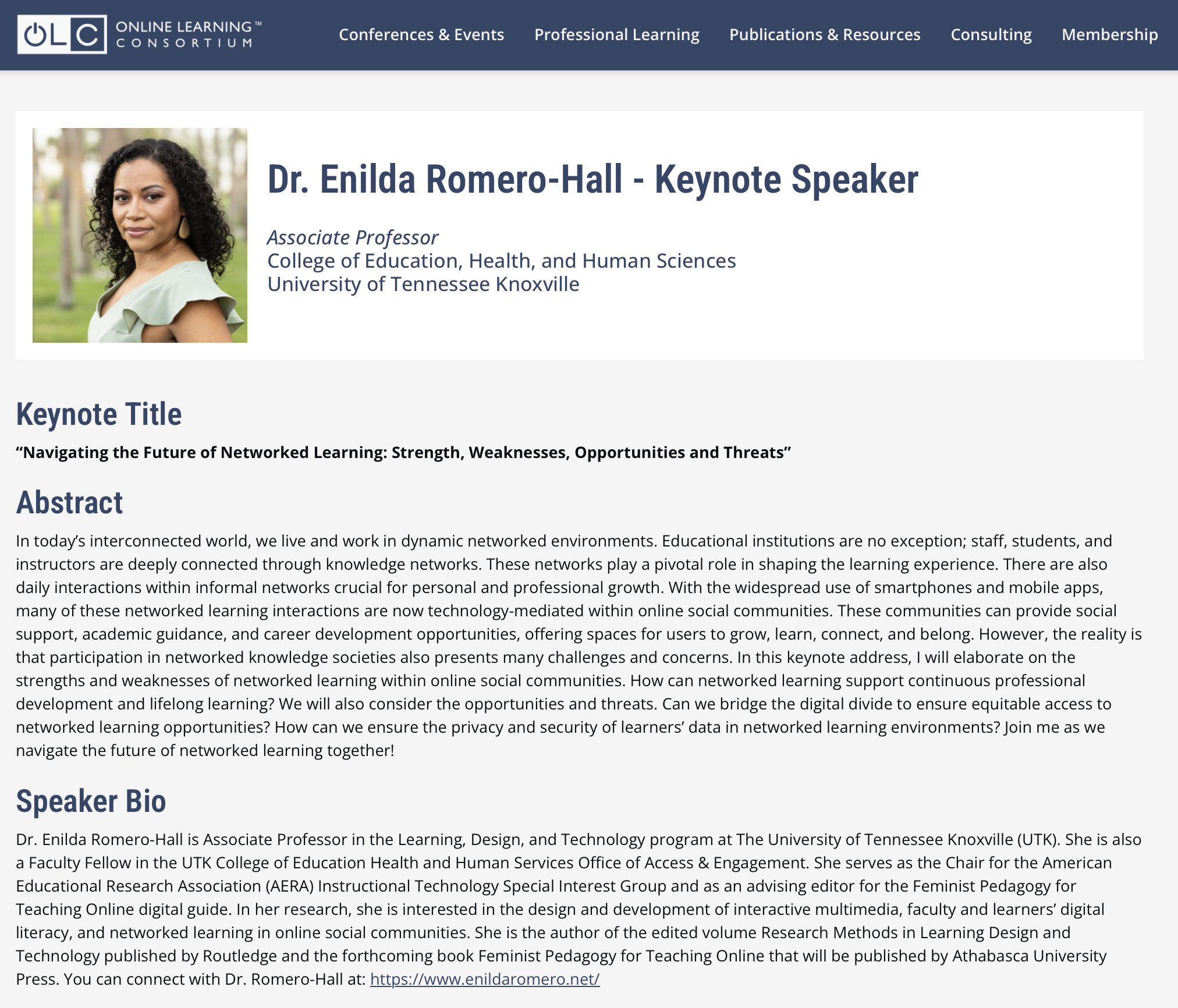
OLC Innovate 2025 Keynote

Read Abstract and Speaker Bio


These are references that I used to inform my OLC Innovate 2025 keynote presentation:

Huge thanks to the Online Learning Consortium (OLC) for the invitation!

Congratulations Dr. Hongyan Yang! #GoVols #GBO

Huge congrats to Dr. Hongyan Yang, completing a Doctor of Philosophy degree in Education with a concentration in Learning Design and Technology at The University of Tennessee Knoxville, who yesterday defended her dissertation titled “Interactions in Asynchronous Courses: Students Perspectives and Instructors Design Strategies”! #GoVols

Committee members: Dr. Rachel Wong (Chair), Dr. Enilda Romero-Hall, Dr. Jennifer Morrow, Dr. Miriam Larson

Abstract:

Asynchronous learning is becoming increasingly prevalent, making it essential to ensure its effectiveness for the academic success and satisfaction of distance learners. Designing interactive engagement in asynchronous courses is a challenge for many asynchronous instructors. This study aims to investigate students’ perspectives and experiences regarding interactions within asynchronous courses and explore effective instructional design strategies to integrate meaningful interactions to foster students’ learning. 

This dissertation research addresses three primary questions: (1) What is the relationship between students’ general satisfaction and diverse types of interactions, including learner-learner, learner-content, learner-instructor, and learner-interface interactions? (2) How do students rank the importance of these interactions? (3) What strategies do instructors use to facilitate these interactions?

Data were collected from 378 students using an online survey, and from 14 experienced asynchronous course instructors through qualitative interviews conducted via Zoom. For the survey quantitative data, correlations and multiple regression analysis were performed using SPSS, while interview qualitative data was analyzed using NVivo with descriptive coding.

The results of this study reveal that learner-content interaction is the strongest predictor of student satisfaction in asynchronous courses, highlighting the importance of high-quality, multimedia-rich, and well-organized course materials. While learner-instructor interaction also significantly influences satisfaction, the study emphasizes the need for timely communication, clear guidance, and a strong instructor presence. Additionally, the findings underscore the role of user-friendly technological platforms and the integration of peer interaction to foster a supportive learning community. Furthermore, the interviews with experienced instructors indicate that strategies such as the use of instructional videos, guided learning paths, and collaborative platforms, etc. are vital for improving learner engagement and success.

The findings suggest that enhancing student satisfaction and learning outcomes in asynchronous learning environments requires a balanced approach that prioritizes content quality, effective instructor support, and accessible technology. These insights contribute to the ongoing development of best practices in asynchronous course design, providing actionable recommendations that educators and instructional designers can implement to optimize the effectiveness of their courses.

Book Release Date!

In March, after our in-person meeting in New Orleans, my co-editors and I submitted our book manuscript to Athabasca University Press. Our edited volume “Feminist Pedagogy for Teaching Online” (Issues in Distance Education Series) is set to be released January 4th, 2025 (or at least that is the date that Amazon will release the book).

You are welcome to pre-order it via Amazon. You also can wait until it is released because it will be available open access! As the date gets closers and we find out more information, I will be sharing more about the book. So excited!

I should add that Athabasca University Press has stated that it is possible that the book could be release Fall 2024. More than anything just know that the book is coming either later this year or early 2025 we will have the pleasure of sharing with you!

The FPTO Editors First In-Person Meeting!

Last year, I received an invitation from my colleague, Clare Daniel, to present in a panel to discuss the Feminist Pedagogy for Teaching Online digital guide and other scholarly efforts related to the digital guide in person at Tulane University. The invitation to travel to New Orleans was extended to Niya Bond and myself (Clare, Jacque, and Liv live in New Orleans). The goal was for all the five editors of the digital guide to join in the panel.

Fast forward to February 2024, Niya and I travelled to New Orleans for the in-person panel. Meeting my colleagues in-person for the very first time was a joyous occasion. I have been personally interacting and collaborating with the FTPO editors for the last 3 years and we had only met through Zoom. It was so nice to fully interact outside the Zoom software and engage in informal convos that allowed us to learn more about each other personally and professionally.

“We want to acknowledge that this panel discussion is part of a lecture series dedicated to Adele Ramos Salzer (NC ’40). Her interest in academic programs focusing on women’s experiences led to the establishment of the Salzer lecture series. Her donation endowing the series has been generously strengthened through gifts in her memory from her family, friends, and classmates.”

Clare Daniel

During our visit to Tulane, we all got to have an short meeting to discuss panel, have dinner to talk about every under the sun (also, celebrate Clare’s new promotion at Tulane University), and have the panel at the Tulane University’s Newcomb Institute for students, faculty, and staff.

The editors of the FPTO digital guide
The editors of the FPTO after the panel presentation

During the panel we:

  • Provided a brief explanation of the origins of the digital guide and the idea for the forthcoming book
  • Shared why and how we expanded our team of editors
  • Shared a brief description of the forthcoming book
  • Discussed how and why we expanded the guide to include annotated assignments
  • Shared an explanation of the blog and the collaborative editing process
  • Allowed for Q & A

It was really nice to have such a strong presence of students during the panel session. The students were very curious about of opinions on online learning, now past the COVID-19 pandemic. We also had some good questions and conversations with faculty who attended the event. I am very thankful for the invite to participate in this panel. I am also grateful for the opportunity to meet my colleagues in-person for the first-time. Online environments, synchronous and asynchronous, have allowed is the opportunity to genuinely connect and communicate. However, it is always nice to further engage in-person to deeper our understanding of each other (personally & professionally), converse about the future of the digital guide, and discuss upcoming projects.

The Key Podcast | @InsideHigherEd | Ep. 91

A few weeks ago, I was invited to join a podcast to talk about HyFlex Instruction. I was on travel when I saw the email from the editor in my inbox and, without too much information, I accepted to join the conversation. I really did not know what direction the podcast was going to take. I know HyFlex learning is “controversial” and even “unwelcome” by many, but I really was just going to speak facts. I reviewed some of the research I have done on the topic and the reviewed the literature I have read on the past in preparation for the podcast. I am very happy that the editor had a conversation approach to the podcast and that guided the conversation on the “what comes next” direction. I will be speaking and doing more research on this topic in the upcoming months. So, this is just the beginning of the conversation.

I really do not like listening to my voice in recordings so I just know what I said from the actual recording session. I have not heard the podcast, so I appreciate colleagues who have reached out to let me know that they enjoyed listen to the podcast and the points I shared as part of the conversation. Above is a link to the tweet from Inside Higher Ed and here is the link to the webpage: Ep.91: The Pros and Cons of HyFlex Instruction

UTK STEM Education Seminar

This past week, I was invited to speak as part of the STEM education seminar sponsored by the Theory and Practice in Teacher Preparation (TPTE) Department STEM team. I am part of the STEM Education team in the department and this semester a group of colleagues are organizing this seminar with presentations for faculty and graduate students every two weeks. I have really enjoyed all of the presentations this semester. Our STEM Education team is doing really amazing work and I love learning about it.

For my presentation, I was a bit nervous because I was not sure how my work would relate to STEM education. I know educational technology is consider part of STEM education. However, I think of my work as more than just educational technology. I actually see Learning, Design, and Technology as the umbrella term under which educational technology, instructional design, instructional technology, learning engineering, and others similar terms come together. Perhaps one of my main concerns is that under the term STEM, learning design is primarily associated with the “technology” term which I really see as just one aspects of the far more complex ecosystems of the learning, design, and technology field.

The presentation focused on how it is okay to have many areas of research interest. We are often encouraged to stay very narrowly focused on a topic. But, what if you are curious about other topics and want to explore them? So, basically, I used myself as an example of an eclectic research agenda. My research has evolved so much and in part it due to my curiosity to explore other topics. This has also been true in my life, curiosity to try new things or study programs outside my focus has helped me evolve and grow. Here is the link to the slides, in case you are curious.

Recent Publications related to Online Teaching and Learning

In this post, as I have done in other posts, I want to share some research that I have co-authored and published so far this year related to online teaching and learning:

The three-tier design process: Streamlined guidelines for designing and developing a course in a learning management system to promote effective learning” You can access this journal article here

This is a collaboration with Weiwei Ji (Instructional Designer at Arkansas Tech University) and Pauline Salim Muljana (Doctoral Candidate at Old Dominion University). It is a design framework supported by research-based evidence and influenced by the instructional design practice of WeiWei (Will) and his experience as an instructional designer. Of course, it is also supported by the knowledge, skills, and experience of Pauline and myself. As we state in the abstract: “We propose a set of guidelines called the Three-Tier Design Process (TTDP), providing a pathway for faculty and other higher-education professionals who intend to design and develop a course in a Learning Management System and to promote learner-centered experiences. This paper includes detailed discussion about each tier of the TTDP, its subcomponents, and an example of its application. The TTDP borrows from existing theories, models, and literature in the instructional design field that focuses on key aspects that help create positive learning experiences. Tier 1 focuses on course design and serves as a foundation for the next two tiers; Tier 2 emphasizes course development; and Tier 3 concentrates on the user-experience considerations. Examples from a real course are additionally provided.” We were invited to write a blog post about the journal article for the Online Learning Research Center. Here is a link to the blog post: https://www.olrc.us/blog/designing-and-developing-courses-in-learning-management-systems-how-do-we-enhance-learners-experiences

“Hybrid flexible instruction: Exploring faculty preparedness” You can access this open access journal article here

I was excited to see this journal article finally published. This journal article is the result of a collaboration with University of Tampa undergraduate elementary education major, Caldeira Ripine. It is a research project supported by the Undergraduate Research and Inquiry Grant from the University of Tampa. The data was collected prior to the COVID-19 pandemic during Fall 2019. As the pandemic started and plans for continuity of instruction were shared by higher education institutions, I knew that the data Caldeira and I had collected needed to get publish as soon as possible. But, due to a number of factors (including lack of childcare) it took a while a to get this out into the review pipeline and of course, then it had to go through the peer review process. In any case, as stated in the abstract: “The aim of this investigation was to survey faculty members on their perceived level of preparedness to design and implement hybrid flexible (HyFlex) instruction. Participants included 121 full- and part-time faculty. Using an electronic survey, faculty members: a) rated their preparedness to engage on different HyFlex instruction competencies, b) shared which pedagogical strategies they felt prepared to use in this instructional modality, and c) listed the resources and support that they felt were needed to successfully implement their course.” The journal article is open access, you are welcome to download, read, and share.

Photo by Samantha Borges on Unsplash

CFP: Feminist Pedagogy for Teaching Online

The curators of the Feminist Pedagogy for Teaching Online guide (Jacquelyne Thoni Howard, Clare Daniel, Niya Bond, Liv Newman, and myself) are putting together a new edited collection on this topic. A list of potential topics is included in the call.

Please consider submitting a book chapter proposal by July 2nd, 2021. The book will be proposed to the Distance Education series at Athabasca University Press for publication in an open-access format.

For more information about the CFP or to submit a proposal visit: http://tiny.cc/FemTeachOnline