2024 Year in Review

This is a 2024 year in review post but focused on publications. These are my 2024 publications:

Gomez-Vasquez, L., Ozi Dias Da Silva, C., Fortsmane, L. & Romero-Hall, E. (2024). Leveraging Connections in Social Media Hashtag Communities: Uses, Gratifications, and Strategies. Journal of Interactive Learning Research, 35(2), 195-221. Waynesville, NC: Association for the Advancement of Computing in Education (AACE). Retrieved July 31, 2024 from https://www.learntechlib.org/primary/p/223892/

Yang, H. & Romero-Hall, E. (2024). A Pilot Study Exploring Interaction and Student Satisfaction in Asynchronous Courses in Higher Education. TechTrends. https://doi.org/10.1007/s11528-024-00986-7

Gomez-Vasquez L., Forstmane L., Dias Da Silva C. O., & Romero-Hall E. (2024). Personal branding strategies in online hashtag communities: the case of #AcademicTwitter. Research in Learning Technology32doi.org/10.25304/rlt.v32.3098

Romero-Hall, E., Gomez-Vasquez, L., Forstman, L., Ripine, C. & da Silva, C.D. (2024). “Visibility, transparency, feedback and recognition”: Higher Education Scholars’ Using Digital Social Networks. Journal of Interactive Media in Education, 2024(1): 7, pp. 1–15. DOI: https://doi.org/10.5334/jime.842

Allen, T., Villaflor-Wilson, R., Muljana, P.S. & Romero-Hall, E. (2024). AI-generated content: Guidelines, higher order thinking skills, and copyrights. Educational Technology Journal, 4(1), 1 – 5. https://journal.unesa.ac.id/index.php/etj/article/view/27840

Carpenter, J., Rosenberg, J.,  Kessler, A., Romero-Hall, E. & Fischer, C. (2024). The importance of context in teacher educators’ professional digital competence. Teachers and Teaching: Theory and Practicehttps://doi.org/10.1080/13540602.2024.2320155 

Romero-Hall, E. (2024). Suzie Beckett and Adam McSweeny: Developing a Role-Playing Simulation. In In P. Ertmer, K. Glazewski, A. Koehler & J. Stefaniak (Eds.), Instructional Design Casebook (6th ed.). Routledge.

My professional experiences are so much more than a list of publications but it is important to acknowledge this work because it took time, effort, energy, mentoring, and collaboration.

Congratulations Dr. Hongyan Yang! #GoVols #GBO

Huge congrats to Dr. Hongyan Yang, completing a Doctor of Philosophy degree in Education with a concentration in Learning Design and Technology at The University of Tennessee Knoxville, who yesterday defended her dissertation titled “Interactions in Asynchronous Courses: Students Perspectives and Instructors Design Strategies”! #GoVols

Committee members: Dr. Rachel Wong (Chair), Dr. Enilda Romero-Hall, Dr. Jennifer Morrow, Dr. Miriam Larson

Abstract:

Asynchronous learning is becoming increasingly prevalent, making it essential to ensure its effectiveness for the academic success and satisfaction of distance learners. Designing interactive engagement in asynchronous courses is a challenge for many asynchronous instructors. This study aims to investigate students’ perspectives and experiences regarding interactions within asynchronous courses and explore effective instructional design strategies to integrate meaningful interactions to foster students’ learning. 

This dissertation research addresses three primary questions: (1) What is the relationship between students’ general satisfaction and diverse types of interactions, including learner-learner, learner-content, learner-instructor, and learner-interface interactions? (2) How do students rank the importance of these interactions? (3) What strategies do instructors use to facilitate these interactions?

Data were collected from 378 students using an online survey, and from 14 experienced asynchronous course instructors through qualitative interviews conducted via Zoom. For the survey quantitative data, correlations and multiple regression analysis were performed using SPSS, while interview qualitative data was analyzed using NVivo with descriptive coding.

The results of this study reveal that learner-content interaction is the strongest predictor of student satisfaction in asynchronous courses, highlighting the importance of high-quality, multimedia-rich, and well-organized course materials. While learner-instructor interaction also significantly influences satisfaction, the study emphasizes the need for timely communication, clear guidance, and a strong instructor presence. Additionally, the findings underscore the role of user-friendly technological platforms and the integration of peer interaction to foster a supportive learning community. Furthermore, the interviews with experienced instructors indicate that strategies such as the use of instructional videos, guided learning paths, and collaborative platforms, etc. are vital for improving learner engagement and success.

The findings suggest that enhancing student satisfaction and learning outcomes in asynchronous learning environments requires a balanced approach that prioritizes content quality, effective instructor support, and accessible technology. These insights contribute to the ongoing development of best practices in asynchronous course design, providing actionable recommendations that educators and instructional designers can implement to optimize the effectiveness of their courses.

Book Release Date!

In March, after our in-person meeting in New Orleans, my co-editors and I submitted our book manuscript to Athabasca University Press. Our edited volume “Feminist Pedagogy for Teaching Online” (Issues in Distance Education Series) is set to be released January 4th, 2025 (or at least that is the date that Amazon will release the book).

You are welcome to pre-order it via Amazon. You also can wait until it is released because it will be available open access! As the date gets closers and we find out more information, I will be sharing more about the book. So excited!

I should add that Athabasca University Press has stated that it is possible that the book could be release Fall 2024. More than anything just know that the book is coming either later this year or early 2025 we will have the pleasure of sharing with you!

AERA SIG Instructional Technology Newsletter

“Hi everyone,

First and foremost, it has been a pleasure serving as the AERA SIG Instructional Technology Program Chair. Huge thanks to everyone who submitted proposals to our SIG. It was very exciting to see the range of topics covered in the proposals submitted. I was also deeply impressed with the quality of the proposal submitted, which made for a difficult peer review process for our reviewers. Speaking of reviewers! I am profoundly grateful for our 94 reviewers who took on the very meaningful tasks of providing feedback and recommending proposals for our SIG Instructional Technology program. Huge thanks to all that have volunteered as Session Chairs, you are a critical component for a smooth conference session! Gratitude!

I can humbly say that we have an amazing AERA 2024 program for the SIG! Each session was carefully designed to ideally create a cohesive line up of presentations. I look forward to meeting you in Philadelphia and to your presentations! I am excited for all of us to engage in academic discourse, professional development, and informal social conversations. See you soon! Go Vols!

Enilda Romero-Hall, Ph.D., Associate Professor, University of Tennessee Knoxville

These quote is a section of the AERA Special Interest Group Instructional Technology Spring 2024 Newsletter recently shared with our members. Below is a copy of the complete AERA Special Interest Group Instructional Technology Spring 2024 Newsletter compiled, formatted, & organized by the 2023-2024 board members of the SIG Instructional Technology:

Learning Designers in Context: Examining Practices Across the Global South [Book in Progress]

I guess it is time for me to write a blogs post about my forthcoming book 😊

It has been a while since I first announced that I was working on my next book and sadly due to various reasons I had to rescheduled my submission of the book to the publisher twice! But over the last two months I have moved full steam ahead with this book project.

I love how it is taking shape and that I get to work on it. Today, I was working on chapter 12 (in a coffee shop) and I was just smiling thinking that someone else would get to read this work.

This is not a book in which I tell someone else’s stories or tell you how to be a learning designer. The book is about learning designers telling their stories. It is about conversations, experiences, and journeys.

More on this coming soonish 😊

UTK STEM Education Seminar

This past week, I was invited to speak as part of the STEM education seminar sponsored by the Theory and Practice in Teacher Preparation (TPTE) Department STEM team. I am part of the STEM Education team in the department and this semester a group of colleagues are organizing this seminar with presentations for faculty and graduate students every two weeks. I have really enjoyed all of the presentations this semester. Our STEM Education team is doing really amazing work and I love learning about it.

For my presentation, I was a bit nervous because I was not sure how my work would relate to STEM education. I know educational technology is consider part of STEM education. However, I think of my work as more than just educational technology. I actually see Learning, Design, and Technology as the umbrella term under which educational technology, instructional design, instructional technology, learning engineering, and others similar terms come together. Perhaps one of my main concerns is that under the term STEM, learning design is primarily associated with the “technology” term which I really see as just one aspects of the far more complex ecosystems of the learning, design, and technology field.

The presentation focused on how it is okay to have many areas of research interest. We are often encouraged to stay very narrowly focused on a topic. But, what if you are curious about other topics and want to explore them? So, basically, I used myself as an example of an eclectic research agenda. My research has evolved so much and in part it due to my curiosity to explore other topics. This has also been true in my life, curiosity to try new things or study programs outside my focus has helped me evolve and grow. Here is the link to the slides, in case you are curious.

Upcoming Free and Open Speaking Engagements

September

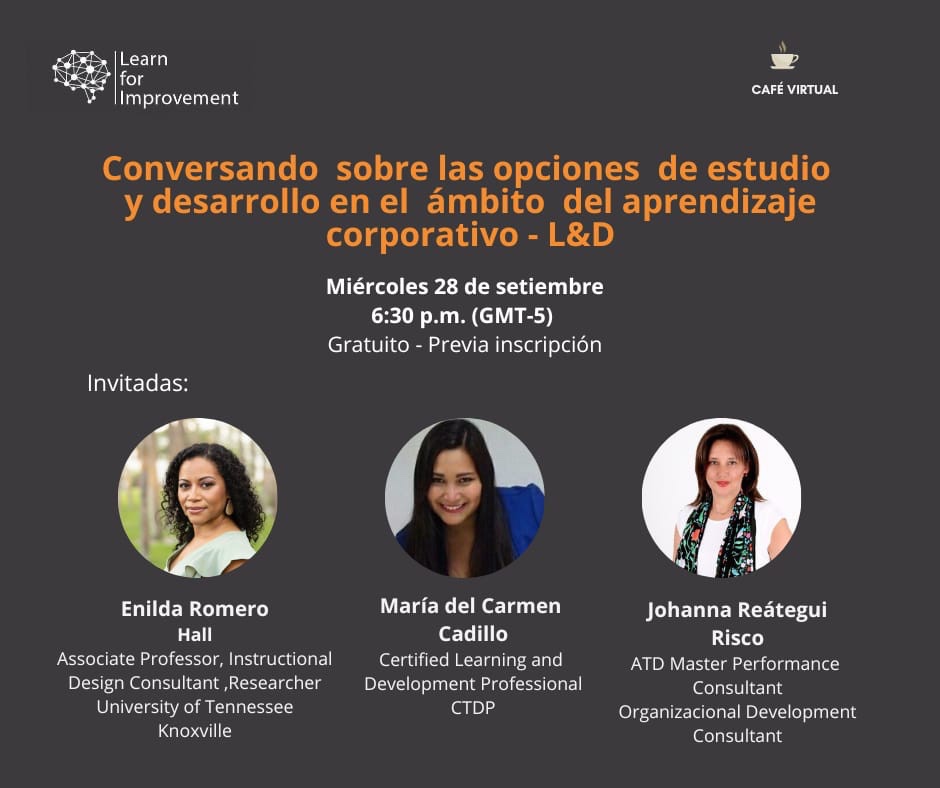
This event is for Spanish speakers, who more than likely live in Latin America but anyone is welcome. If you are interested in an instructional design program or a program focused on learning and development for a corporate environment, join us! We will be talking about this topic on September 28! The organizers of this event are the Learning for Improvement group the is organized by instructional designers in Peru. I am thankful that I was invited to be part of this Cafe Virtual. Here is the link to register for the event: https://forms.gle/5sexFAfqaBM6J6jE7

Flyer for the “Cafe Virtual” organized by the Learn for Improvement group

October

On October 19, I will be doing a presentation for my alma mater, the Graduate Student Organization of the Instructional Design and Technology program at Old Dominion University. More details coming soon.


November

On Nov. 3, I will be presenting as part of the University of Tennessee Knoxville (UTK) Theory and Practice in Teacher Preparation (TPTE) STEM seminar and discussing “inclusive and equitable learning design practices”

On Nov. 17, I will presenting for the members of the Hampton Roads International Society for Performance Improvement (ISPI) Chapter. Topic: “Social, Learner Centered, Culturally-Relevant Digital Workforce Development.” You are welcome to register for this virtual event. It is a free and open event: https://www.eventbrite.com/e/social-learner-centered-culturally-relevant-digital-workforce-development-tickets-415319711437

For my Spanish speaking connections! On Wednesday, November 23 I am honored to be joining an amazing group of speakers as part of the Semana de la Innovación (Innovation Week) of the Centro de Innovación y Excelencia Docente de la Universidad Autónoma de Chile. Tema: “Inclusión e igualdad en la enseñanza en línea”. Mas detalles pronto.


December

Last but not least, for the European crowd, the ProDiGI project at the Technische Universität Braunschweig @tuBraunschweig is hosting a free & open conference in early December. I’ll be sharing more details about my presentation later on. But, in case you want to learn more about the conference or would like to join the conference here is the link: https://bit.ly/3BKcHIs

Grateful for the opportunity to participate in this events in an online format. Also, grateful that colleagues thought about me and asked me to join them in these events.

Recent Publications related to Online Teaching and Learning

In this post, as I have done in other posts, I want to share some research that I have co-authored and published so far this year related to online teaching and learning:

The three-tier design process: Streamlined guidelines for designing and developing a course in a learning management system to promote effective learning” You can access this journal article here

This is a collaboration with Weiwei Ji (Instructional Designer at Arkansas Tech University) and Pauline Salim Muljana (Doctoral Candidate at Old Dominion University). It is a design framework supported by research-based evidence and influenced by the instructional design practice of WeiWei (Will) and his experience as an instructional designer. Of course, it is also supported by the knowledge, skills, and experience of Pauline and myself. As we state in the abstract: “We propose a set of guidelines called the Three-Tier Design Process (TTDP), providing a pathway for faculty and other higher-education professionals who intend to design and develop a course in a Learning Management System and to promote learner-centered experiences. This paper includes detailed discussion about each tier of the TTDP, its subcomponents, and an example of its application. The TTDP borrows from existing theories, models, and literature in the instructional design field that focuses on key aspects that help create positive learning experiences. Tier 1 focuses on course design and serves as a foundation for the next two tiers; Tier 2 emphasizes course development; and Tier 3 concentrates on the user-experience considerations. Examples from a real course are additionally provided.” We were invited to write a blog post about the journal article for the Online Learning Research Center. Here is a link to the blog post: https://www.olrc.us/blog/designing-and-developing-courses-in-learning-management-systems-how-do-we-enhance-learners-experiences

“Hybrid flexible instruction: Exploring faculty preparedness” You can access this open access journal article here

I was excited to see this journal article finally published. This journal article is the result of a collaboration with University of Tampa undergraduate elementary education major, Caldeira Ripine. It is a research project supported by the Undergraduate Research and Inquiry Grant from the University of Tampa. The data was collected prior to the COVID-19 pandemic during Fall 2019. As the pandemic started and plans for continuity of instruction were shared by higher education institutions, I knew that the data Caldeira and I had collected needed to get publish as soon as possible. But, due to a number of factors (including lack of childcare) it took a while a to get this out into the review pipeline and of course, then it had to go through the peer review process. In any case, as stated in the abstract: “The aim of this investigation was to survey faculty members on their perceived level of preparedness to design and implement hybrid flexible (HyFlex) instruction. Participants included 121 full- and part-time faculty. Using an electronic survey, faculty members: a) rated their preparedness to engage on different HyFlex instruction competencies, b) shared which pedagogical strategies they felt prepared to use in this instructional modality, and c) listed the resources and support that they felt were needed to successfully implement their course.” The journal article is open access, you are welcome to download, read, and share.

Photo by Samantha Borges on Unsplash

Writing during “Stay at Home” Orders

How much fun was it to write manuscripts during “Stay at Home” orders without childcare? Well if you have not experience this during the last year and half of the COVID-19 pandemic then consider yourself lucky! It is not fun at all. I wrote the following in a reflection I was putting together on what April 2020 was like:


Upon our return to the U.S. we were faced with the news that, due to the pandemic, our childcare center had closed indefinitely. My partner and I had to adjust to working from home while providing childcare for our 4-year-old son. I had to quickly realize that some of the projects that I was hoping to start before the end of my sabbatical were going to be delayed or canceled. The projects that I was planning to complete were going to require a massive amount of focus and dedication. In order to accomplish all our work requirements, my partner and I had to divide our days into three “shifts.” The morning shift (8 am to 1 pm) in which I worked and he would care for our son. The afternoon shift (1 pm – 6 pm) in which my partner worked and I would provide care for our son. The evening shift (6 pm until midnight) in which were are exhausted but aimed to spend time together as a family.”


In April 2020 during a three week period during my “morning shift” I wrote a manuscript for a special issue that was published in the Educational Technology Research and Development (ETR&D) journal. The realization that I was going to have less than the estimated amount of time to write this paper stressed me so much. But I had to channel that stress into getting the work done. During the process of writing the proposal I had gathered and read most of the literature and had put together an outline. Having this things done was a lifesaver! During the three weeks of writing I had to buckle down and eloquently put the literature and my ideas into a document.

I should give a little bit of context: I initially thought I was going to have a month of full-time work hours during a term in which I was on sabbatical. But because of the lack of childcare (due to COVID-19) I actually had three weeks with 4-hours per day (during week days) to write the paper. I do not know how fast others are at writing papers but gosh I am such a tortoise. To make it more interesting, this was a solo-authored publication.

Kind of funny, I can write without problem in a busy cafe with all sorts of background noise. I pretty much wrote all of my dissertation in a Panera a few blocks from my apartment when I lived in Norfolk, VA. But it was so hard to write this paper from home while having my family members’ voices in the background. I remember putting on my headphones and close the door and still every now and then I would still hear their voices and conversations in the background.

I think that been really passionate about the topic I was writing about made a huge difference on how I approached this writing project, despite the hardship endured in the process. I am grateful for Reviewer # 1 and the editors of the special issue for such wonderful and detailed feedback. I truly helped me improve the paper during the R&R submit process. The manuscript was published “online first” this January 2021 and is titled: Current initiatives, barriers, and opportunities for networked learning in Latin America .

This was the first of many experiences like this. Our son stayed home for 6 months while we worked from home without childcare. And, even after he went back to the childcare center, there were other instances in which he has stayed home and we had to maneuver the same dynamics of still completing our work. Having the deadline of special issue submission did add more pressure in this specific instance (shared in this post)! It made it hard for me commit to any special issue submissions for almost a year (hence why I missed out on so many opportunities to submit for COVID-19 related special issues in 2020, sadly)!

Happy Monday everyone!

CFP: Feminist Pedagogy for Teaching Online

The curators of the Feminist Pedagogy for Teaching Online guide (Jacquelyne Thoni Howard, Clare Daniel, Niya Bond, Liv Newman, and myself) are putting together a new edited collection on this topic. A list of potential topics is included in the call.

Please consider submitting a book chapter proposal by July 2nd, 2021. The book will be proposed to the Distance Education series at Athabasca University Press for publication in an open-access format.

For more information about the CFP or to submit a proposal visit: http://tiny.cc/FemTeachOnline