Publication in the IJDL: “Nursing Pain Assessment & Management: A 3D Interactive Simulation”

Journal Article Published in the International Journal of Designs for Learning

Title: “Nursing Pain Assessment & Management: A 3D Interactive Simulation”

Authors: Enilda Romero-Hall, Ginger S. Watson, Yiannis Papelis, Hector Garcia

Link: http://scholarworks.iu.edu/journals/index.php/ijdl/article/view/5169

Abstract:

In this design case, a team developed a 3D interactive simulation for nursing students and professional nurses to train and practice pain assessment and management procedures. In the simulation environment, the trainees interact with three emotionally expressive animated patients. The three patients vary in their ethnicity, age, and emotion intensity. Successful completion of the scenario requires that the trainee perform of a series of pain assessment and management tasks.  The trainee is evaluated on the efficiency and appropriate sequencing of the tasks.

The purpose of this paper is to describe the decisions made regarding the type of virtual patients used, the clickable objects, the pain assessment interview protocol, the visual representations in the simulation and the web portal. The paper also provides insight into the processes and steps taken during the design and development phases of this 3D interactive simulation including: the tasks analyses, motion capture, validation of the animations in the simulation, programming, and other tasks.


ID&T Job Ads Data Analysis #EME610

The graduate students in the EME610 Trends and Issues in ID&T course (Spring 2014) presented their research results from the analysis of 150+ ID&T job ads. The students were divided into groups and each group focused on a specific job market (faculty, corporate, higher education/K-12, government/military).

ID&T — Corporate:

TeamCorporate_EME610_IDT Job Ad Analysis

ID&T — Faculty

TeamFaculty_ID&T Job Ads Data Collection and Analysis

ID&T — K-12

TeamHigherEducation&K-12_ID&T Job Ads

ID&T — Government & Military

TeamMilitary&Government_EME610 JobAdsPresentation

EERA 2014 Annual Conference: Disseminating Educational Research

20140223-000614.jpg

This past week I had the opportunity to attend the EERA Annual Conference in Jacksonville, Florida. I was excited about this conference because it was my first time attending it and I was curious to see the presentation topics that others would cover during the conference. Since EERA is a educational research conference it provides the opportunity to have a mix of academics with different backgrounds, which is always good for discussion (everyone brings their own perspective).

In the first session that I attended (I was very happy to see another alum from the ID&T program at Old Dominion University, Chris Nickels) the presentation topics related to organizational behavior (i.e., manager motivation, virtual moderation in online meetings, decision making models). I immediately started thinking about the instructional design courses that I teach and how my graduate students would really enjoy the presentations. Some of the topics related to their instructional design projects, especially those in the EME620 course (working in their Systematic Instructional Design project).

I also attended a session related to technology in education, in which several doctoral graduate students from the University of Georgia presented their research projects (dissertation projects and other collaborations). It was nice to meet them in person because I had exchange emails with a few of them for activities related to AECT. The presentation topics included: Blogs in Education (Firat), Technology Integration (Missy) and Learn by Designing Games (Daisy). This was a well attended session with other instructional designers. Very interesting data from all participants. The “Learn by Designing Games” presentation solidified what has been echoed by many others in the instructional design field: “designers learn more when they do (design) something rather than just sitting in the classroom and talking about it.” Another takeaway from this session, from Firat’s presentation, is that currently there is research hoping to create instruments that help assess the importance of blogging in education. Potentially, future research will also help gain knowledge on the use of social media tools for educational purposes (i.e., Facebook, Instagram, etc. ). Firat mentioned that the instrument is currently in Turkish but his collaborators and him are working on an English version.

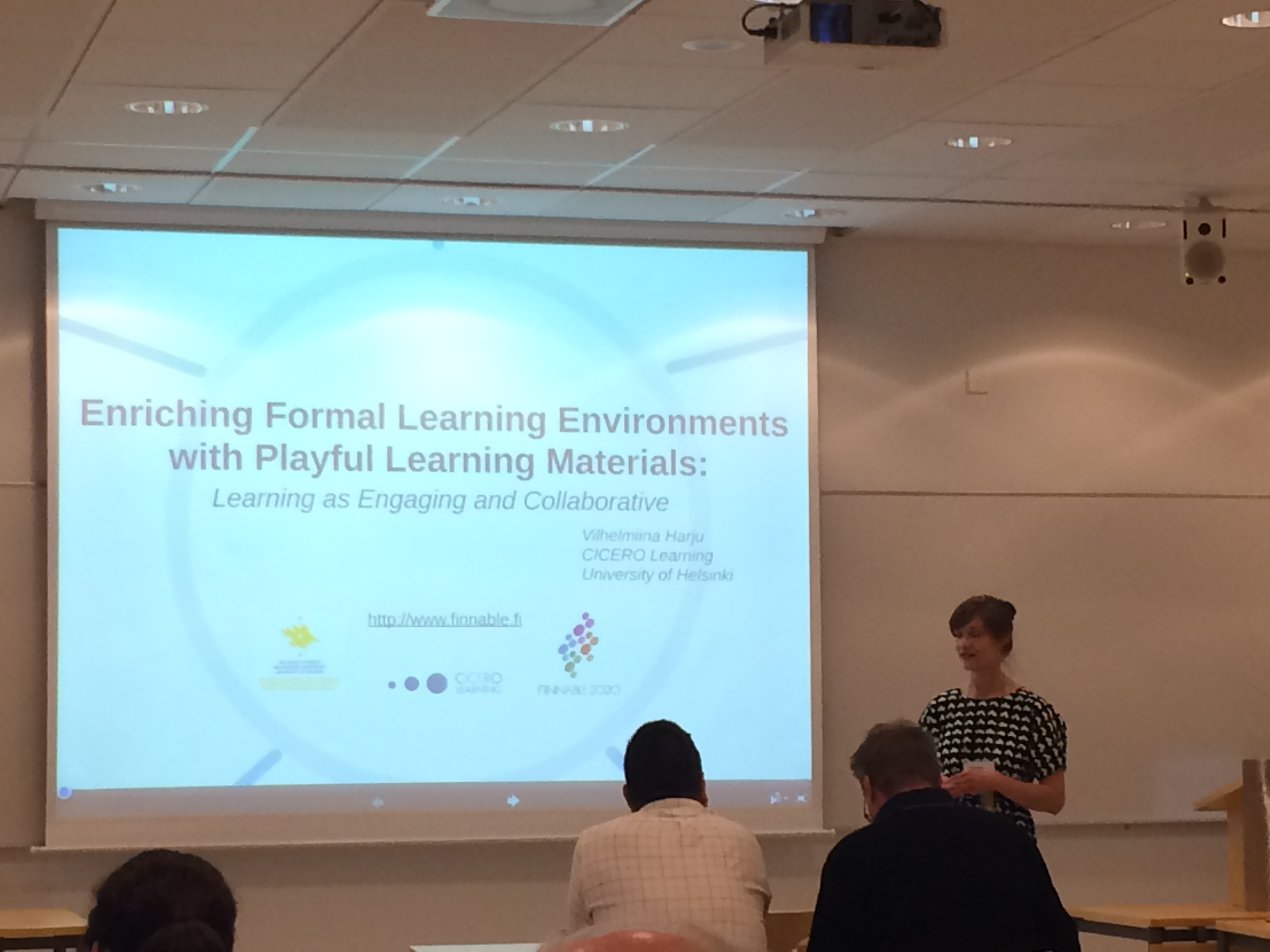
20140223-102822.jpg 20140223-102835.jpg

The last session I attended was a great presentation on “how to handle distractions on the age of the screenagers.” The presentation provided good theoretical background on multitasking literature and our misconceptions of what is multitasking. The author also provided great tips on how to handle those “screenagers” in the classroom and good practices for instructor. One really good takeaway is to add students in the decision making process for rules on “laptops in the classroom.”

In addition to attending different sessions, I was also presenting a session on the use of visual attention measures to investigate multimedia design and development. This sessions was a result of the research that I conducted during my last research project in which I used visual attention measures (eye tracking) and other psychological measures  to investigate the differences between novices and expert nurses interacting with a 3D simulation. The presentation at EERA was more than anything a collection of theoretical and empirical evidence that helps support the use of visual attention measures (eye tracking) in the instructional design field to better understand the difference between neutral and emotional stimuli presented to the learners in multimedia environments. I was specifically discussing the importance of visual attention measures to investigate the design of emotionally expressive animated agents. The discussion during the session was interesting and very informative for the audience and for me (as presenter). One colleague that joined the discussion mentioned that her husband was in the marketing industry and she shared some of the research that they do when they use eye tracking to investigate the design of marketing ads.

I have to say that although it is smaller than the other conferences I normally attend, EERA was a great conference. The sessions were well attended, their was a great conversations/discussion about topics related to the instructional design field, and I had the opportunity to sit down and meet other faculty and grad students to learn about their research. A huge bonus is that is it normally hosted in the Southeast part of the U.S. and that is fairly convenient for my current location. Next year the conference will be in Sarasota (Florida) and I highly encourage others to attend and join the EERA Annual Conference.

AECT 2013: Research, Networking & Professional Development

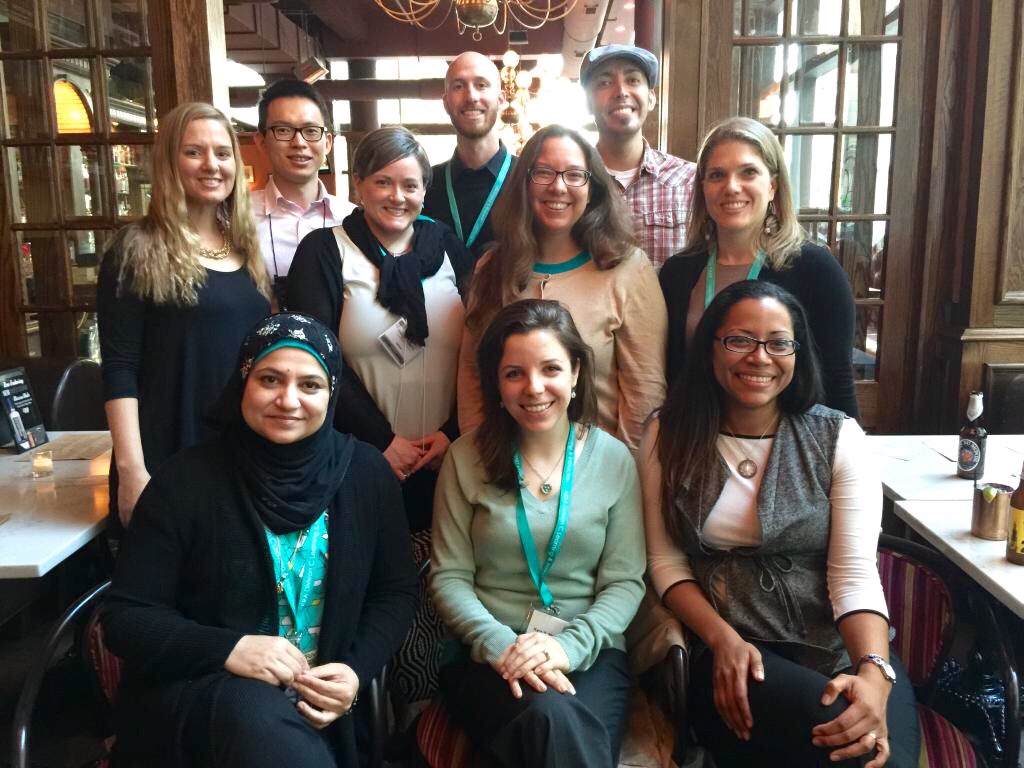
This year, like all previous years, I was looking forward to the AECT conference. I look forward to meeting with my Emporia State University IDT family and the Old Dominion University IDT group. I also get to interact with friends and colleagues that I have made over the years at AECT. It is always the anticipation of knowing that you will get to see each other face-to-face rather than having a conference call or a virtual conversation via videochat. This year as usual it was great to see everyone! The plane ride to Anaheim, California was long but worth it.
I attended meetings for the Research & Theory Division. We have new leadership that will be taking over and we all want the transition to be a smooth one. Also, there are new ideas and members that are interested in joining the conversation. Elections will start in February so we are hoping to recruit members for several positions. I just finished my term as secretary of the division but will continue to work as Professional Development Facilitator focused on the webinar series. I was able to catch up with my co-facilitator during the conference and we are in the initial planning stages of our second webinar (which we hope to have in December).

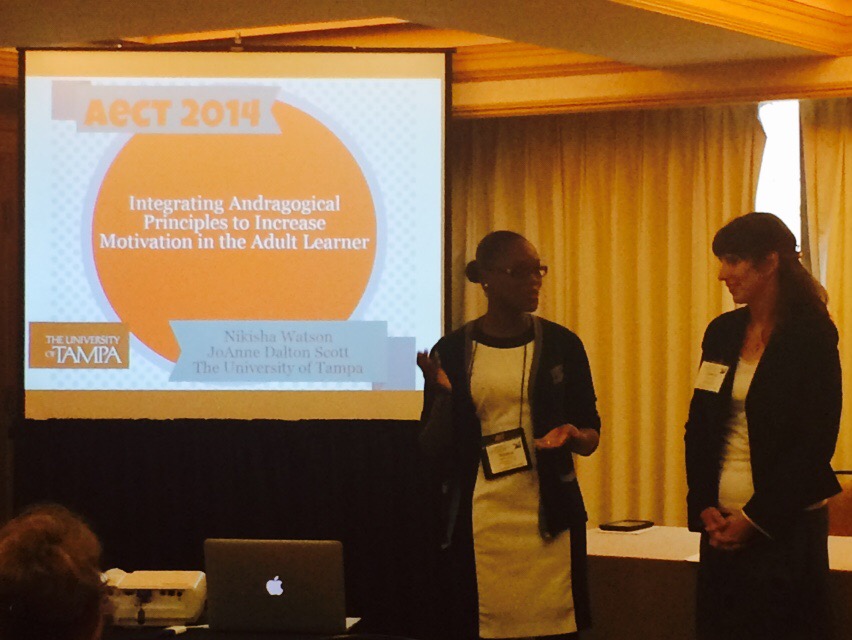
My participation at AECT 2013 also consisted of two presentations. The first one was the Design & Development Showcase, which was a very busy time! It was a lot of fun and I was able to meet people that were very interested on the topic of the simulation that I helped design for my dissertation research. It was a great way to showcase the work that had happened for the last two years of my life. The second presentation was a concurrent session focused on the validation study that I conducted while pilot testing the animations that were used for the final simulation.

This year I also attended several keynote sessions and I have to say I really enjoyed the keynote presentations. They were current, lively and very informative! AECT was broadcasting the sessions live and will also have a link of the recordings in the few weeks (for those that missed it!). Overall, my experience was just fantastic. I love connecting with new colleagues and re-connecting with old ones. I also took sometime to provide advise to current doctoral students and just let them know that “it will be okay at the end… just keep at it and never, never give up.”

I am already looking forward to AECT 2014 because it will be in Jacksonville! Welcome to Florida AECT! But for now it is time to email new connections and to look/read at all the resources/information that I gained at the conference.