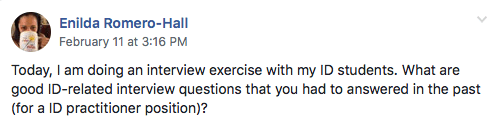
Last week, in preparation for a class, I reached out to professional instructional designers (ID) via Facebook and asked them to share good instructional design related questions that they had to answer in an interview in the past. The reason for collecting these questions was to engage my graduate students in an mock interview exercise.
The response from the ID community in Facebook was great. I am still getting notifications of questions that are getting posted. In addition to the questions posted by ID professionals, I also asked the graduate students in both the Intro and Advance IDT Seminar courses to create questions that would be a good fit for an ID-related interview.
Here is the final Google document with all the interview questions, including those: a) crowdsourced from Facebook, b) UT IDT Intro seminar students, and c) UT IDT Advance seminar students: The Instructional Design Interview
If you are interested in becoming part of this ID FB communities, here are the links:
So, I think by now everybody and their grandma knows that I have earned tenure and promotion to Associate Professor at the University of Tampa. Just in case you missed my Facebook and Twitter post, the Dean’s newsletter, and the global email send to all members of the UT community, here is photographic evidence of the good news!
Tenure and Promotion Letter
All joking aside, I feel proud of this accomplishment. I am immigrant afro-latinx women who started this journey with very little financial support or knowledge about the education system in North America.
Have you ever seen the movie “My Big Fat Greek Wedding”? One of my favorite parts is when the father of bride is sitting in the kitchen table with his daughter and they are discussing who is invited to the wedding. The father feels such pride that his daughter is getting married and he wants to invite every single one of his friends. The daughter wants to keep it intimate and then the father says: “I came to this country with 8 dollars in my pocket!” and then he goes to tell her how hard he worked and the pride feels on everything they have accomplished as a family.
I sometimes feels that as my son gets older, I will say something similar to him: “Diego, your grandparents and I came to North America with one suitcase each and very little money.” This is very true! When I was 19 years old, my parents and I left our home country (Panama) to settle as an immigrant family in Canada. It was not easy. We did not know the culture, we struggled with the language, the cost of living was high, and we knew no-one. It is a really long story with sad memories, struggles, moments of triumphs, and joy. It all let eventually to settling into our new country of residence.
I wrote before about taking a year off from school to work and save money for my education. This happened immediately after I moved to Canada. I worked many jobs, including: the maintenance person (cleaning offices in the Sears headquarter building in downtown Toronto), as a front desk person in several hotels downtown Toronto, and even did a short-term gig as an admin assistant for an administrator in the Toronto School District Board. I feel a little like that Drake song “Started from the bottom”:
“Started from the bottom, now we’re here Started from the bottom, now my whole team fuc*** here”
Sorry when you have affiliations to Toronto, you start quoting Drake! lol
It is true, we started from the bottom now we, as a family, are here. I made two phone calls as soon as I found about T&P. I called my mom in Toronto and I called my dad who is currently Panama. The joy in their voice was everything I needed to hear in that moment. Of course, I celebrated with my husband and son. They have all been part of this journey with me <smiles>.
Something else that I have not mentioned to many, just recently shared in a Twitter post, is that last fall in addition to my tenure & promotion (T&P) dossier, I also submitted an application for sabbatical. At my institution we are allowed to applied for sabbatical the same year you apply for T&P. The sabbatical application was approved both by the sabbatical committee and the Provost. I am very excited for the sabbatical and the projects that I will work on during that time. More on that later this year.
The biggest benefit I get out of FB are the groups that I belong to. They are great for sharing resources and learning from others. Recently, in one of those groups a colleague from a different institution shared a link to the Trends in ID&T Database:
The Trends in ID&T Database is now live! You can access information from more than 80 resources pertaining to the innovations employed and valued in K-12 schools, higher education, and business and industry. We also welcome contributors to help keep the database current. Additionally, please feel free to use this resource within your classes! Find out more at trendsandissues.org
I am currently on the early stages of a book project. The title of this edited volume is “Research Methods in Learning Design and Technology.” The book isanticipated to be released in 2020. Currently, there are 11 confirmed book chapters. I am now in the process of seeking authors for a few additional chapters that will complete the line up for the book (link to the full Call For Proposals).
Introduction: This edited volume serves to combine knowledge related to research methodologies in the instructional design and technology (IDT) field. It will address questions such as: How has our research methodologies evolve? What are the methodologies that can be used to investigate traditional and new research environments? How can we apply innovative research methodologies to address questions related to learning, design, and technology? This edited volume will provide IDT scholars with a solid foundation of the different methods that can be taken to investigate a research problem. This knowledge aids researchers in the understanding of the rationale for the application of specific procedures or techniques used to identify, select, process, and analyze information applied to understand a research question.
Objectives of this Book:
Present a historical overview of how different methodologies have adapted to the new and changing learning environments
Illustrate how different methodologies can be used to investigate topics related to IDT
Explore benefits and drawbacks to different types of research methodologies in research related to the IDT research
Discuss the future of research methodologies in the IDT field
Target Audience: There is a wide range of individuals that can serve as the audience for this book. Any individual (research faculty, teaching faculty, and graduate students) interested in research in instructional design, educational technology, instructional technology, and learning sciences would serve as an audience for this book. This book would also be appealing to instructional design practitioners who conduct research within their workplace. The chapters in this book will also be of benefit to educational researchers, in general, who at some point within their careers would like to focus on research related to instructional design, educational technology, instructional technology, and learning sciences.
Again, if this project is of interest to you and you feel that you would like to learn more about the call for proposal please: click here
Important Dates
Proposal Submission Deadline: March 1, 2019 Full Chapters Due: August 30, 2019
Abstract: In this critical autoethnography, we come together as female instructional design (ID) faculty and graduate students. We use self-reflection to explore, through our writing, the experiences of our lives as female scholars. This includes gender-related challenges, concerns, and experiences that shape our lives as researchers, instructors, and practitioners. The theoretical frameworks that guide this critical autoethnography are radical and intersectional feminism. Radical feminists practice consciousness-raising in which women come together to share their personal experiences with each other. Intersectional feminists acknowledge that the various aspects of humanity, such as class, race, sexual orientation, and gender do not exists separately from each other. Our stories provide a view into the gender inequalities experienced by women, from various cultural backgrounds, ranks, and roles, while maneuvering the socio-cultural norms ingrained in higher education institutions. Our intention is that these stories generate understanding of these issues and inform ways that higher education may be more inclusive and supportive of female academics in the future.
This personalized URL provides 50 days’ free access to the article (until November 17, 2018). You are welcome to read or download. No sign up, registration, or fees are required: https://authors.elsevier.com/a/1Xoml-6kqPaWN
This editorial was recently published (online first). It will be available on print in the next issue of TechTrends introducing the articles that showcase “innovation in research methodology in the instructional design & technology field.”
Earlier this summer, I was invited to share my thoughts on online education in an interview hosted by Dr. Will Deyamport, III as part of his podcast series [The Dr. Will Show Podcast]. It was a really neat experience. Some of the questions and topics address include:
Where does online learning come into play (when looking at different models, school missions, and varying ways to delivery instruction)?
How does teaching and learning change when the classroom can be accessed via any device connected to the internet?
What is the learning curve for teachers in learning how to design and deliver instruction via a Learning Management System?
What are some of the skills needed to be an effective instructional designer of online learning?
Where do you see online education going within the next 5 to 10 years?
What do you say to those educators or individuals who believe online education is a fad or doesn’t deliver on providing the same quality of education as face-to-face instruction?
I feel like I have neglected my blog a bit this summer but I have to be honest it has been a busy summer (just like every summer — this is starting be a trend in my life). Anywho, this post in going to be nice, sweet, and short post because its going live today (enough of neglecting my blog).
I attended the Hong Kong AECT conference a few weeks ago. It was amazing! I mean this very honestly. I like learning from others and connecting with different people. I know for a fact that I will experience this (learning from others and connecting with colleagues) at the conferences that I attend regularly, AERA and AECT (this is why I go back to those conferences every year). But I also like to put myself in uncomfortable situations that force me to talk and meet people who I have never connected with in the past. So I made a promise to myself that I would aim to attend a conference that I have never attended before because: a) I want to know what others, who are outside my network, are researching and b) because I think it will expose me to topics that are new to me.
With this in mind, last year I attended the Social Media and Society conference in Toronto which by the way was an absolutely fantastic experience (if I had the budget, the time, and the energy, I would have gone to Copenhagen this year — where the conference was held — and then to Hong Kong to attend HKAECT). This year, I decided to attend HKAECT18 conference. I saw that a friend and colleague attended last year (Dr. Ana Paula Correia) so I reached out to her to ask about her experience. I also saw that the theme of the conference which aligned well with my research interested so I submitted a conference proposal. It was accepted and a few months later I was on a plane to Hong Kong.
I wish I could put into this blog everything that I experienced and the topics we discussed but since I have other things I should be writing, I am instead going to share the link to conference program: http://www.hkaect.org/hkaect2018/programme.html (some
A few things I do want to mention:
All sessions were well attended and we had some really good discussions about the topics presented
Presenters were prepared, addressed questions, and engaged with the audience
There were several social aspects to the conference that allowed us to continue conversations outside the presentation rooms in a more informal manner (coffee breaks, lunch, and dinner)
Final thoughts and message from our official study abroad blogger: Marquis Holley. Love how Marquis captured complete and totally random moments, objects, scenes, and people from our study abroad experience in his photos. I think his writing and images show his background in communication and instructional design. It fills my heart with joy to know that this short experience will have a lasting effect in him as a participant in the program.
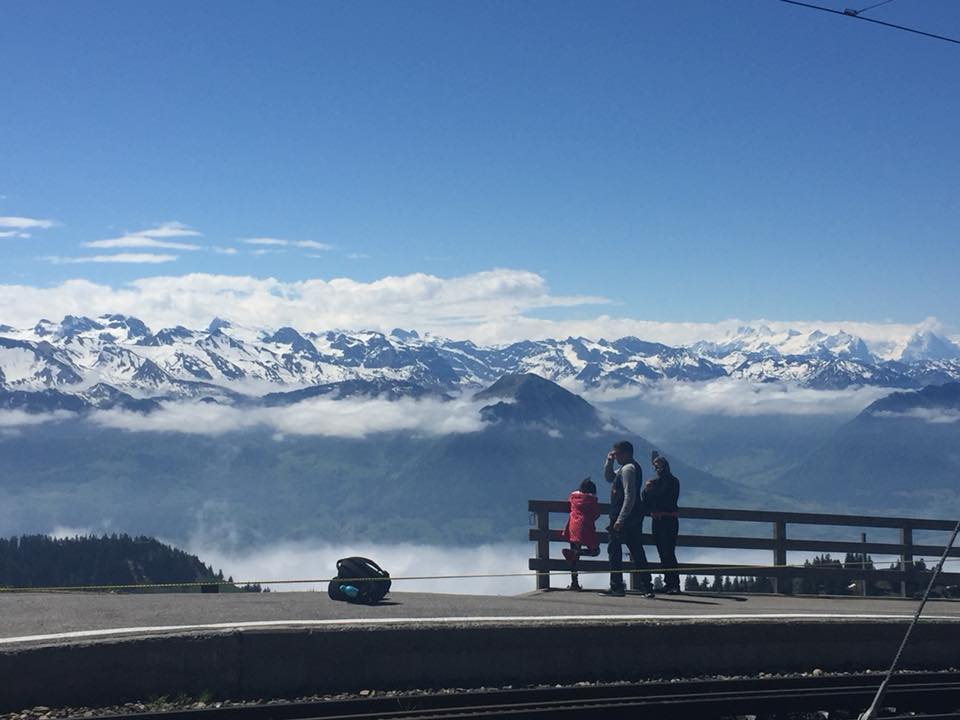
It’s hard to believe, but this week will mark two weeks since we’ve all returned from Switzerland. What a journey it was. Here are a few more images to provide a closure of sorts for our trip. We’re truly thankful for you following us, as well as your commentary. Please know that education was the reason we as students decided to study abroad, and we learned more than we could imagine on this trip. Special thanks to the University of Tampa for allowing this trip to take place. Furthermore, the Instructors that accompanied us during this trip are to be commended. Much appreciation to Mr. Frederic Palazy, CIS representative, as a true help and guide during our stay here. And to all of the teachers, students, administrators, and people we met on this trip, much love and gratitude to you for making it one to remember for a lifetime. Once…
The study abroad program to Switzerland was everything that I expected and many things I did not expect. Just for reference on what I am taking about, here is the link to the post with info about the study abroad program: The official flyer: #UTampa Travel Course to Switzerland [Spring 2018]
Jetlag sucks and it is important to take it into consideration. When I do this again, I will plan to have very light activities on the first few days.
It is very different to travel with students that have a high interested on the theme of the program compared to students have some interest. In the group with had a 75% of students with very high interest on the theme of the program. The other 25% were participating mostly for the experience.
The leadership team of this program are very active individuals that had no problem been on-the-go. It can be challenging to accommodate for others who do things like “nap” or are not very active. If you want to participate in this type of programs or recruit students to participant, make them aware that to make the most out of the experience you will be spending very little time in the hotel room posting on Snapchat.
Just like with any group, there are students who tend to be more vocal. Therefore, they tend to drive the direction of the group. It is important to give the other students options or opportunities to voice their opinions/choices.
In making connections or plans to meet with schools, university research groups, or others, it is at times difficult to know how casual or formal the visit will be. Asking for as much information as possible before hand will help give the students context.
Good Times
I cannot say enough about my assistant coordinator for the program: Merrie Tankersley. I already miss her! Having a good traveling partner to bounce ideas will make your study abroad program an amazing experience. Merrie was an absolutely joy to be around. I will miss our time together in Switzerland and I look forward to our experience next year in Belgium.
We organized most of the logistics through a study abroad service provider, CISabroad. As part of that arrangement, we had a on-site representative all the time. We met at the airport in Zurich after arriving in Switzerland, his name is Fred. Fred was honestly the best. He was very resourceful, friendly, and extremely patient.
The weather was just perfect. We would have made the best out of rainy days in Switzerland but I am glad that every day we were blessed with good weather.
Although there were some challenges with group dynamics, I was very happy to see that the five girls in our group grew so close together. They were also very inclusive of our male student. Overall, I am glad we had each of them in the group.
Aside from an strain ankle and a student with a cold, we had no major incidents during the trip. All students were always on time, respectful of the program rules, and participated in all required activities.
Switzerland is a beautiful country (and pretty much that sums it all). Our side trip to France was a treat. I strongly recommend visiting Colmar, France.
I am EXTREMELY thankful to every individual and organization that welcomed us during our visit in Switzerland. I plan to spend a good chunk of my pre-departure time at the Zurich airport writing thank you emails.
I am sure there are other comments I want to write about this experience, but this is all I have for now. Here are some of the pictures I captured:
You must be logged in to post a comment.