
Congrats to Dr. Makhosazana (Khosi) Lunga, completing a Doctor of Philosophy degree in Education with a concentration in Learning Design and Technology at The University of Tennessee Knoxville, for successfully defending your dissertation titled “Understanding Undergraduate Microbiology Instructors Online Course Design Judgement while Living Through the COVID-19 Pandemic”! #GoVols
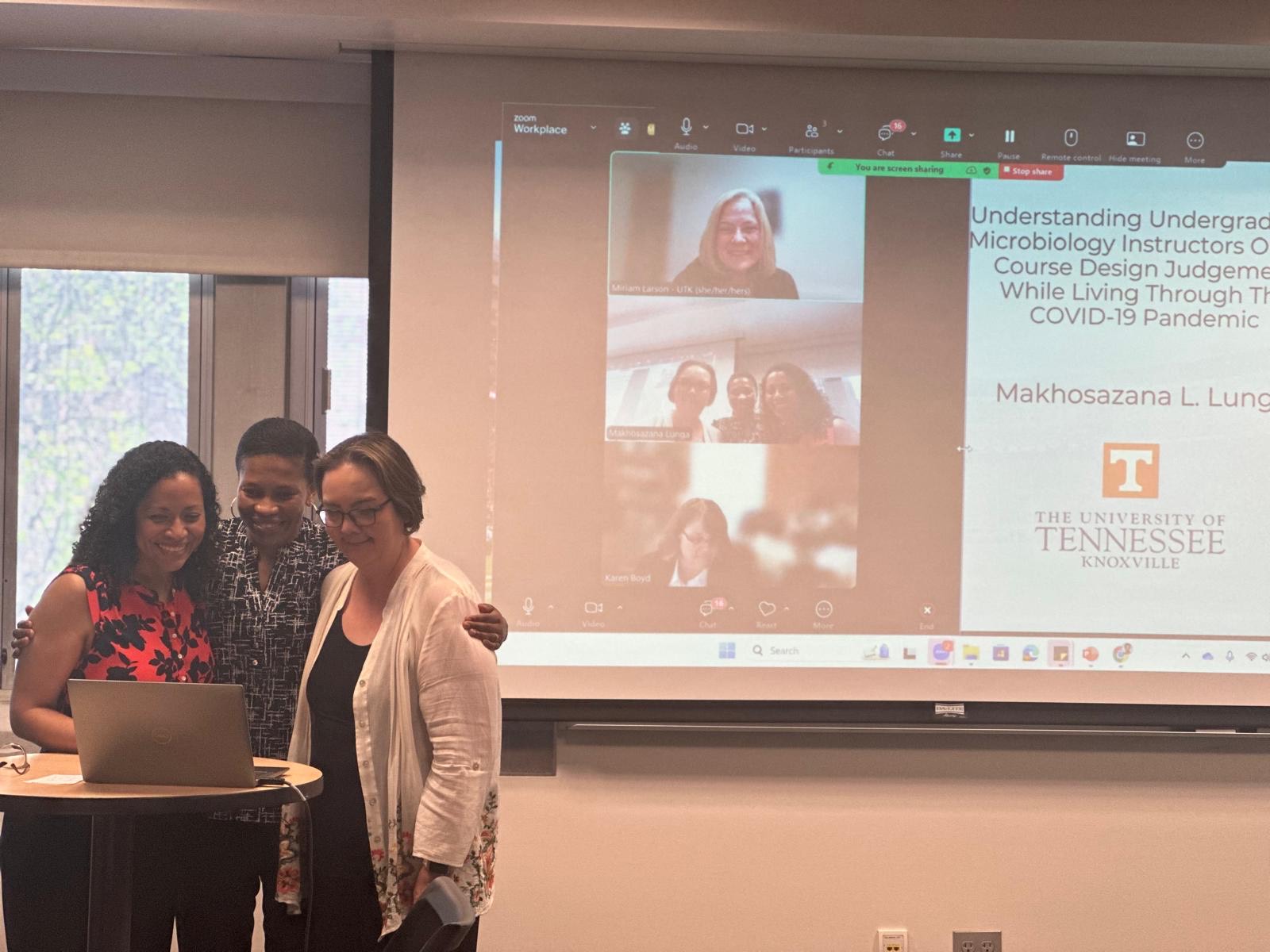
Committee Members: Dr. Lisa Yamagata-Lynch (Chair), Dr. Boyd, Dr. Larson, and Dr. Romero-Hall
Abstract:
This qualitative, descriptive multiple-case study investigates the online teaching experiences of seven undergraduate microbiology instructors at public universities in South Africa and the United States during the COVID-19 pandemic. This study investigated instructors unfamiliar with online course development to (a) describe how they designed online courses during the COVID-19 pandemic, (b) discover what influenced how they designed those courses, and (c) detail why they made the respective design decisions. It leans into the theoretical tenets of social constructivism and follows a multiple case study approach, relying on interviews and document analysis. Instructors were recruited through criterion-based convenience sampling and snowball methods. They are faculty who traditionally taught in-person large-sized microbiology courses prior to the COVID-19 pandemic. They transitioned to an online learning modality during the pandemic. Despite the differences in these countries’ economies and educational systems, the study findings revealed that participant instructors exercised similar overlapping design judgments as they redesigned their courses during the COVID-19 pandemic. Participants indicated that they developed courses within the institution’s learning management systems, integrated open educational resources, and utilized various teaching tools, including digital games. They encouraged students to interact and work in teams, enabling them to co-construct their learning. However, instructors wrestled with balancing many teaching demands against anxious students’ expectations. Instructors also grappled with ways to accommodate diverse students’ needs while promoting equity, diversity, accessibility, and inclusion in an online learning environment. Most notably, there was tension between finding efficient ways to maintain rigor and protect assessment integrity while empathizing with students. As demand for online learning increases, the study’s findings aim to make explicit the connection between design judgment research and practice. The goal of this study is to draw attention to instructors’ unconscious assumptions, behaviors, attitudes, thoughts, experiences, beliefs, culture, goals, and skills that influence design decisions, particularly during disruptive events such as the COVID-19 pandemic. It aims to empower the instructional design community members with awareness and sensitivity to what instructors bring with them to the collaborative design process.
Keywords: Authentic Learning Environment, Design Decisions, Design Judgments, Online Learning Environment, Social Constructivism Theory
 Design Goodiness