#HKAECT18: New Media for Educational Change

I feel like I have neglected my blog a bit this summer but I have to be honest it has been a busy summer (just like every summer — this is starting be a trend in my life). Anywho, this post in going to be nice, sweet, and short post because its going live today (enough of neglecting my blog).

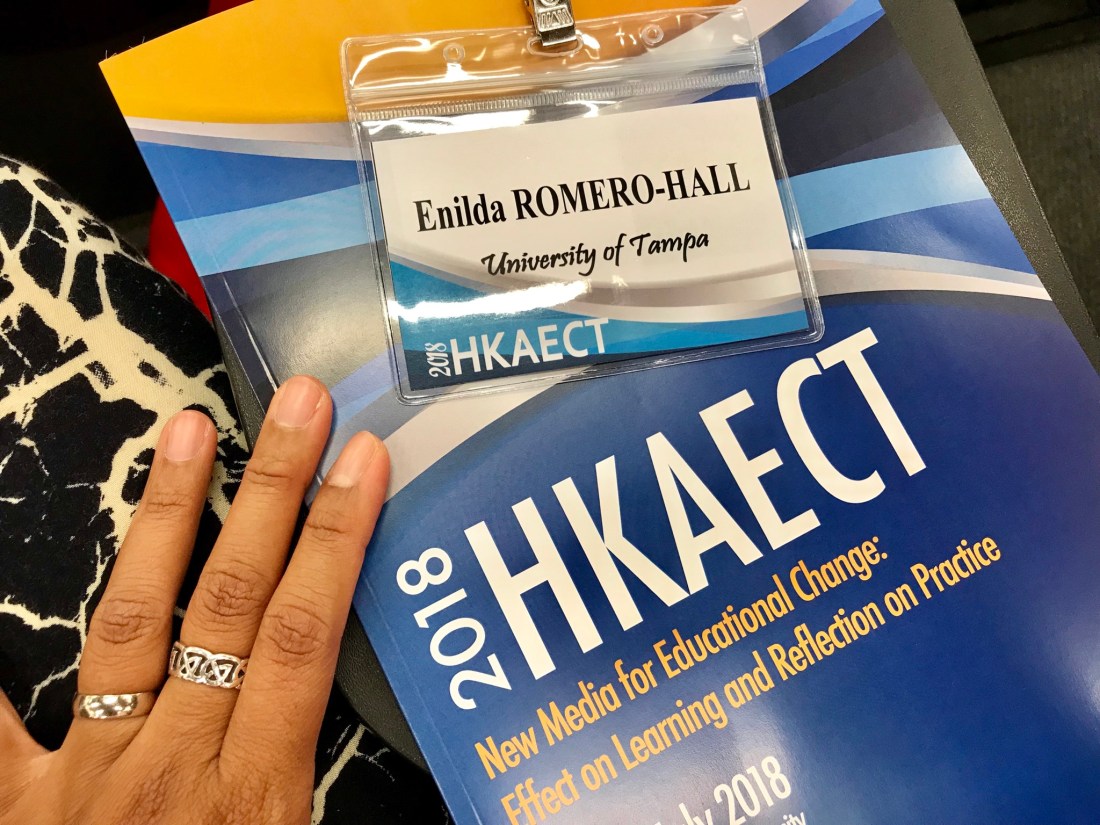
I attended the Hong Kong AECT conference a few weeks ago. It was amazing! I mean this very honestly. I like learning from others and connecting with different people. I know for a fact that I will experience this (learning from others and connecting with colleagues) at the conferences that I attend regularly, AERA and AECT (this is why I go back to those conferences every year). But I also like to put myself in uncomfortable situations that force me to talk and meet people who I have never connected with in the past. So I made a promise to myself that I would aim to attend a conference that I have never attended before because: a) I want to know what others, who are outside my network, are researching and b) because I think it will expose me to topics that are new to me.

With this in mind, last year I attended the Social Media and Society conference in Toronto which by the way was an absolutely fantastic experience (if I had the budget, the time, and the energy, I would have gone to Copenhagen this year — where the conference was held — and then to Hong Kong to attend HKAECT). This year, I decided to attend HKAECT18 conference. I saw that a friend and colleague attended last year (Dr. Ana Paula Correia) so I reached out to her to ask about her experience. I also saw that the theme of the conference which aligned well with my research interested so I submitted a conference proposal. It was accepted and a few months later I was on a plane to Hong Kong.

I wish I could put into this blog everything that I experienced and the topics we discussed but since I have other things I should be writing, I am instead going to share the link to conference program: http://www.hkaect.org/hkaect2018/programme.html (some

A few things I do want to mention:

  • All sessions were well attended and we had some really good discussions about the topics presented
  • Presenters were prepared, addressed questions, and engaged with the audience
  • There were several social aspects to the conference that allowed us to continue conversations outside the presentation rooms in a more informal manner (coffee breaks, lunch, and dinner)

I saw that the call for proposals for HKAECT19 was posted today: https://www.aect.org/docs/HKAECT2019-Call_for_Papers.pdf. If you are considering attending and have questions, please feel free to reach out.


Thoughts on Facebook.

Last week we all learned about Facebook breach of data. It sucked. But to be honest, it was not surprising to me at all as a user. I never really had expectations that Facebook would keep our data safe, protected, that they would use it ethically, or that they were really thinking about providing us healthy ways to use the platform. I wish they did. But they are greedy. 

Many friends, family, and colleagues have discussed their discontent and are considering doing without a Facebook account. I am not here to encourage you to continue using Facebook. I think it is a personal decision. I have quit Facebook in the past (I do not mean deactivated my account. I mean, that I took the time to delete every single post and photo, unfriend every single person, wipe my account clean, and made the request to Facebook to completely delete my account) and it was hard. Three years of “social connections from my undergraduate years” gone! However, at the same time it was exactly what I needed to do then.

I returned to Facebook two and half years after my hiatus with a completely different mindset. That time apart (from Facebook) really made me realize the benefits and disadvantages it has. I should also say that the context of my situation made it very unique: during the time I quit Facebook I ended a five year romantic relationship, moved from my little college town in Kansas to a city where I knew no one, and started a doctoral program (I talk a bit about this in my TEDxUTampa talk). Last, I should add, this all happened before “smartphones” and apps like WhatsApp, FaceTime, and others where a thing.

Again, I am really not here to convince anyone to keep their Facebook account or to delete it. I am here to say that for me it would be difficult to quit again. I was born and raised in Panama. I did all of my elementary, middle, and secondary school there. Unlike most people who attend different school during the K-12 years, I spend most of my years (since grade 4th) in the same institution with the same classmates (yes, there are people that I know since I was in 4th grade). I am connected with most of them through Facebook, which in Panama is almost the equivalent of text messaging (the only App that is more popular in Panama is probably WhatsApp). No one really writes emails there anymore. Seriously, I cannot even remember the last time anyone from Panama wrote me an email (now that I think about it).

I have lived in three different countries: Panama, Canada, and the United States (six different cities total). Ain’t nobody got time to be emailing to keep up with people (I already have enough with all the emails I get and have to send for work). 

Another reason it would be difficult to quit, is my constant connection to professional organizations and support groups. Connections to the groups that are created as part of my professional organizations, truly helps me stay connect to colleagues throughout the year. It helps me know what they are up to professionally. Also, sometimes there are beneficial conversations that occur (in professional circles and support groups). I may not be a participant in the conversation (just a lurker) but the resources that are shared help me in one way or another. Sometimes I participate, if I know something about a topic or have resources to share. This is something I learned during my time away from Facebook: use the platform to your advantage.  

I know some people are thinking: it is an echo chamber, people just use it to post their perfect pictures, others are just nosy about your business, all those political post are annoying, etc. Maybe it is because I am at different point in my life, but I enjoy seeing updates from my FB friends (no I do not get offended because I did not get a personalized text message from them letting me know about something special that happened to them). Also, I am very intentional about who I connect with. If I cannot be “me” with you, then I will not accept your request OR I will simply delete you as a friend. If I feel that what you post is toxic, then “delete.” BTW, I am also like this offline. This is who I am, you can take it or leave.  

During my time away from Facebook, I learned that it is really hard to keep up with people. Relationships require time and it is easy to neglect them. Again, this was all before smartphones and the development of all those other social platforms. I know what you are thinking: a centralized friendship “hub” is evil. Yes, it sucks that in order to keep up we have use this evil thing call Facebook but I personally do not have time to do it differently. 

That is all I have for now. BTW, I am human. I may have a different opinion tomorrow. I also want to leave you with three personal quotes:

“So to some extend it is true. Social media can be harmful (and affect our mental well being), difficult to manage and overwhelming, too public, distracting, and influence and miss inform us.” 

“Instead of solely focusing on the “bad” or “thinking of social media as a waste of time”  it is imperative that we find innovative ways to use and repurpose this online social environments in a manner that is safe, ethical, and beneficial to us.”

“I am also not saying that we need to overlook the challenges that social media present for our social, mental, and physical well-being. We absolutely need to find ways to deal with this challenges.”


Let’s talk about complicated pregnancies #academicmamas

Had my yearly Pap Smear today and it served as a reminder of post that has been in draft folder for too long [it is also Spring Break so I get to catch up on a few things that I normally tend to put of for later]. Let’s talk about complicated pregnancies.

We often think that pregnancy is this magical time in a women’s life in which they can eat whatever they want, glow, and crochet something for their bundle of joy. Well, at least, that is what I thought pregnancy were until I experienced it.

The reality is that for me pregnancy was the worry of knowing how my baby was developing, heartburn, and sleepless nights. But I was fine with that because “it is all just part of the process.” It was until I was 22 weeks pregnant that things got “complicated.”

During a routine visit to the doctor (the first week of classes of that term) the ultrasound technician noticed that I was experiencing an “incompetent cervix.” Everything went from calm to faces of worry and the doctor rushing into the ultrasound room. I was asked to go the emergency room in the hospital and told that they were extremely worry that I would deliver early.

I was so confused by everything that was happening but without thinking about it, my husband and I drove to the hospital and expressed what the gynecologist had just explained. I was immediately checked into the emergency room at the hospital. The doctor in the emergency room explained what an “incompetent cervix” meant. Basically means that I have a “weak” cervix tissue.” What followed was just a mess:

  1. Taught class for one week that semester [Fall 2015]
  2. Then rushed back to the emergency room (and FMLA for the remainder of the term)
  3. Was told by the doctor to consider having an abortion (early delivery would mean having a baby that would not survive or would have severe brain damage)
  4.  Was told by another doctor to consider having a cerclage procedure done to prologue the pregnancy as long as possible (although he clarified the success rate for a 50/50 chance)
  5. Decided to do the cerclage and wait to see what happened.
  6. Orders of bed rest until delivery date
  7. Three long months of at home bed rest

Why did I continued my complicated pregnancy? Because I honestly could not terminate my pregnancy after watching my healthy baby boy in an ultrasound.

What is was like to do three months of bed rest? For me, it was torture. I honestly channel my energy into doing things that I enjoyed (writing, reading, researching, or anything I could do from bed/couch).

This is is really a summarized version of everything that happened. All the emotions that I experienced during those months, would be really difficult to capture in a post. I was very private about all of this, when it happened, because if things did not work out in a positive way, I did not want to mourn my loss publicly. It would have been too difficult. However, I did have many reach out to me privately and I would share what I was going through (I guess my lack of FB and Twitter post was noticed). I had many friends and family check in with me regularly (almost daily). Thank You. I also a had a dear friend that lives in the area have lunch with weekly through the three months of bed rest (thank you JoAnne Scott).

I am not writing this post because I want a pity party. I am writing and sharing it with you because pregnancies don’t always go as planned, which is even more reason to have have adequate institutional policies for pregnant women and partners. I would have never predicted my health issue (not even in my wildest dreams). Since this happened to me I’ve known at least two other women who had similar experiences, including another faculty member at my institution.

I also want to add that my story had a complicated but happy ending but not all stories end the same way. I want to share with the emotional story written by Ilde Torres Walter in her blog (it is a journey of love): http://www.journeytoliam.com/2017/01/09/hello-world/  [you should make time to read her five blog posts].

Latest Publication: #SocialMedia Use by #InstructionalDesign Departments

Our publication titled “Social Media Use by Instructional Design Departments” was recently published under ‘early release’ by the Australasian Journal of Educational Technology #openaccess

Romero-Hall, E., Kimmons, R., & Veletsianos, G. (2018). Social media use by instructional design departments. Australasian Journal of Educational Technology, 34(5), 86-98. https://doi.org/10.14742/ajet.3817

Graduate & Undergraduate Mentee Contract

Hello! Happy New Year (sorry it is that awkward time of the year in which I am not sure if I should or should not say “Happy New Year”)!

I recently started a small research group with graduate and undergraduate students at my institution. Early in the Fall semester, a few students reached out to me (looking for research experience, mentorship, and collaboration) and I thought it would be a good idea. All of this students want to further their education and go on to doctoral programs. We are currently working on three to four projects together. Last semester was sort of my first time giving this “research group” thing a trial. I learned so much from the experience!

  • Consistent meetings are good
  • Have a meeting agenda
  • Set realistic deadlines
  • Understand each other’s skills
  • Understand each other’s expectations

Yesterday was our first meeting after the Winter Break. We talked about the upcoming data collections, IRB applications, conference proposals, conference presentations, and manuscripts we are planning to work on this semester (we are busy!). I also took time during our meeting to talk about this mentoring experience and what we should all expect. I shared the “Graduate Mentee Contract” to guide the discussion. It was passed on to me by an academic mama who works at a different institution. So I am paying it forward and sharing it in my blog just in case anyone else is looking for something similar.


Latest publication: “Examining Distance Learners in #Hybrid #Synchronous #Instruction: Successes and Challenges” #OpenAccess

Our latest publication titled “Examining Distance Learners in Hybrid Synchronous Instruction: Successes and Challenges” in now available #openaccess as part of the latest issues of Online Learning Journal (Special Issues of the AERA SIG Online Teaching and Learning):

Romero-Hall, E. & Vicentini, C. (2017). Examining distance learners in hybrid synchronous instruction: Successes and challenges. Online Learning, 21(4). doi:http://dx.doi.org/10.24059/olj.v21i4.1258.

Instructional Design Research Women’s Caucus #AECT17

Please consider joining us during this Research and Theory Division panel session at the AECT 2017 International Convention:

Women Caucus
Lead Discussant:
Enilda Romero-Hall
University of Tampa

Discussants:
Zeni Colorado-Reza
Emporia State University

Ginger Watson
University of Virginia

Camille Dickson-Deane
University of Melbourne

Ayesha Sadaf
University of North Carolina at Charlotte

Tugce Aldemir
Pennsylvania State University

See you in Jacksonville. Hope you can join us!

CFP: TechTrends #AECTRTD Special Issue [Proposals due: September 15]

TechTrends Special Issue
Research and Theory Division (RTD)

The Research and Theory Division of AECT is sponsoring a special issue of TechTrends related to current innovative research methodology in the instructional design and technology field. We welcome proposals in which researchers are rigorously using innovative methods of data collection and analysis as part of an investigation that helps further advance knowledge on the field.

Special Issue Co ‐ Editors

Enilda Romero-Hall, Ph.D.
University of Tampa
eromerohall@ut.edu

E-ling Hsiao, Ph.D.
Valdosta State University
ehsiao@valdosta.edu

Fei Gao, Ph.D.
Bowling Green State University
gaof@bgsu.edu

Submissions should align with the RTD mission to promote the development and advancement of theory; promotes, presents, and disseminates research and scholarship that encompasses multiple perspectives; advocates the study of social and cultural issues in the field; supports, fosters, and mentors emerging scholars. The division provides a professional community for AECT members with an interest in research and theory. The following is a non-exhaustive list of possible innovative methods of data collection and analysis:

  • Educational data mining
  • Learning analytics
  • Social network analysis
  • Advanced statistical modeling
  • Network anthropology
  • Eye tracking
  • EEG
  • fMRI
  • Other physiological measures
  • Integrative approaches to ‘mixing’ qualitative research
  • Netnography
  • Person-centered analyses
  • Interactional ethnography
  • Rhizoanalysis
  • Photovoice
  • Art-based data analyses
  • Appreciative inquiry
  • Concept mapping research
  • Visual analysis
  • And other innovative research methodologies

Expected publication date: September 2018

Submission Information

Articles should follow the writing style guidelines for Tech Trends. Submissions should be 4000-­‐5000 words in length (10 ­‐15 pages) and abstracts should not exceed 150 words. Use APA formatting throughout.

Please upload a PDF file with your name, institution, and email address as well as a brief overview (approx. 500 words) of the proposed article using the following link: http://tiny.cc/TechTrendsRTDSpecialIssue for initial review. If accepted for review, you will be directed to a Tech Trends portal for this special issue where you will submit your full article per the schedule below.

We kindly ask authors to also serve as reviewers for the submissions. Reviewers will also be requested from the overall AECT RTD membership. Thank you.

Important Dates

  • August 7, 2017 ‐ Call for Proposals posted
  • September 15, 2017 ‐ Proposals due: http://tiny.cc/RTDSpecialIssue_Dropbox
  • October 16, 2017 ‐ Notify accepted proposals
  • January 29, 2018 – Full submissions due AND start peer review process
  • March 16, 2018 – Reviews due
  • April 27, 2018 – Notify authors of review decisions
  • June 1, 2018 – Final and reviewed papers due


#AECT2017 Early Career Symposium: Now Accepting Applicants

AECT’s Research and Theory Division will be hosting the 2017 Early Career Symposium this year sponsored by AECT. The symposium will be held as a half day online conference October 28th and at the annual AECT International Convention on Tuesday, November 7 (half day 1-6 PM starting with lunch) and Wednesday, November 8 (half day, 7:30AM – noon, ending with lunch together with the AECT Board), 2017, in Jacksonville, Florida. The symposium will thus engage participants in a day and a half of focused career mentoring and networking.

The symposium will reimburse Early Career faculty and Advanced Graduate Students with the conference fee ($395 for Early Career Faculty and $240 for Advanced Graduate Students). Reimbursements are pending submission of receipts after the symposium.

http://www.aect.org/events/mentor/CareerSymposium.asp


Link to full-text: “Posting, Sharing, Networking, and Connecting: Use of Social Media Content by Graduate Students”

Here is a link to my latest publication: http://rdcu.be/qiVq

[This is a view only version. Unless you have a personal or institutional subscription to the journal]

Abstract:

The purpose of the present investigation was to better understand graduate students’ use of the content shared in the social media channels of their programs and the perceived impact that their participation in these social media spaces has on the graduate students’ transformation as professionals. Seventy-seven instructional design and technology (ID&T) graduate students completed an electronic questionnaire. The results revealed that although graduate students use social media for personal purposes, they are not always followers or members of the social media spaces of their ID&Tprogram. However, those who follow the social media of theirID&T program found tremendous benefits from the experience. These benefits range from feelings of belonging to acommunity of ID&T professionals, to career opportunitiesfor networking, and cross country interactions.