CFP: TechTrends #AECTRTD Special Issue [Proposals due: September 15]

TechTrends Special Issue
Research and Theory Division (RTD)

The Research and Theory Division of AECT is sponsoring a special issue of TechTrends related to current innovative research methodology in the instructional design and technology field. We welcome proposals in which researchers are rigorously using innovative methods of data collection and analysis as part of an investigation that helps further advance knowledge on the field.

Special Issue Co ‐ Editors

Enilda Romero-Hall, Ph.D.
University of Tampa
eromerohall@ut.edu

E-ling Hsiao, Ph.D.
Valdosta State University
ehsiao@valdosta.edu

Fei Gao, Ph.D.
Bowling Green State University
gaof@bgsu.edu

Submissions should align with the RTD mission to promote the development and advancement of theory; promotes, presents, and disseminates research and scholarship that encompasses multiple perspectives; advocates the study of social and cultural issues in the field; supports, fosters, and mentors emerging scholars. The division provides a professional community for AECT members with an interest in research and theory. The following is a non-exhaustive list of possible innovative methods of data collection and analysis:

  • Educational data mining
  • Learning analytics
  • Social network analysis
  • Advanced statistical modeling
  • Network anthropology
  • Eye tracking
  • EEG
  • fMRI
  • Other physiological measures
  • Integrative approaches to ‘mixing’ qualitative research
  • Netnography
  • Person-centered analyses
  • Interactional ethnography
  • Rhizoanalysis
  • Photovoice
  • Art-based data analyses
  • Appreciative inquiry
  • Concept mapping research
  • Visual analysis
  • And other innovative research methodologies

Expected publication date: September 2018

Submission Information

Articles should follow the writing style guidelines for Tech Trends. Submissions should be 4000-­‐5000 words in length (10 ­‐15 pages) and abstracts should not exceed 150 words. Use APA formatting throughout.

Please upload a PDF file with your name, institution, and email address as well as a brief overview (approx. 500 words) of the proposed article using the following link: http://tiny.cc/TechTrendsRTDSpecialIssue for initial review. If accepted for review, you will be directed to a Tech Trends portal for this special issue where you will submit your full article per the schedule below.

We kindly ask authors to also serve as reviewers for the submissions. Reviewers will also be requested from the overall AECT RTD membership. Thank you.

Important Dates

  • August 7, 2017 ‐ Call for Proposals posted
  • September 15, 2017 ‐ Proposals due: http://tiny.cc/RTDSpecialIssue_Dropbox
  • October 16, 2017 ‐ Notify accepted proposals
  • January 29, 2018 – Full submissions due AND start peer review process
  • March 16, 2018 – Reviews due
  • April 27, 2018 – Notify authors of review decisions
  • June 1, 2018 – Final and reviewed papers due
 

#AECT2017 Early Career Symposium: Now Accepting Applicants

AECT’s Research and Theory Division will be hosting the 2017 Early Career Symposium this year sponsored by AECT. The symposium will be held as a half day online conference October 28th and at the annual AECT International Convention on Tuesday, November 7 (half day 1-6 PM starting with lunch) and Wednesday, November 8 (half day, 7:30AM – noon, ending with lunch together with the AECT Board), 2017, in Jacksonville, Florida. The symposium will thus engage participants in a day and a half of focused career mentoring and networking.

The symposium will reimburse Early Career faculty and Advanced Graduate Students with the conference fee ($395 for Early Career Faculty and $240 for Advanced Graduate Students). Reimbursements are pending submission of receipts after the symposium.

http://www.aect.org/events/mentor/CareerSymposium.asp


[Chapter] #SocialMedia in HigherEd: Enriching Grad Students’ Prof Growth Outside the Classroom

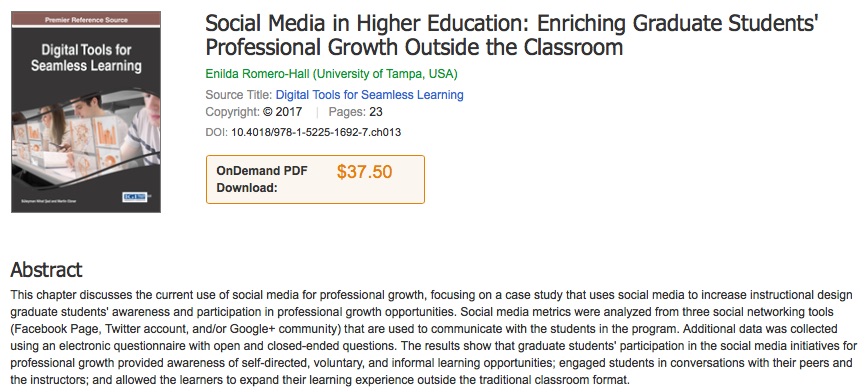
Received notification today that the book chapter I wrote for the book “Digital Tools for Seamless Learning” published by IGI Global is now available. The title of the book chapter is: Social Media in Higher Education: Enriching Graduate Students’ Professional Growth Outside the Classroom. Here is a copy of the abstract:

“This chapter discusses the current use of social media for professional growth, focusing on a case study that uses social media to increase instructional design graduate students’ awareness and participation in professional growth opportunities. Social media metrics were analyzed from three social networking tools (Facebook Page, Twitter account, and/or Google+ community) that are used to communicate with the students in the program. Additional data was collected using an electronic questionnaire with open and closed-ended questions. The results show that graduate students’ participation in the social media initiatives for professional growth provided awareness of self-directed, voluntary, and informal learning opportunities; engaged students in conversations with their peers and the instructors; and allowed the learners to expand their learning experience outside the traditional classroom format.”

If you are interested in reading the rest of the book chapter, please feel free to contact me. I will gladly share it privately so that I do not break any “copyright” rules. Here is my email: eromerohall@ut.edu

social-media

#UTampa Honors Program Symposia [Presentation]

Yesterday, I had the pleasure of presenting to the UT Honors Programs students and faculty as well other UTampa colleagues and staff members. I presented on the topic: “Use of Social Media by Graduate Students and Programs.” This is a research area that I am currently exploring and I was able to share some preliminary results. Click on the image below to access the link to the complete Prezi presentation:

image001 Click on the Image to Access the Slides
Photo Credit: Gul Sahin

Sneak Preview: #AECT16 Research & Theory Division Highlights

Yesterday, I purchased my plane ticket to Las Vegas (to attend the AECT 2016 International Convention later this year).  This reminded me that I wanted to share a sneak preview of the AECT Research & Theory Division (RTD) sessions. As you know (if you read my blog posts regularly), I have the pleasure of serving as the AECT RTD Convention Planner as well as the Featured Research (FR) Sessions planner. The peer review process for all the sessions was earlier this year (it was not an easy process). The AECT RTD had a large number of good submissions and, at the same time, it had a limited number of allotted presentation hours (plus we had very rigorous reviewers). Now that the review process is completed and all accepted authors have been notified, all planners put together division highlights for the conference printed program. Below are the sneak preview or “highlights” for the AECT RTD and Featured Research Sessions. The full AECT16 schedule will be available in a few months.

Featured Research Sessionshttps://cloudup.com/cZomjap6oqL

Research and Theory Highlightshttps://cloudup.com/cs6T_t6JAID

For more info about the conference, visit the AECT 2016 website: http://www.aect.org/events/convhotel/


Academic Momma Traveling with an Infant

Recently travelled abroad for a professional development seminar and took my 6-month old with me. The trip was overseas (Miami to Spain with a layover in Lisbon on the way there and back. The layover on the way back involved an overnight stay in Lisbon). I want to share some advice and things to consider when engaging in this type of travel adventures. I know there are many academic mommas that have to travel to conference and other engagements. Hope these bits of information and advice help make your travel journey a bit less stressful. One more thing, this advice relates to all mommas traveling with an infant (academic or not).

  • Call the airline in advance. Let them know you are traveling with an infant. They can arrange a decent seat for you and your child, perhaps with close access to a bathroom (in case you need to change your child). I called the airline three weeks in advance my travel dates and they arranged to seat us in the first row of economy class. We were fairly close to the bathroom with the changing table and had a bit of extra room in front of us because we were in the first row. Also, the airline that we used (TPA Portugal) provided us with a small, detachable bassinet so that baby could sleep in it during the flight.
  • Let the hotel know that you are traveling with a baby. If you let them know in advance, they can arrange to give you a quiet room or put a crib in your room. Most hotels will do this for free. I have not come across a hotel that charges for a crib.
  • Make sure you carry enough diapers and wipes with you in your diaper bag. I did not see any stores selling diapers in the airport. I initially thought I had packed enough diapers for the entire trip and was in a bit of panic mode when I realized I could run out of diapers.
  • When you are in the airport, check for queue lines that are assigned for parents with children. In particular for security, passport control, or other lines. It will save you time and energy. I did not see queue lines for “parents with children” in the U.S. airport (Miami) but I did see and used them in Europe (Spain and Portugal).
  • Strongly recommend traveling with another adult to help you with the process. This person can be your spouse, parents, or a friend. It is doable for you to travel on your own with your infant but it will be a bit stressful. Having someone else to share the responsibility will ease the stress of dealing with paperwork, timelines, luggage, changing diapers, feeding, and everything else that comes with traveling with an infant.
  • Do not leave packing until the last minute. If you can find someone to watch baby while you pack, it will be very helpful. I recommend making a list of the things you must take with you (clothes, toys, food) and the things that you could buy at your destination.
  • Take time to think about traveling with your baby and proceed as desired. For some reason other people will feel the need to tell you their opinion on whether you should or should not travel with your infant. The reality is that you know yourself and your infant better than anyone else. If you feel that you and your infant are ready, do it.
  • Make sure you have a pacifier or bottle with food ready during the changes in altitude. During a flight, give you infant the pacifier or bottle as the plane takes off or lands to avoid pain in his/her ears:  http://www.entnet.org/content/ears-and-altitude

So far, this is the initial list I have. I know I will remember other suggestions and advice in the future. I will just update this post as I remember them.

The “Quick Update” Post

I wanted to write a couple of posts about things I experienced this last semester and then life happened! So, I am merging it all into this post. Please forgive the imperfection of my writing. I probably will not take the time edit and re-edit. What you are about to read are the words as they flow from my brain to the keyboard to this blog.

Since I last wrote a blog post (not an announcement but an actual blog post) I became a mom. This time last year, I was in Switzerland in a Faculty Exchange program. It was exactly during the exchange that I discovered that I was expecting a baby. Yes, the pregnancy test results read “Schwanger.”


image

Many things have happened in my personal/professional life in the last year (since I found out I was pregnant) and I want to share them in my blog. However, I am still trying to figure out how to best express those experiences and feelings in a blog post (or maybe more than one). I hope to take some time to write about this experiences in the near future.

What I do want to share in this blog post is that I have officially completed my third year in  a tenure track position. At the beginning of the Spring 2016 semester, I submitted all my materials and by mid March had received all the pre-tenure letters. This is a minor milestone but I still consider it a milestone. I guess the questions that I need to answer now is: what is happening past pre-tenure? Well, pretty much just keep on working hard. I have a long term “to-do list” that I have to tackle and of course, the everyday “to-do list.”

The last three years served to connect with really amazing faculty and graduates students with whom I have found common ground (topics of interest) to work on projects. Some of these projects are strictly related to the instructional design practice and others are more multidisciplinary. I am very excited about this projects and some of them will presented in conferences later this years (currently working on getting some manuscripts out for review). Other projects are just starting so more details coming soon.

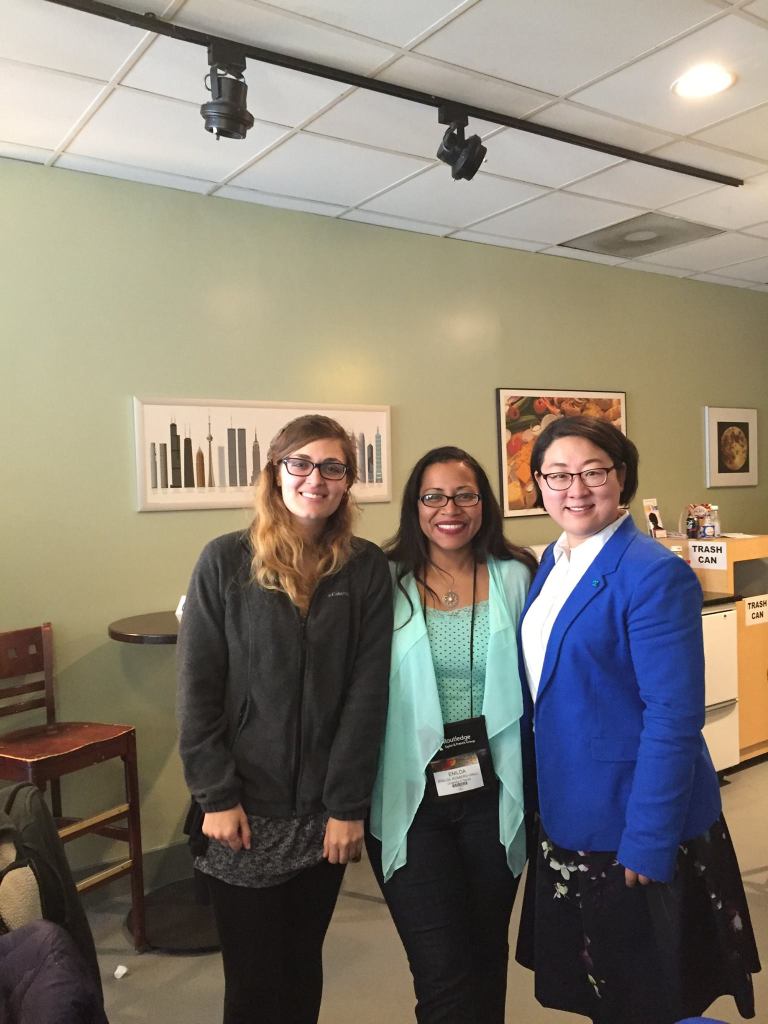
I also want to quickly mention that I also started professional service with the AERA SIG Design & Technology as a Technology Liaison. I am excited for this opportunity and very much looking forward to working with colleagues in the SIG. This previous sentence reminded me that I wanted to mention how much I enjoyed attending AERA 2016. I did not present a paper but instead had the opportunity to participate in a mentoring program sponsored by the AERA SIG Design & Technology. I met two outstanding graduate students, Amanda and Yi.
13087222_903053373151445_3939118171814845924_o

I hope the SIG continues the mentoring program in the future. It was a great opportunity to share my graduates student and faculty journey. Most importantly, it was an opportunity to listen to the concerns of graduate students and, hopefully, provide guidance. I also learned from the graduate students in the process. Both graduate students, Amanda and Yi, shared conferences, resources, and research groups that were completely new to me.

During the conference I also participated as moderator in a panel discussion on the past, present, and future of the design and technology field. The panelist included Elizabeth Boling, Pat Hardre, and George Veletsianos. It was nice to listen to the panelists’ perspective on the current state of the field as well as suggestions for graduate students and faculty doing research on topics related to design and technology. The current Graduate Student Representative of the SIG Design and Technology board, Shonn, live tweeted the panel presentation. If you are interested in reading more about it, you can check out the AERA SIG Design & Technology Twitter stream.

That is all I have for now. Hoping to be post more in the near future. Hopefully, future post will not be as lengthy.

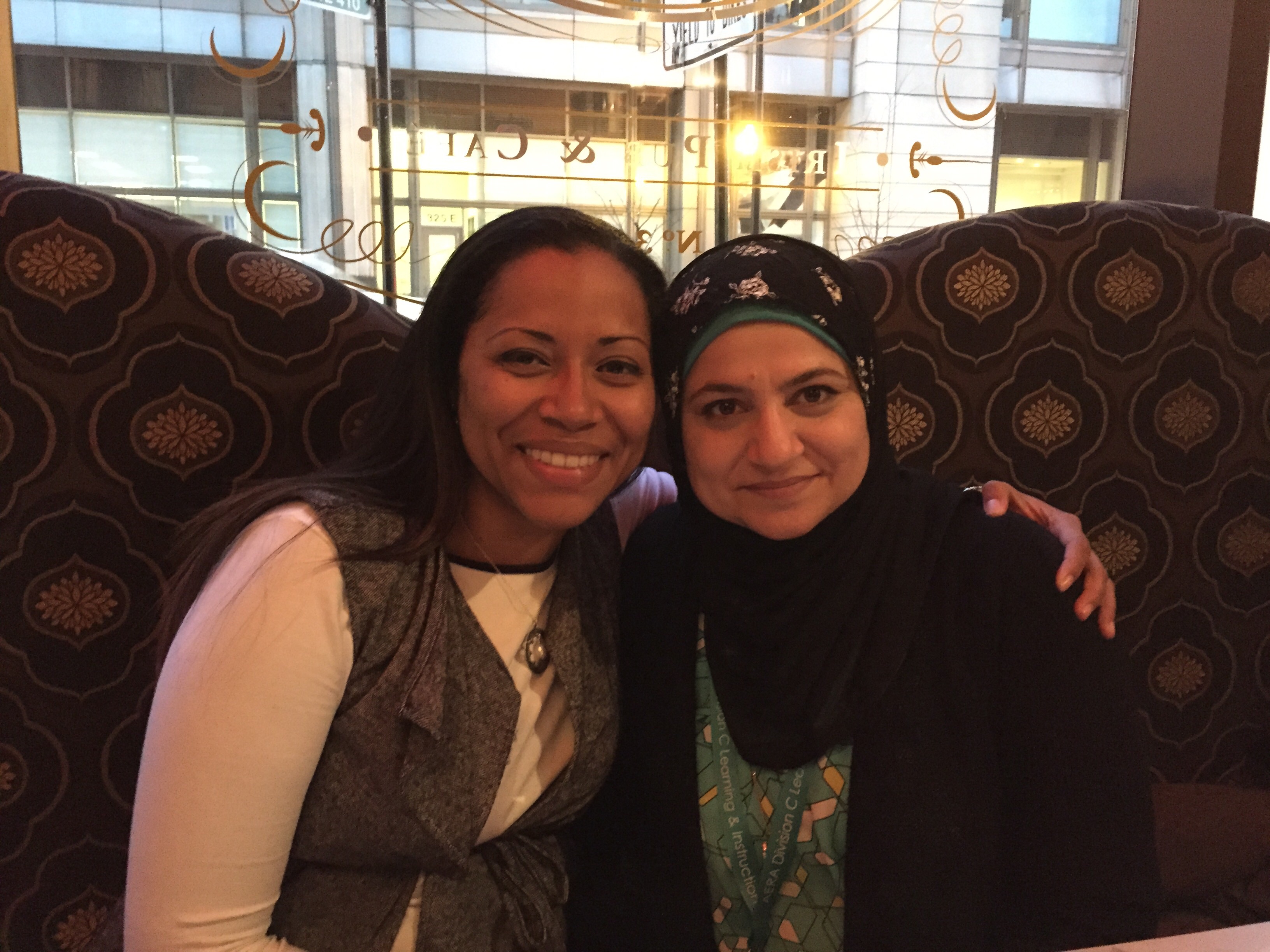
New Faculty Mentoring Program: 2015 Cohort [Research, Teaching, Collaboration, & Support] #AERA15 #AERADivC

During the AERA 2015 conference in April, I attended the Division C New Faculty Mentoring Program. I had attended a mentoring program in the past at AECT 2012. The AECT 2012 mentoring program was a two-day seminar with three mentors who volunteered their time to provide advance graduate students and new faculty with words of wisdom and practical advice for the tenure track journey. It was also great for networking. Unfortunately, due to Hurricane Sandy I was not able to catch my initial flight from Norfolk, VA (where I was living at that time) to Louisville, KY (where AECT was having the conference). My flight was delayed an entire day, this meant I was not able to attend in person the first day of the mentoring program. Instead, I joined the discussing via Google Hangout but it was not the same. I was relaying on hotel conference room wi-fi which was “okay.” Also, it was hard to be part of the conversation because it was not something the organizers were expecting. I did manage to join the conversation the second day of the mentoring program at AECT 2012 [Sorry, that was my “blast from the past” portion of this post].

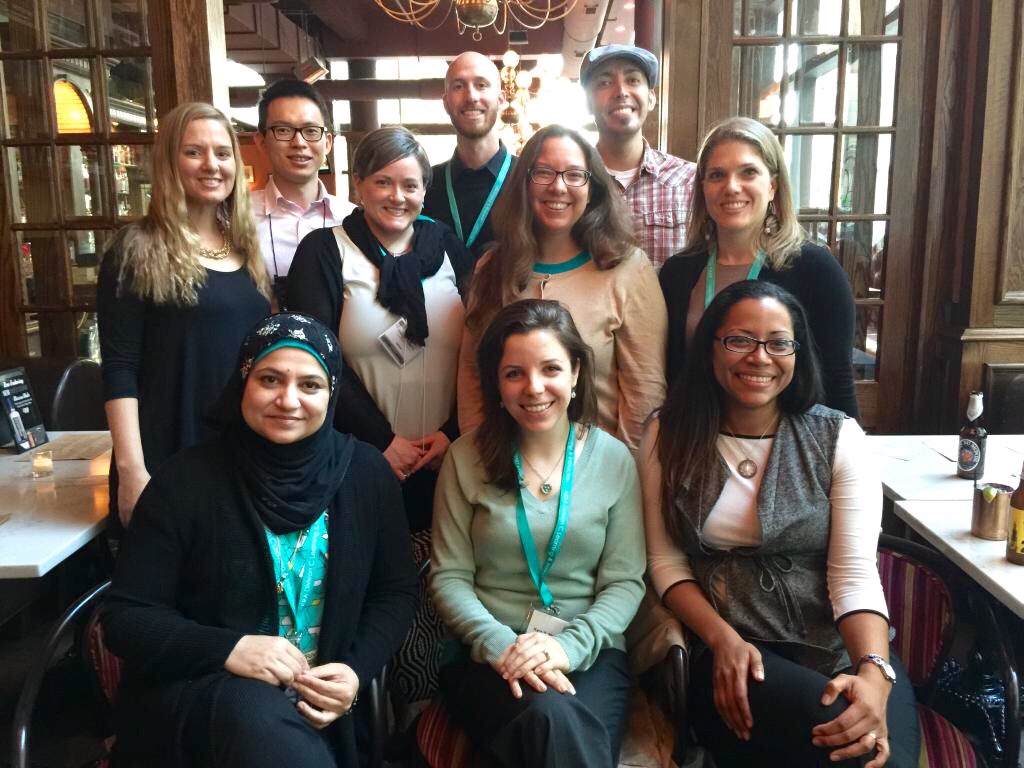
Back to AERA 2015: This year during the mentoring program at AERA15, the organizers [Gwen & Rayne] emailed us in advance the program with the different sessions and speakers. I was thrilled about the sessions and excited to meet my cohort. We were a very diverse group based on our universities and our cultural/regional backgrounds. The first day of the mentoring program we all provided a brief introduction of ourselves and what we hoped to get out the program. Then, worked on an exercise about our identities, which by the way was very difficult to write. I mean — How often do you think about your identity (in your community, your institution, your department, and your field)? We also had various sessions related to grants and external funding opportunities. We talked to faculty members that have in the past successfully acquired grant funding. They definitely shared some insight into grant writing, selecting a collaborator, what happens after you get a grant, and myths about grants/external funding. The best advice we got (from my perspective) was to have a good budget, have a great idea, select a collaborator that you want to interact with on a very regular basis, and polish your project management skills. We also had a session with two program officials. One from the National Science Foundation and one from the Spencer Foundation. This was just amazing because they shared some of the programs that their institutions offer to new faculty (at least within the first five years of appointment). One of the best recommendations given to us by the NSF program officer was to volunteer as a reviewer.

image

One of the most interactive sessions was definitely the session related to teaching. We had a speaker from the Center for Teaching and Learning at Penn State University who talked about strategies we should consider, the amount of time we spend preparing our courses, evaluations, resources our universities provide, and other related topics. One of the highlights of this session was that we were sitting in different tables (about 4 new faculty members in each table) and we were sharing our information with two teaching mentors per table. This mentors were individuals in field that are well known for their teaching. This is pretty unique. We often hear about research mentors but we rarely hear about teaching mentors. It was nice to have the small group discussion with our colleagues and the teaching mentors.

We also had a discussion session with faculty members who have been publishing for over 30 years and gratefully shared some much needed wisdom on putting together your research agenda (post on this coming soon), writing habits, submitting to peer review journals (and re-submitting, revising, getting rejected), and just been scholars in our field. I loved the informal environment of this discussion. It was more than anything a Q & A session.

Of course, we spend the two day program with Gwen and Rayne who not only organized all the sessions, the speakers, our delicious dinner, and happy hour but also provided their own wisdom and experience. Thank you ladies for your work and dedication. BTW — Gwen will be the main organizer of the NFMP next year so make sure to check in November and December for an email from Division C. If you are a new faculty member, this program will be very refreshing, eye opening, and definitely worth your time/energy. As a cohort, we have managed to stay connect (I know it has been less than a month since we met). We took steps to ensure we can reach out to each other if we have questions or need feedback or are struggling with an issue — you get the point. To help us stay in touch we started our social media group and we are currently working on starting a writing group.

image

Last, thank you to the AERA Division C for their commitment to their members!