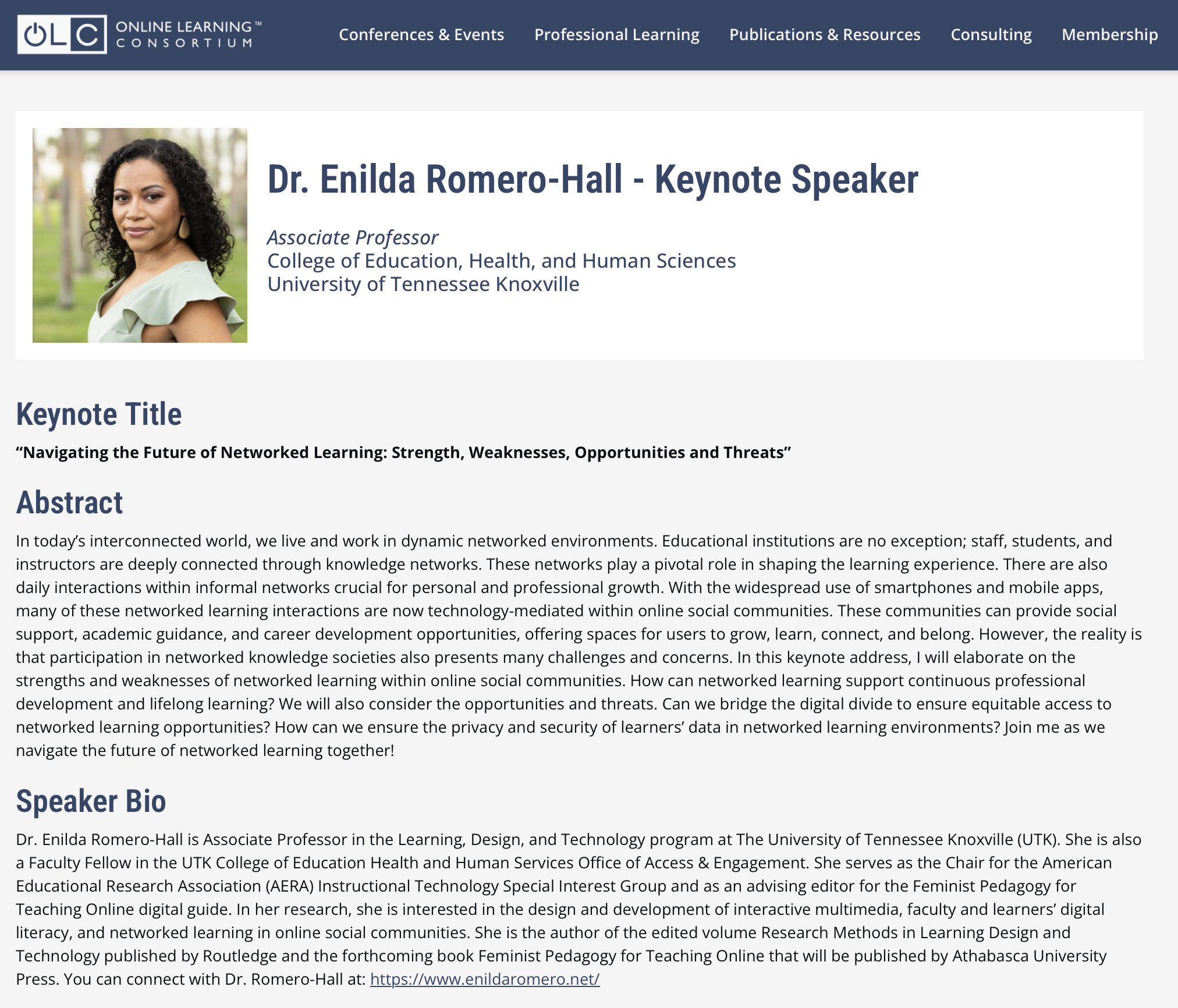

These are references that I used to inform my OLC Innovate 2025 keynote presentation:
- Networked Learning Editorial Collective (NLEC). Networked Learning: Inviting Redefinition. Postdigital Science and Education 3, 312–325 (2021). https://doi.org/10.1007/s42438-020-00167-8
- Wenger, E. (1998). Communities of practice: Learning, meaning, and identity. New York: Cambridge University Press.
- Luo, T., Freeman, C., & Stefaniak, J. (2020). “Like, comment, and share” —Professional development through social media in higher education: A systematic review. Education Technology Research and Development, 68, 1659-1683. http://doi.org/10.1007/s11423-020-09790-5
- Veletsianos, G and Kimmons, K. 2012. Networked participatory scholarship: Emergent techno-cultural pressures toward open and digital scholarship in online networks. Computers & Education, 28: 766–774. DOI: https://doi.org/10.1016/j.compedu.2011.10.001
- Romero-Hall, E. (2017). Posting, Sharing, Networking, and Connecting: Use of Social Media Content by Graduate Students. TechTrends, 61 (6), pp. 580-588.
- Romero-Hall, E., Gomez-Vasquez, L., Forstman, L., Ripine, C. & Dias da Silva, C. (2023). The Complexities of Using Digital Social Networks in Teaching and Learning. The Open/Technology in Education, Society, and Scholarship Association Journal, 3(1), 1–18. https://doi.org/10.18357/otessaj.2023.3.1.48
- Lupton, D. (2014). ‘Feeling better connected’: Academics’ use of social media. Retrieved from https://www.canberra.edu.au/aboutuc/faculties/arts-design/attachments2/pdf/n-andmrc/Feeling-Better-Connected-report-final.pdf
- Rodriguez, J. (2011). Social media use in higher education: Key areas to consider for educators. Journal of Online Learning and Teaching, 7(4), 539-550.
- Marwick, A. E., & boyd, danah. (2010). I tweet honestly, I tweet passionately: Twitter users, context collapse, and the imagined audience. New Media & Society, 13(1), 114-133. https://doi.org/10.1177/1461444810365313 (Original work published 2011)
- Are Students Experiencing Harassment on your College or University’s Digital Learning Platforms?
- Leeder, C. (2019). How college students evaluate and share “fake news” stories. Library and Information Science Research, 41(3). https://doi.org/10.1016/j.lisr.2019.100967
- Bastick, Z. (2021). Would you notice if fake news changed your behavior? An experiment on the unconscious effects of disinformation. Computers in Human Behavior, 116. https://doi.org/10.1016/j.chb.2020.106633
- Hodson, J., Gosse, C., Veletsianos, G., & Houlden, S. (2018). I get by with a little help from my friends: The ecological model and support for women scholars experiencing online harassment. First Monday, 23(8). https://doi.org/10.5210/fm.v23i8.9136
- Castellanos-Reyes, D., Romero-Hall, E., Vasconcelos, L., & Garcia, B. (2022). Mobile learning for emergency situations: Four design cases from Latin America. In Dennen et al. (Eds), Global Perspectives on Educational Innovations for Emergency Situations. Springer, Cham.
- Asino, T. I., Gurjar, N., & Boer, P. (2021). Bridging the Informal and Formal Learning Spaces with WhatsApp. The Journal of Applied Instructional Design: September 2021, 10(3). https://doi.org/10.51869/103/tangpb
- “What’sApp” with the Social Message? Networked Learning and Social Media Interactions in Curriculum Design: Exploring Student Perceptions: https://www.mona.uwi.edu/soe/publications/cje/article/520
- Bohemia, E., & Ghassan, A. (2012). Globally Networked Collaborative Learning in Industrial Design. American Journal of Distance Education, 26(2), 110–125. https://doi.org/10.1080/08923647.2012.663678
- Shilova, M. (2017). Datafication concept: Definitions and examples. Retrieved from https://apiumhub.com/tech-blog-barcelona/datafication-examples/
- Szcyrek S., Stewart B., & Miklas E. (2024). Educators’ understandings of digital classroom tools and datafication: perceptions from higher education faculty. Research in Learning Technology, 32. https://doi.org/10.25304/rlt.v32.3040
- Krutka, D. G., Manca, S., Galvin, S. M., Greenhow, C., Koehler, M. J., & Askari, E. (2019). Teaching “Against” Social Media: Confronting Problems of Profit in the Curriculum. Teachers College Record, 121(14), 1-42. https://doi.org/10.1177/016146811912101410
- How have social media algorithms changed the way we interact? https://bbc.com/news/articles/cp8e4p4z97eo
- UTK Collaborative Online International Learning: https://cge.utk.edu/coil/
- The Global OER Graduate Network: https://go-gn.net/
- CWU Library: Misinformation & Fake News Case Studies: https://libguides.lib.cwu.edu/c.php?g=625394&p=4391900#s-lg-box-30321291
- Learning about Algorithm – Definition, Types, Characteristics, Applications, and more: https://www.analytixlabs.co.in/blog/what-is-an-algorithm/
- Traxler, J. (2018). Learning with mobiles: The Global South. Research in Comparative and International Education, 13(1), 152-175. https://doi.org/10.1177/1745499918761509
- Drexler, W. (2010). The networked student model for construction of personal learning environments: Balancing teacher control and student autonomy. Australasian Journal of Educational Technology, 26(3). https://doi.org/10.14742/ajet.1081
Huge thanks to the Online Learning Consortium (OLC) for the invitation!
You must be logged in to post a comment.