Link to full-text: “Posting, Sharing, Networking, and Connecting: Use of Social Media Content by Graduate Students”

Here is a link to my latest publication: http://rdcu.be/qiVq

[This is a view only version. Unless you have a personal or institutional subscription to the journal]

Abstract:

The purpose of the present investigation was to better understand graduate students’ use of the content shared in the social media channels of their programs and the perceived impact that their participation in these social media spaces has on the graduate students’ transformation as professionals. Seventy-seven instructional design and technology (ID&T) graduate students completed an electronic questionnaire. The results revealed that although graduate students use social media for personal purposes, they are not always followers or members of the social media spaces of their ID&Tprogram. However, those who follow the social media of theirID&T program found tremendous benefits from the experience. These benefits range from feelings of belonging to acommunity of ID&T professionals, to career opportunitiesfor networking, and cross country interactions.


New Faculty Mentoring Program: 2015 Cohort [Research, Teaching, Collaboration, & Support] #AERA15 #AERADivC

During the AERA 2015 conference in April, I attended the Division C New Faculty Mentoring Program. I had attended a mentoring program in the past at AECT 2012. The AECT 2012 mentoring program was a two-day seminar with three mentors who volunteered their time to provide advance graduate students and new faculty with words of wisdom and practical advice for the tenure track journey. It was also great for networking. Unfortunately, due to Hurricane Sandy I was not able to catch my initial flight from Norfolk, VA (where I was living at that time) to Louisville, KY (where AECT was having the conference). My flight was delayed an entire day, this meant I was not able to attend in person the first day of the mentoring program. Instead, I joined the discussing via Google Hangout but it was not the same. I was relaying on hotel conference room wi-fi which was “okay.” Also, it was hard to be part of the conversation because it was not something the organizers were expecting. I did manage to join the conversation the second day of the mentoring program at AECT 2012 [Sorry, that was my “blast from the past” portion of this post].

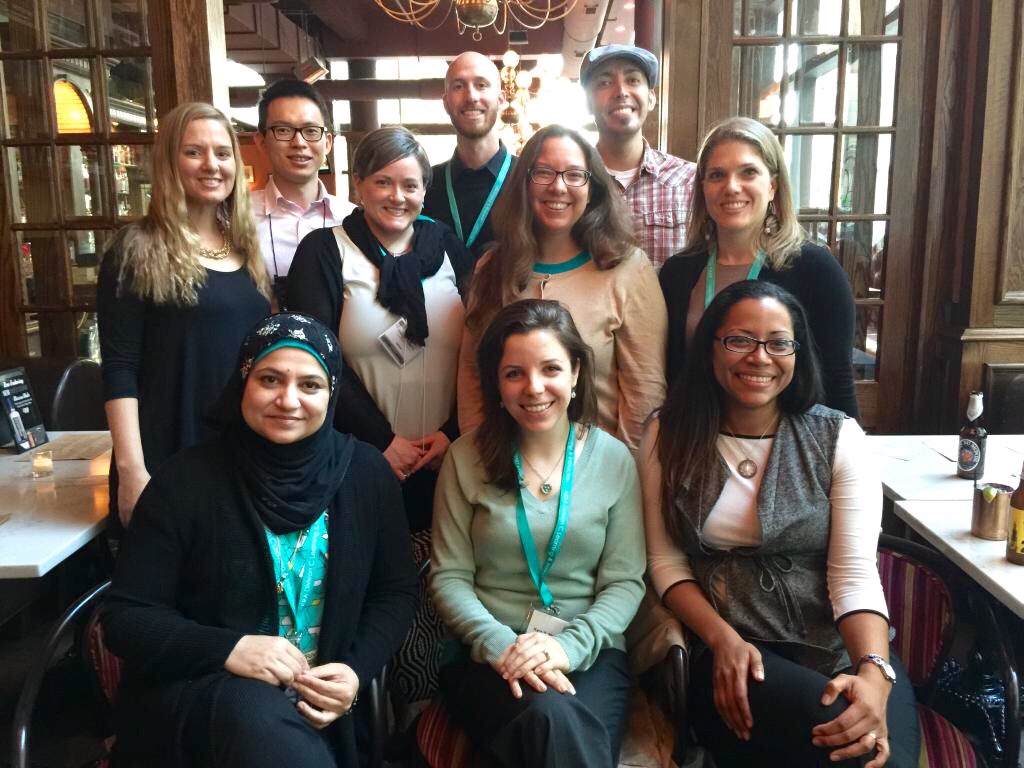
Back to AERA 2015: This year during the mentoring program at AERA15, the organizers [Gwen & Rayne] emailed us in advance the program with the different sessions and speakers. I was thrilled about the sessions and excited to meet my cohort. We were a very diverse group based on our universities and our cultural/regional backgrounds. The first day of the mentoring program we all provided a brief introduction of ourselves and what we hoped to get out the program. Then, worked on an exercise about our identities, which by the way was very difficult to write. I mean — How often do you think about your identity (in your community, your institution, your department, and your field)? We also had various sessions related to grants and external funding opportunities. We talked to faculty members that have in the past successfully acquired grant funding. They definitely shared some insight into grant writing, selecting a collaborator, what happens after you get a grant, and myths about grants/external funding. The best advice we got (from my perspective) was to have a good budget, have a great idea, select a collaborator that you want to interact with on a very regular basis, and polish your project management skills. We also had a session with two program officials. One from the National Science Foundation and one from the Spencer Foundation. This was just amazing because they shared some of the programs that their institutions offer to new faculty (at least within the first five years of appointment). One of the best recommendations given to us by the NSF program officer was to volunteer as a reviewer.

image

One of the most interactive sessions was definitely the session related to teaching. We had a speaker from the Center for Teaching and Learning at Penn State University who talked about strategies we should consider, the amount of time we spend preparing our courses, evaluations, resources our universities provide, and other related topics. One of the highlights of this session was that we were sitting in different tables (about 4 new faculty members in each table) and we were sharing our information with two teaching mentors per table. This mentors were individuals in field that are well known for their teaching. This is pretty unique. We often hear about research mentors but we rarely hear about teaching mentors. It was nice to have the small group discussion with our colleagues and the teaching mentors.

We also had a discussion session with faculty members who have been publishing for over 30 years and gratefully shared some much needed wisdom on putting together your research agenda (post on this coming soon), writing habits, submitting to peer review journals (and re-submitting, revising, getting rejected), and just been scholars in our field. I loved the informal environment of this discussion. It was more than anything a Q & A session.

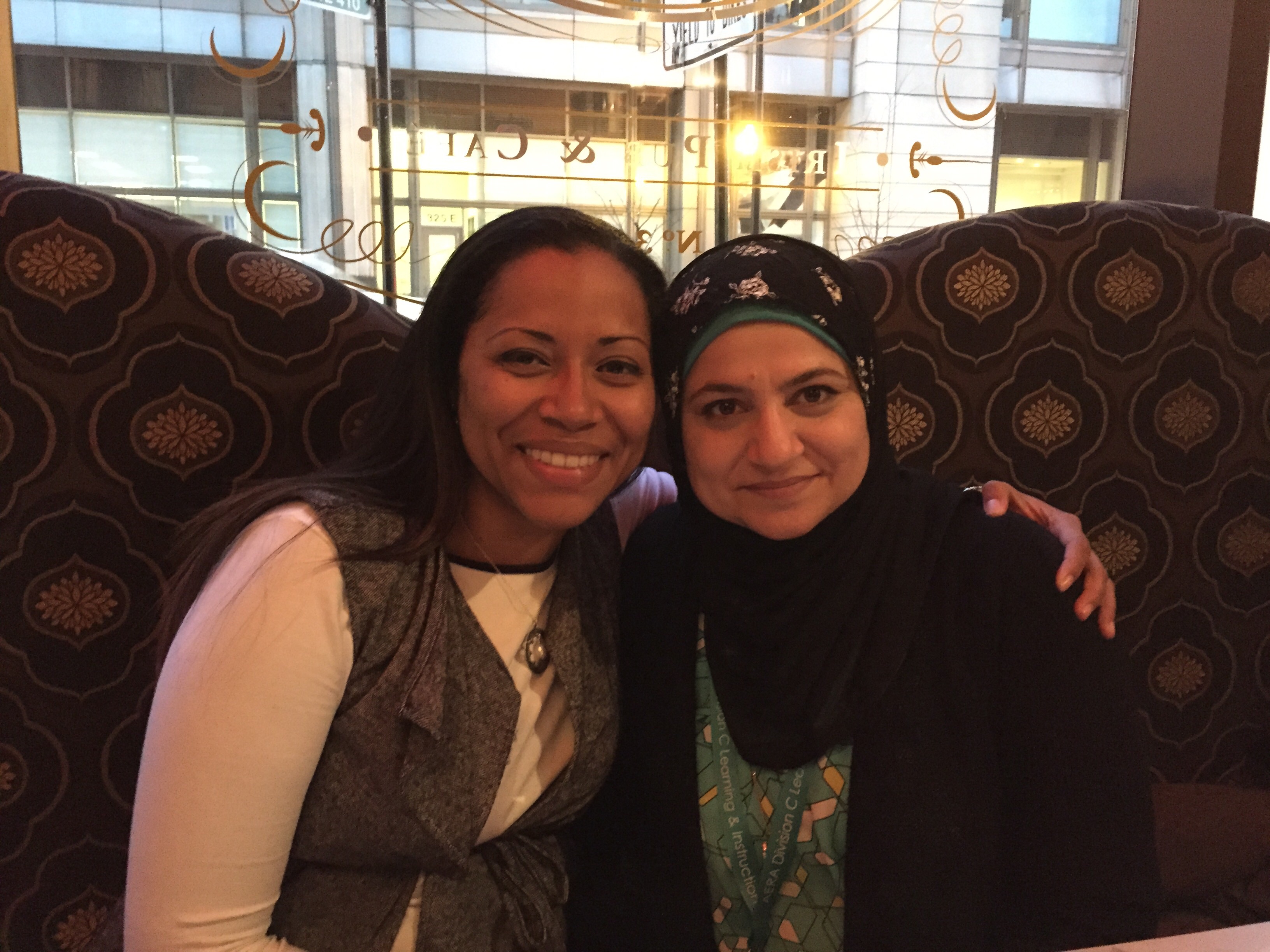
Of course, we spend the two day program with Gwen and Rayne who not only organized all the sessions, the speakers, our delicious dinner, and happy hour but also provided their own wisdom and experience. Thank you ladies for your work and dedication. BTW — Gwen will be the main organizer of the NFMP next year so make sure to check in November and December for an email from Division C. If you are a new faculty member, this program will be very refreshing, eye opening, and definitely worth your time/energy. As a cohort, we have managed to stay connect (I know it has been less than a month since we met). We took steps to ensure we can reach out to each other if we have questions or need feedback or are struggling with an issue — you get the point. To help us stay in touch we started our social media group and we are currently working on starting a writing group.

image

Last, thank you to the AERA Division C for their commitment to their members!

Publication in the IJDL: “Nursing Pain Assessment & Management: A 3D Interactive Simulation”

Journal Article Published in the International Journal of Designs for Learning

Title: “Nursing Pain Assessment & Management: A 3D Interactive Simulation”

Authors: Enilda Romero-Hall, Ginger S. Watson, Yiannis Papelis, Hector Garcia

Link: http://scholarworks.iu.edu/journals/index.php/ijdl/article/view/5169

Abstract:

In this design case, a team developed a 3D interactive simulation for nursing students and professional nurses to train and practice pain assessment and management procedures. In the simulation environment, the trainees interact with three emotionally expressive animated patients. The three patients vary in their ethnicity, age, and emotion intensity. Successful completion of the scenario requires that the trainee perform of a series of pain assessment and management tasks.  The trainee is evaluated on the efficiency and appropriate sequencing of the tasks.

The purpose of this paper is to describe the decisions made regarding the type of virtual patients used, the clickable objects, the pain assessment interview protocol, the visual representations in the simulation and the web portal. The paper also provides insight into the processes and steps taken during the design and development phases of this 3D interactive simulation including: the tasks analyses, motion capture, validation of the animations in the simulation, programming, and other tasks.


I survived my first semester as a faculty member!

Hard to believe it is already December!

Before starting the Fall 2013 semester I was told by many colleagues that the semester would go by so fast, it was going to feel like a blur at the end of the semester. I was a bit reluctant! But now that is all said and done, I have to say that it went by faster than expected.

One of the things that was a bit harder to do in this new academic environment was the adjustment to teaching night-time classes. In all honesty, I am all about cooking dinner with my significant other, decompressing at the dinner table, a nice evening walk and then some work. I have managed to figure it out. I combined working from home, working from the office, teaching a few classes in a hybrid format and teaching other classes completely face to face. I figured that if most of my students were able to do a 8 hour job and then make it to a 6 to 9 pm class, then I could do it too. It does make the days I have nights off and weekends even more special.

Another adjustment this past semester was the amount of email that I had to manage and all the work that comes with it. While I was in the doctoral program, I received a moderate amount of email related mostly to my dissertation. I also received email related to service at my professional organization. But between the students, the department, the college, the university, professional organizations, and every one else that decided to email me at some point in time, email was at times a major consumption of productivity. I am starting to think it should be part of self evaluations (how much time did you spend replying to emails during the semester?). I guess I have improved my emailing skills and management of emails.

Of course, the biggest adjustment is finding the balance between research, teaching, and service. I am not going to claim that I found it because I would be lying. I had, as recommended by several colleagues, designated a writing day for the week. However, I was not able to keep up with it. I still managed to get conferences proposals written and a few manuscript to a decent level. But I really wish I could immerse myself in writing a bit more. It is still “work in progress.”

A few other things to keep in mind if you are going into your first semester as a faculty member are:

  • Meetings take a chunk of your time: Days in which I had meetings (that were longer than an hour) were the most challenging. I tried hard to prepare in advance but I always was catching up after the meetings right until the 6 pm class. This had mainly to do with my personal and class schedule. Since most meeting started around 11:30 am , I would have to cut short work time in the morning and catch up with work in the afternoons.  Although, I am glad that the meetings are mainly around 11am since I have stay around campus for 6pm classes.
  • Be prepare to explain your grading criteria and assigned grades: We need to create a culture of “constructive feedback” in the classroom. I know that grades and points are important but what I really like is a focus on creativity, higher order thinking skills and problem solving. I like to see assignments in two ways: what was done correctly and what can be improved. I remember that when I was working on my dissertation I would asked my significant other to just criticize my work as if I was his worst enemy. But I know that sometimes it difficult to received that constructive feedback. After all, that student just spent a few sleepless nights working on it. I do have to say that once I explain my grading criteria students see it with a very different mindset.

Overall, reflecting on my first semester, I am still learning how the academic systems works. But, I am happy to be part of the UT family and to be a Floridian (the sunshine state!). One of the nicest comments I received at the end of the semester on a one on one meetings was when I student said “Dr. Romero-Hall you are a great addition to the UT IDT program, I want to take the rest of the classes with you! I really appreciate your honest feedback.” So, I guess I must be doing something right 🙂

The Art of Writing

I titled my post “the art of writing” because I do think that writing is a form of art. Let’s be honest writing is not an easy process for most people. Personally, for me it takes time and a bit of inspiration to write. I always try to put myself in the shoes of the reader. I ask myself, will the reader interpret the message correctly? I like to write a couple of paragraphs and then read over them to edit. Sometimes, if I’m not in a rush, I will put my writing project away for a day or two. That way I can read over it and hopefully catch any mistakes that were not easy to identify before. There are also some external factors that affect my ability to write… The time of the day, my mood, noise, stress level… I just have to get myself in the right frame of mind and then… The words, ideas, they just start to flow.