Hello World!

As usual I have once again neglected my blog.

I really have not felt inspired to write in my blog. Since my last post on June 8th, I was busy teaching my summer course (which ended at end of June) and June was also an intense month with writing projects. It seems like everything was due in June.

Then I decided that July would be a month of recovery. Recovery meant spending as much time as possible outdoors. Working from home means I sometimes neglect to spend time outside during the work week. By July, I really needed to make time for the great outdoors, getting vitamin D, and fresh air. I needed it both physically and mentally.

August was a month of change. So much change. I really need to dedicate an entire blog post to describe it all. So, let’s put a pin on it for now.

So in order to hold myself accountable, I am going to write that over the next few months I will share more on my blog about some of the hobbies in the great outdoors that I have enjoyed lately, some of the changes in my life (and the life of those around me), and updates on some projects.

This post sounds so vague but it gives my some direction to make an effort to reconnect with my blog.


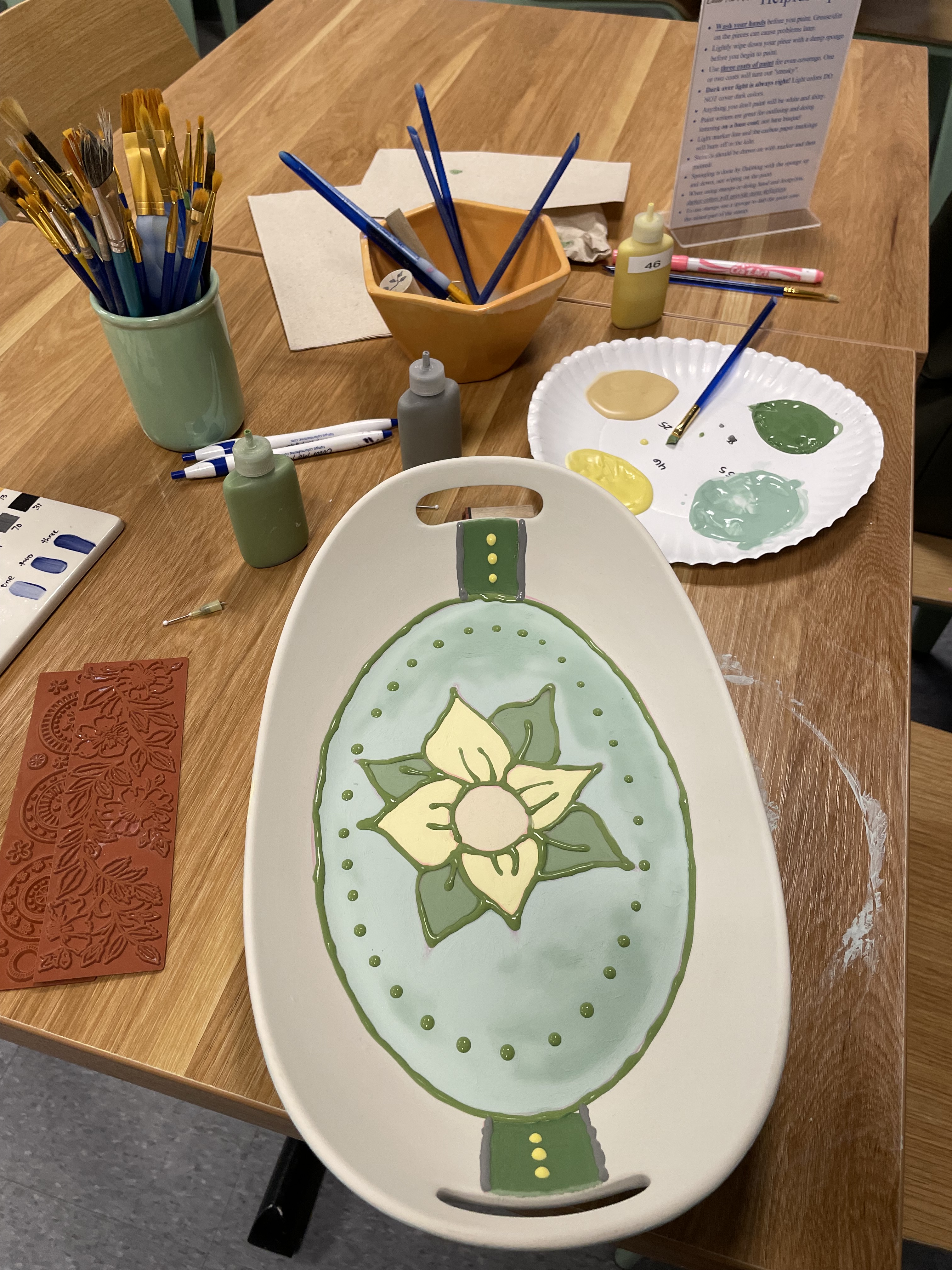
One of the few relaxing things that I did manage to do in June was to spend a weekend alone while my partner and son went camping. It had been 16 months since I had been apart from them overnight and felt super weird. I did used some of that weekend to do some writing (which I hardly ever do on the weekends) but more importantly I made sure to spend plenty of time relaxing. One of the relaxing experience that I had that weekend was pottery painting. It was seriously so calming, relaxing, and such fun experience. I spend nearly 4 hours painting. I should do it more often. Use the slider below to see some before and after pictures of my “work of art”. I am not Picasso but I think did pretty good!

Pottery Painting

CFP: Feminist Pedagogy for Teaching Online

The curators of the Feminist Pedagogy for Teaching Online guide (Jacquelyne Thoni Howard, Clare Daniel, Niya Bond, Liv Newman, and myself) are putting together a new edited collection on this topic. A list of potential topics is included in the call.

Please consider submitting a book chapter proposal by July 2nd, 2021. The book will be proposed to the Distance Education series at Athabasca University Press for publication in an open-access format.

For more information about the CFP or to submit a proposal visit: http://tiny.cc/FemTeachOnline

Recent AECT Interactions Post about #FeministPedagogy

I was recently invited to write a post for the newly established AECT Interactions digital publication. I welcomed the opportunity to write about a topic of my choice and was honored to be amongst those invited (which included colleagues who I deeply admired and whose work I value). Since I am starting to explore and write about feminist theories in various ways in my work, I decided that I wanted to write a short practical piece about feminist pedagogy. The lead of this new AECT initiative, Dr. Michael Grant, encourages us to write pieces that serve as a reflection of our own teaching experience and/or research outcomes. It seemed natural to me to write about my own experience embracing feminist pedagogies in my teaching. You can read my published post in AECT Interactions here: How to Embrace Feminist Pedagogies in your Courses

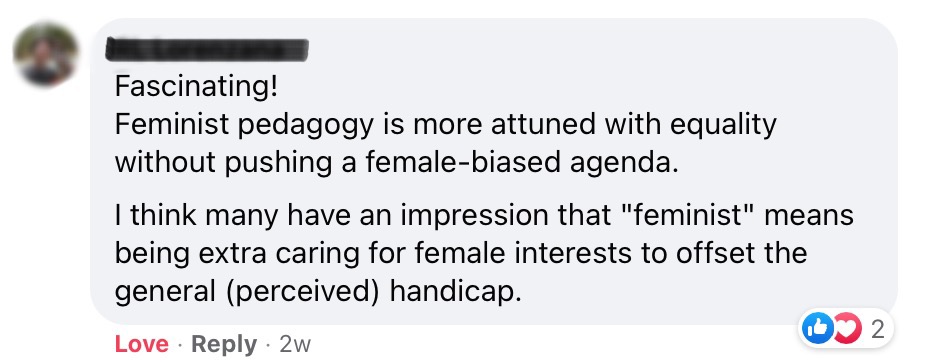
I shared the post widely online in different social media outlets and received fairly positive feedback on the topic and content covered. One of my favorite comments was shared in a Facebook group. It put a smile on my face. Below is a screenshot of the comment.

Facebook Comment’s Screenshot

I know that AECT is looking for authors who would be interested in contributing posts for this new publication. To learn more about AECT Interactions or how to submit a post for publication, click this link: Launching a digital publication to impact educators and learning professionals.

Reflections on “Open at the Margins: Critical Perspective on Open Education”

I do a short writing assignment every semester in my “Intro Seminar to Instructional Design and Technology course.” The main purpose of the assignment is to expose students to diverse topics in the instructional design field, to share an open access book with them (so that they can have as a future reference), and to assess their writing abilities (in order to provide support or share resources when needed).

Last semester, the students read “Foundations of Learning and Instructional Design Technology” and they shared wonderful reflections from the various topics covered in the book. This semester the open access book I shared with my students was “Open at the Margins: Critical Perspectives in Open Education.”

The assignment is the following:

  • Please select ONE chapter of the book “Open at the Margins: Critical Perspectives on Open Education
  • Write a reflection on the chapter you read
  • The paper should be:
    • MS Word document
    • 12 point font: Calibri or Times New Roman
    • Two-pages maximum
    • Include the title of the chapter you read in the first paragraph
    • If you use additional references, please include a reference list at the end (otherwise, you do not need to include references)
    • Use the submission link provided in the next Module [Nov. 2] to submit your reflection

Some of the chapters that the students reflected on this term included:

There are so many great reflections this semester. One of the main takeaways was “openness as more than just textbooks and access but as a way of to improve our practice, sharing, and collaborating.” The chapter “Open Education in Palestine: A tool for Liberation” was selected by three different students and “Diversity, Equity, and Inclusion in Open Research and Education” was selected by two students. Clearly, the topics/titles peaked the students’ interest.

Next week, I will ask the students if it is okay to share some of their reflections. Happy Friday!

One step closer: Research Methods in Learning Design and Technology

I was supposed to write about this weeks ago, but it did not happened. However, here I am to blog about the book “Research Methods in Learning Design and Technology.” First, I want to say thanks to all the book chapter authors. The work that these authors have put into their chapters is admirable.

What has happened since I last blogged about the book? Well, I shared that I had written the “acknowledgement” and was getting ready to submit materials to the publisher. That is exactly what occurred, I submitted all materials in mid-April. It was a huge sense of relief to have all the work completed and submitted, while dealing with all the stress and anxiety of the COVID-19 pandemic.

Back then, I also shared via social media (Twitter and LinkedIn) a link to an online repository, that I created, of the book chapter abstracts: http://www.researchmerge.com. In April, I also shared (with permission from the publisher and the book chapter authors) a pre-print of Chapter 5: Considerations for Using Social Media Data in Learning Design and Technology Research (by Spencer Greenhalgh, Matthew J. Koehler, Joshua M. Rosenberg and K. Bret Staudt Willet). If you had not seen these links before, I encourage you to explore the repository of the abstracts and feel free to download a copy of Chapter 5.

This week, I have spend the majority of the week reviewing queries in all of the chapters and the front matter of the book. This has given me an opportunity to read again all the book chapters. One of the hightlights was having a running head titled: “Futurama.” That really made me smile. By the way, I had to send a few “IMPORTANT: Chapter Information” emails to book chapter authors. Huge thanks for the prompt response of my colleagues, who I know have so much going on right now.

So, as the title states: One step closer!

A sabbatical during COVID-19

Where do I start?

I guess I can start by writing that a few months into my sabbatical the world turned upside down due to the COVID-19 pandemic. Yet, I was able to use my time to complete the tasks that I had outlined for my sabbatical period. April and May did require a significant adjustment since we had to manuoiver a new work schedule without child care. Maneuvering this new schedule required being realistic about what I could accomplish and saying “no” to some invitations for new collaborations.

The first two months of my sabbatical were as planned. I worked on writing two chapters for the book “Research Methods in Learning Design and Technology.” Book chapter authors submitted their completed and revised book chapters to me by the end of January and I worked on doing final reviews of each book chapter. I initially had planned to submit the book to the publisher by mid-March, but I switched the format of the last chapter, and this required giving extra time to my co-authors to complete their writing. This meant that I had to delay the submission of the book documents to the publisher until mid-April. Thankfully, by the time the world turned upside down in mid-March, all my co-authors and book chapter authors had turned in all required documents to me.

One of the elements of my sabbatical that was partially affected by the COVID-19 pandemic was work-related travel. I was scheduled to attend the American Educational Research Association (AERA) Annual Convention in San Francisco in mid-April and the conference was canceled. I am glad it was canceled, I am also glad it was not held virtually. April was a month of re-adjustement, tension, and stress for many. I was also scheduled to travel to Florence, Italy to present at the DEPIT Annual Meeting at the University of Florence. This event was re-scheduled for an online format.

I had some personal travel plans changed because of travel restrictions. I was scheduled to spend all of March and a portion of April in Panama City, Panama, where I was going to work while spending time close to my family. So, I traveled to Panama at the end of February and was monitoring all the news related to COVID-19. Due to the way the virus was spreading, my family and I decided it was best for us to travel back to the United States, so we changed our flights to travel back on March 22 (which is the day Panama was scheduled to close their international airport). On the evening of March 20, I received an email from COPA airlines letting me know that our flights had been cancelled. I was shocked and extremely disappointed. However, we all stayed calm and determined that we would just ride the storm in Panama. That same evening, as a last attempt, we figured we would see if there were any flights on March 21 to Tampa with a different airline. Thankfully, we did manage to fly back to Tampa on March 21. My dad was in Panama with me and we were also able to find a flight for him to fly back to Toronto (within one hour difference of our flight), which gave peace of mind. I would not have left Panama without my dad.

The weeks after returning from Panama, were weeks of adjustments as mentioned at the beginning of this post. In addition to all the tasks for the book, I was also scheduled to write a manuscript (with a deadline) that I had not even started. It took discipline to stay focus. I admit that there were many emotions related to what was happening in the world with the pandemic, leaving Panama, and experiencing the “new normal.” I felt like I had to work hard on my “emotional intelligence” to get the paper written and deliver all the book materials to the publisher.

I am thankful for the sabbatical term. In addition to the tasks mentioned in this post, I also used the time to work in revisions to several manuscripts and continue mentoring my undergraduate student (we presented at a conference in February and are currently working on a few writing tasks). Of course, I spend time with my family (even more than planned due to the lack of childcare).

Since my sabbatical ended, I am back to serving as the Graduate Coordinator of the Instructional Design and Technology program and I taught a six-week summer intensive course on Learner Motivation in June. I definitely missed my students and the joy of our convos.


Editorial: “The (Re)adaptability of Research Methodologies in the InstructionalDesign & Technology Field”

This editorial was recently published (online first). It will be available on print in the next issue of TechTrends introducing the articles that showcase “innovation in research methodology in the instructional design & technology field.”

Latest Publication: #SocialMedia Use by #InstructionalDesign Departments

Our publication titled “Social Media Use by Instructional Design Departments” was recently published under ‘early release’ by the Australasian Journal of Educational Technology #openaccess

Romero-Hall, E., Kimmons, R., & Veletsianos, G. (2018). Social media use by instructional design departments. Australasian Journal of Educational Technology, 34(5), 86-98. https://doi.org/10.14742/ajet.3817

Instructional Design Research Women’s Caucus #AECT17

Please consider joining us during this Research and Theory Division panel session at the AECT 2017 International Convention:

Women Caucus
Lead Discussant:
Enilda Romero-Hall
University of Tampa

Discussants:
Zeni Colorado-Reza
Emporia State University

Ginger Watson
University of Virginia

Camille Dickson-Deane
University of Melbourne

Ayesha Sadaf
University of North Carolina at Charlotte

Tugce Aldemir
Pennsylvania State University

See you in Jacksonville. Hope you can join us!

CFP: TechTrends #AECTRTD Special Issue [Proposals due: September 15]

TechTrends Special Issue
Research and Theory Division (RTD)

The Research and Theory Division of AECT is sponsoring a special issue of TechTrends related to current innovative research methodology in the instructional design and technology field. We welcome proposals in which researchers are rigorously using innovative methods of data collection and analysis as part of an investigation that helps further advance knowledge on the field.

Special Issue Co ‐ Editors

Enilda Romero-Hall, Ph.D.
University of Tampa
eromerohall@ut.edu

E-ling Hsiao, Ph.D.
Valdosta State University
ehsiao@valdosta.edu

Fei Gao, Ph.D.
Bowling Green State University
gaof@bgsu.edu

Submissions should align with the RTD mission to promote the development and advancement of theory; promotes, presents, and disseminates research and scholarship that encompasses multiple perspectives; advocates the study of social and cultural issues in the field; supports, fosters, and mentors emerging scholars. The division provides a professional community for AECT members with an interest in research and theory. The following is a non-exhaustive list of possible innovative methods of data collection and analysis:

  • Educational data mining
  • Learning analytics
  • Social network analysis
  • Advanced statistical modeling
  • Network anthropology
  • Eye tracking
  • EEG
  • fMRI
  • Other physiological measures
  • Integrative approaches to ‘mixing’ qualitative research
  • Netnography
  • Person-centered analyses
  • Interactional ethnography
  • Rhizoanalysis
  • Photovoice
  • Art-based data analyses
  • Appreciative inquiry
  • Concept mapping research
  • Visual analysis
  • And other innovative research methodologies

Expected publication date: September 2018

Submission Information

Articles should follow the writing style guidelines for Tech Trends. Submissions should be 4000-­‐5000 words in length (10 ­‐15 pages) and abstracts should not exceed 150 words. Use APA formatting throughout.

Please upload a PDF file with your name, institution, and email address as well as a brief overview (approx. 500 words) of the proposed article using the following link: http://tiny.cc/TechTrendsRTDSpecialIssue for initial review. If accepted for review, you will be directed to a Tech Trends portal for this special issue where you will submit your full article per the schedule below.

We kindly ask authors to also serve as reviewers for the submissions. Reviewers will also be requested from the overall AECT RTD membership. Thank you.

Important Dates

  • August 7, 2017 ‐ Call for Proposals posted
  • September 15, 2017 ‐ Proposals due: http://tiny.cc/RTDSpecialIssue_Dropbox
  • October 16, 2017 ‐ Notify accepted proposals
  • January 29, 2018 – Full submissions due AND start peer review process
  • March 16, 2018 – Reviews due
  • April 27, 2018 – Notify authors of review decisions
  • June 1, 2018 – Final and reviewed papers due