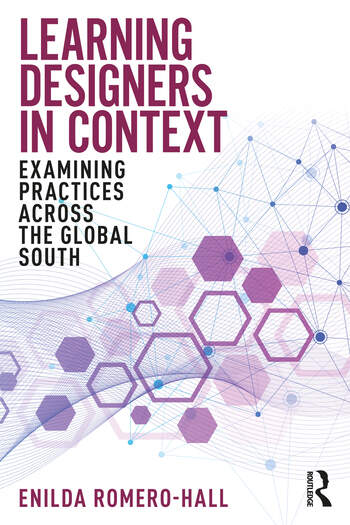
“Learning Designers in Context” is now published!

 I wanted to pass along that my latest book is now published and available!

Learning Designers in Context: Examining Practice Across the Global South examines learning design across professional sectors, local cultures, and geographic regions in the Global South, addressing the ways in which practitioners effectively draw on the knowledge, skills, and resources available to them. The book explores design and implementation in higher education, corporate, non-profit, and government sectors while attending to urgent cultural and geographic distinctions, these chapters vividly illustrate the roles, challenges, and opportunities of learning designers’ use in real-world settings home to specific demographics, traditions, socioeconomic parameters, and policy orientations. 

For more information about the book, and to order a copy (exam copies available), please visit: Learning Designers in Context (currently at a 20% discount). This file offers a brief sample of the book, including the table of contents and the concluding chapter: Book Sample including Table of Content and Chapter 15.

Please feel free to share with anyone who may find it useful.

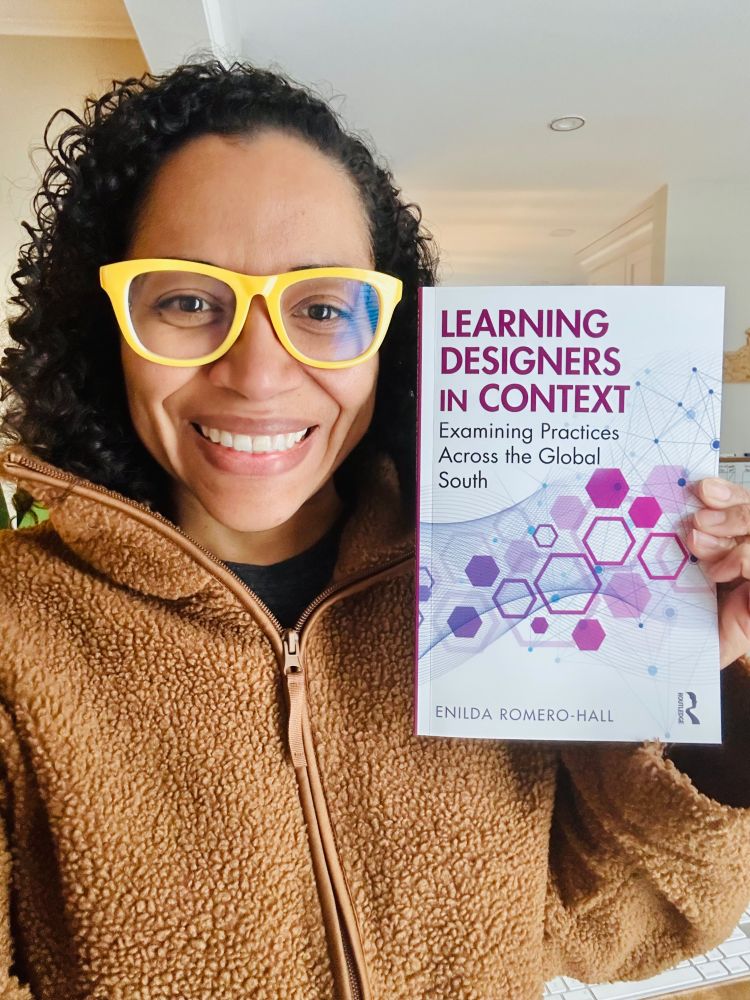
A smiling person with curly hair and bright yellow glasses holds up a book titled Learning Designers in Context: Examining Practices Across the Global South by Enilda Romero-Hall. The person is wearing a brown fleece jacket and standing indoors. The book cover features purple and pink hexagonal graphics on a white background.

The acknowledgement

Five years ago, I embarked on this book writing journey. I had the idea to write this book even before my previous book “Research Methods on Learning, Design, and Technology” was published in October 2020. The email I sent to the publisher on July 17, 2020 read:

I have an idea for a book project and I am wondering if I could chat with you to discuss it. I want to know if this is a topic that would be considered before working on the book proposal

I knew exactly what I wanted to write. I was inspired by the findings of a book chapter (titled: “Educational Technologists in Latin America and the Caribbean: Perceived Importance of Competencies for Practice”) that I co-authored with my former graduate students: Leonor Adams, Erika Petersen, and Adriana Viana. In the process of disseminating the survey for data collection we came across pockets of learning designers throughout Latin America and the Caribbean. It made me wonder how much we had yet to learn from learning designers in other parts of the world and the context of their practice. 

I would like to express my gratitude to the learning designers who took the time to meet with me and share their journeys into learning design practice. Your bravery and sincerity are truly appreciated. Your willingness to open up about your experiences, challenges, and successes has provided invaluable insights that will undoubtedly enrich the field of learning design. Your contributions have not only enhanced this work but also inspired me personally. Thank you for your dedication and for being a source of inspiration to others in the profession. 

I am beyond grateful for the support of McFadden Hall for cheering me on throughout this process, brainstorming with me when I needed a voice of reason, and holding my hand when I just wanted to give up. 

Thank you to the University of Tennessee Knoxville for providing resources and funds, which were instrumental in facilitating various aspects of this book project.

Making it through every step (i.e., writing a proposal, submitting the IRB, conducting the interviews, formatting, transcribing, translating, editing the chapters, writing, and organizing) seemed like a massive ordeal while leaving through changes in my personal and professional life. I am so incredibly thankful for those who have, in many ways, inspired and encouraged me without even knowing it. Gratitude!

“Learning Designers in Context” Now Available for Pre-Order

I do not know how many people actually read this blog, but I figured I would go ahead and share that “Learning Designers in Context” is now available for pre-order.

It also is discounted right now, when you order it directly from the publisher: Pre-Order Here

The book is scheduled for release December 5th, 2025. Copies of the book will be shipped after the released date.

I have previously published two edited books (i.e., Research Methods in Learning Design and Technology, Feminist Pedagogy for Teaching Online) and it honestly feels so different promoting a solo-authored book! In previous instances, I wanted to recognized and disseminate their work of my colleagues who had their work in the edited books, so promoting those books felt easy! However, having to promote my solo-authored book is so hard. I feel like my introverted side all of a sudden takes over!

I also wanted to add that if anyone would like to get a copy of the book, feel free to send me an email. I am happy to share a PDF.

Sneak Preview of “Learning Designers in Context”

Over the last few weeks, I have re-read the proofs of my forthcoming book “Learning Designers in Contexts” so many times that I honestly I feel I could recite some of the chapters. Due to some communication issues, the release date has been pushed back a bit. It is all part of the process or at least that is what I tell myself.

I am very happy that last Friday I saw a final version of the proofs. But that excitement was quickly met with a very familiar feeling of seen a grammatical mistake in the final proofs. It always happens! After seen this, I laughed a bit, closed my computer, and when to my son’s soccer game.

Last week, I also contacted the publisher and asked for permission to share a bit of the book in my blog. My editor, Hannah, asked me what chapter I wanted to share and I decided to go with Chapter 15. This sneak preview PDF also includes the table of content. I will do a bit more writing about the other chapters in the upcoming month or so. But, for now you are welcome to read Chapter 15.

Abstract:

This chapter is based on a keynote address I delivered at the Association for Educational Communications and Technology (AECT) International Convention on October 22, 2024, in Kansas City, Missouri. The speech has been adapted for this book, maintaining its original themes and ideas while refining the content for a reading audience. Through the lens of deep canvassing and the acknowledgment of practitioners’ stories, the chapter highlights how context-specific experiences shape competencies and practices. It advocates for moving beyond Anglocentric and Eurocentric paradigms to embrace inclusive approaches. By reflecting on personal journeys and collective actions, the chapter underscores storytelling as a transformative tool for fostering understanding and innovation in education technology and learning design.

Citation:

Romero-Hall, E. (2026). Learning Designers in Context. Routledge. https://doi.org/10.4324/9781003270591

Book Published: Feminist Pedagogy for Teaching Online

Athabasca University Press recently published our book as part of the Issues in Distance Education series. Feminist Pedagogy for Teaching Online edited by Jacquelyne Thoni Howard, Enilda Romero-Hall, Clare Daniel, Niya Bond, and Liv Newman examines the experiences that interdisciplinary and global feminist educators have had-both their successes and their challenges-in infusing feminist pedagogical tenets into their online teaching and learning practices. The book is available in multiple open access formats, and I hope you will take the opportunity to browse through the chapters and discover how this freely available resource can benefit your organization and members. 

About the Book

Instructors across higher education require inspiring and practical resources for creating, adapting to, and enhancing, online teaching and learning spaces. Faculty need to build collaborative, equitable and trusting online learning communities. This edited volume examines the experiences that interdisciplinary and global feminist educators have had-both their successes and their challenges-in infusing feminist pedagogical tenets into their online teaching and learning practices. Contributors consider how to promote connection, reflexivity, and embodiment; build equity, cooperation, and co-education; and create cultures of care in the online classroom. They also interrogate knowledge production, social inequality, and power. By (re)imagining feminist pedagogy as a much-needed tool and providing practical advice for using digital technology to enact these tenets in the classroom, this collection will empower educators and learners alike.

About the Editors

Jacquelyne Thoni Howard is a professor of Practice of Data at the Connolly Alexander Institute for Data Science at Tulane University. 

Enilda Romero-Hall is associate professor in the Learning, Design, and Technology program at The University of Tennessee Knoxville. 

Clare Daniel is senior professor of practice and director of research at Newcomb Institute of Tulane University, where she teaches in the Department of Communication. 

Niya Bond is an online educator, faculty development facilitator, and PhD candidate at the University of Maine studying online teaching and learning. 

Liv Newman is administrative assistant professor and Associate Director of the Center for Engaged Learning and Teaching at Tulane University.

Romina Wilson selected for the J. Wallace and Katie Dean Graduate Fellowship!

I am really excited to share that one of our incoming learning design and technology doctoral students in the Theory and Practice in Teacher Education (TPTE) Department, Romina (Mina) Wilson has been awarded the J. Wallace and Katie Dean Graduate Fellowship for the 2025 – 2026 academic year from The Graduate School at the University of Tennessee Knoxville (UTK)!

As stated in the notification email: “By receiving this fellowship for new graduate students, you are being recognized as one of the most promising incoming students to the University of Tennessee, Knoxville. We are excited to offer this award to you.”

Mrs. Wilson’s dedication and contributions to the field of learning design and technology are evident through her numerous collaborations with esteemed scholars, resulting in several journal article publications. In 2024 alone, Mrs. Wilson published two journal articles and a book chapter. She co-authored an article titled “AI-Generated Content: Guidelines, Higher-Order Thinking Skills, and Copyrights” with Taylor Allen, a graduate student at UTK, and Dr. Enilda Romero-Hall, Associate Professor at UTK, which was published in the Educational Technology journal. Additionally, she co-authored an article in the International Journal of Adult Education and Technology titled “An Inquiry into the Use of Generative AI and Its Implications in Education: Boon or Bane,” where she examined the benefits and challenges of integrating generative AI in educational settings. Her most recent publication is a book chapter titled “Redefining Learning in the Digital Age,” included in the edited volume “Integrating AI into Pedagogical Education.” – TPTE Graduate Education Committee Nomination Letter

Mina will be starting the learning, design, and technology doctoral program at UTK this fall 2025, under my advising. She will also be joining our research team (Learning Environments and Ecosystems Research Network (LEARNET). Very much looking forward to working with Mina during her studies at UTK!

Online Ready: Designing Culturally Competent K-12 Online Learning

“Online Ready: Designing Culturally Competent and Impactful K-12 Online Learning” (funded by the Institute of Museum and Library Services, #RE-250017-OLS-21) was a three-year design-based exploratory study led by Lucy Santos Green (University of Iowa) in partnership with Kristin Fontichiaro, University of Michigan, and Melissa P. Johnston, University of West Georgia. The project assessed and addressed school librarianship knowledge gaps in the design and delivery of targeted and culturally competent online learning.

As part of this grant project, I collaborated with Lucy, Kristin, and Melissa in the design and developed of the Online Ready curriculum. I also taught one of the three online asynchronous mini-courses, titled Culturally-Competent Design Mini Course. I feel so incredibly honored to have been part of this project. The Online Ready course was instrumental in allowing K-12 school librarians to reflect on their practice and their schools context while also advancing their learning design and online learning knowledge and skills.

You can explore all the mini-courses from this project by accessing the Online Ready platform available for free through the UI Learn Catalog. Please share widely with your school librarians colleagues and friends!

Supporting Faculty Against Online Harassment and Abuse: Online Course

A few years ago, Jaigris Hodson, George Veletsianos, and Victoria O’Meara invited me to collaborate on a project titled: Online Harassment as a Barrier to Research Communication: An Intersectional Approach (SSHRC Insight Grant). As part of the collaboration, we worked on the design and development of an online learning course that illustrates the experiences of diverse researchers who are harassed when they communicate their research online.


The goal of the course is to educate others on the different types of online harassment experienced by diverse researchers and to provide an opportunity for stakeholders to engage in perspective taking activities related to online harassment. This training is designed specifically for administrators, to equip you with the knowledge and tools you need to support your faculty. By following the guidelines in this training, we can all be better equipped to contribute to a safe, respectful, equitable, professional, and ethical workplace.

Objectives of the Course

Upon completion of the training, you will be able to:

  1. Name 3 reasons why online harassment may be underreported at your institution.
  2. Examine how adopting a system for supporting faculty during or after an experience of online harassment can improve equity within the department.
  3. Identify the best course of actions to take to support faculty targeted with online harassment.
  4. Distinguish between strategies that you can use to support your faculty vs. strategies that are likely to be unhelpful.

The course was developed by Niki Watson using Articulate Storyline. You can access the course using this link: https://facultytraining.github.io/Supporting-Faculty-Against-Online-Harassment-and-Abuse/


Contributors:

  • Jaigris Hodson, PI, Subject-Matter Expert
  • George Veletsianos, Co-PI, Subject-Matter Expert, Instructional Design
  • Victoria O’Meara, Collaborator, Subject-Matter Expert
  • Enilda Romero-Hall, Collaborator, Instructional Design
  • Niki Watson, Instructional Design, Online Development
  • Joan Owen, Research Assistant

SIG Instructional Technology Spring 2025 Newsletter!

We are very excited to share the latest edition of our newsletter with you! This edition covers:

  • SIG Instructional Technology Updates
    • Message from the SIG Chair
    • 2025 SIG IT Awards
    • 2025 SIG IT Travel Scholarships
    • AERA 2025 Annual Meeting Program News
    • Community Building
  • Our Members: Awards, Grants, and Professional Accomplishments
  • What are Our SIG IT Members Reading?
  • SIG Instructional Technology Members Spotlights!

Read the newsletter here: tiny.utk.edu/SIGIT_Spring2025_Newsletter

Thank you for being part of our community!

How to Embrace Feminist Pedagogy in Your Courses

This post was originally published on AECT Interactions but is no longer available there. However, an archived version can be accessed via the Wayback Machine using this link. As the original author, I wanted to make sure this content remains accessible to ensure continued access to its insights and discussions. If you have any questions or concerns, please feel free to reach out. 

Feminist pedagogies belong in academia, whether incorporated into onsite or online curricula. If this term is new to you, or if you’d like to find out how you might bring feminist pedagogies into your teaching, I welcome you to read on. 

I’ll start here: I consider myself an intersectional feminist. As thoroughly discussed by Rosemary Tong, in her book Feminist Thought, feminist theories aim to describe women’s experiences through analyzing patriarchy, sexuality, or other ideologies. Yet it often overlooks the role of race and class. Therefore, feminist theory remains White and its potential to broaden and deepen its analysis by addressing non-privileged women remains unrealized (Crenshaw, 1989). Intersectional feminism views identities as consisting of multiple social dimensions including gender, race, sexuality, and class. As a woman of color—an Afro-Latinx woman—intersectional feminism fully embraces my experiences. 

Photo by Red Dot on Unsplash

As I learned more about the feminist movement and how some colleagues have embraced feminism in their teaching practice, I quickly realized that because of my intersectional feminist tendencies I had adopted a feminist pedagogy. According to Shrewsbury (1987), feminist pedagogy is a philosophy of teaching/learning processes that guides our choice of classroom practices in which a community of learners is empowered to act responsibly towards one another and the subject matter. Feminist pedagogy also encourages us to apply what we learn to social action.

Intersectional feminism views identities as consisting of multiple social dimensions, including gender, race, sexuality, and class. As a woman of color, an Afro-Latinx woman, intersectional feminism fully embraces my experiences.— Enilda Romero-Hall

FEMINIST PEDAGOGIES IN TEACHING

Here are some ways in which I have embraced intersectional feminist pedagogies in my teaching:

  • Construction of Knowledge: In my classroom, I view learners as equal contributors to knowledge construction. I encourage my students to reflect on prior experiences and share them during our discussions. The aim is to decentralize knowledge. 

    Put it into practice: The learners in my courses are empowered and the ‘learner-instructor’ relationship is transformed (e.g. creating an open access book authored by graduate students in a course). I also aim to decolonize knowledge by acknowledging the existence of multiple epistemological frameworks from scholars around the world. Examples of decolonization of knowledge include having a variety of guest speakers, sharing reading lists of non-White authors, and/or amplifying colleagues with global perspectives.
  • Course Design: When designing a course, I am open to being flexible, recalibrating, and redesigning based on learner inputs. There is a balance in the  instructor and learner input to help inform curriculum and classroom practices. 

    Put it into practice: On the first day of classes, I always state that “the syllabus is not written in stone.” Therefore, it is not uncommon to have changes in the course schedule to provide learners with additional time to work on a project or explore a topic. Also, I aim to identify authentic evidence of learning. Rather than engaging learners in regurgitation of content, I use generative strategies and authentic assessments, enabling learners to show genuine and valid evidence of learning (e.g., a short writing assignment).    
  • Power and Authority: One of the key tenets of feminist theory is to be critical of power: Who has power? Why are they in a position of power? It is important to challenge normalized notions of dominant culture because they often serve to oppress the “others.” The idea is not to give the “façade of equality,” but instead to recognize how power structures are represented in the course and take action to correct it. 

    Put it into practice: In my HyFlex courses, I have observed this power imbalance, noticing that my synchronous online students may not be able to interject during discussions in the same way onsite students do. Therefore, I make a point to facilitate the discussion in a manner that opens moments in which online students can interject and make a contribution to the discussion. 
  • Dealing with Differences: In this element, the ‘intersectional’ element of  feminist theory is critical. Dealing with differences encourages dialogue that helps learners come to realize their own privilege and stereotypes they may have (i.e., race, class, gender, and others). Learners also get to know their classmates and the many different views each person holds.

    Put it into practice: For an onsite course, this may be an open conversation between the learners and the instructor at the beginning of the course. In an online course, it’s important to highlight this in course ‘netiquette.’ This is one of the netiquette points I like to include on the main page of my course: “Be sensitive to the fact that online participants represent a wide variety of different political and religious beliefs, as well as cultural and linguistic backgrounds. Disagreeing is fine and even encouraged, but remember that you should aim for rational discourse.”
  • Community Building: Embracing community-building following a feminist pedagogy framework means valuing solidarity and shared power. The idea emphasizes to the learners how collective action can help empower a group of individuals just like it can empower groups to address inequalities and discrimination faced as individuals in society. 

    Put it into practice: Community building can be implemented by building equitable learning communities for students who are studying in person or online (Bali, 2021).  

I recently joined the curation team of the Feminist Pedagogy for Teaching Online guide (co-curators include: Clare Daniel, Jacquelyne Thoni Howard, Niya Bond, and Liv Newman). The initial founders created it as a resource to assist faculty with the mass transition to remote learning due to the COVID-19 pandemic, as feminist pedagogies are equally important in online teaching and learning. The guide includes a range of readings, podcasts, and teaching tools that embrace the tenets of feminist pedagogy. 

ADDITIONAL RESOURCES

Here are additional resources and readings that can also benefit you as you consider feminist pedagogies in your own teaching practice:

OLC Innovate 2025 Keynote

Read Abstract and Speaker Bio


These are references that I used to inform my OLC Innovate 2025 keynote presentation:

Huge thanks to the Online Learning Consortium (OLC) for the invitation!