A few weeks ago, I found out that the Tenured Upon Appointment process at The University of Tennessee Knoxville (UTK) was completed. I am grateful to the UTK community for honoring my work and contributions as an Associate Professor with tenure. I look forward to continuing my work as researcher, instructor, and member of my professional community. Also, thankful to the many collaborators so much of the work that I do is a join effort with colleagues and students.
This week's episode of The Key is about a form of blended learning called HyFlex and features two professors who have both taught in the format and done research on its impact. #AcademicTwitter
A few weeks ago, I was invited to join a podcast to talk about HyFlex Instruction. I was on travel when I saw the email from the editor in my inbox and, without too much information, I accepted to join the conversation. I really did not know what direction the podcast was going to take. I know HyFlex learning is “controversial” and even “unwelcome” by many, but I really was just going to speak facts. I reviewed some of the research I have done on the topic and the reviewed the literature I have read on the past in preparation for the podcast. I am very happy that the editor had a conversation approach to the podcast and that guided the conversation on the “what comes next” direction. I will be speaking and doing more research on this topic in the upcoming months. So, this is just the beginning of the conversation.
I really do not like listening to my voice in recordings so I just know what I said from the actual recording session. I have not heard the podcast, so I appreciate colleagues who have reached out to let me know that they enjoyed listen to the podcast and the points I shared as part of the conversation. Above is a link to the tweet from Inside Higher Ed and here is the link to the webpage: Ep.91: The Pros and Cons of HyFlex Instruction
This past week, I was invited to speak as part of the STEM education seminar sponsored by the Theory and Practice in Teacher Preparation (TPTE) Department STEM team. I am part of the STEM Education team in the department and this semester a group of colleagues are organizing this seminar with presentations for faculty and graduate students every two weeks. I have really enjoyed all of the presentations this semester. Our STEM Education team is doing really amazing work and I love learning about it.
For my presentation, I was a bit nervous because I was not sure how my work would relate to STEM education. I know educational technology is consider part of STEM education. However, I think of my work as more than just educational technology. I actually see Learning, Design, and Technology as the umbrella term under which educational technology, instructional design, instructional technology, learning engineering, and others similar terms come together. Perhaps one of my main concerns is that under the term STEM, learning design is primarily associated with the “technology” term which I really see as just one aspects of the far more complex ecosystems of the learning, design, and technology field.
The presentation focused on how it is okay to have many areas of research interest. We are often encouraged to stay very narrowly focused on a topic. But, what if you are curious about other topics and want to explore them? So, basically, I used myself as an example of an eclectic research agenda. My research has evolved so much and in part it due to my curiosity to explore other topics. This has also been true in my life, curiosity to try new things or study programs outside my focus has helped me evolve and grow. Here is the link to the slides, in case you are curious.
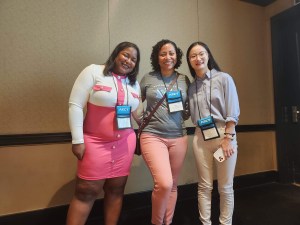
Last week, I attended the AECT International Convention. It was my first time since 2019 that I attended in person. It was great to see so many colleagues who I have communicated with via email or Zoom for the last three years. Also, I got to meet new colleagues who I had never connected with before.
It was a fairly busy but rewarding schedule for me. I started early every day with a conference presentation or panel session. I am writing this blog post primarily to share some resources and presentation slides from AECT.
CLT- Prioritizing Care, Respect, Empowerment, and Intersectional Identity while in Emergency Remote Teaching: Analysis through a Feminist Pedagogy Lens
This was a presentation with co-author, Dr. Nadia Jaramillo Cherrez. It is work that we have written up and plan to published as part of a forthcoming book on Feminist Pedagogy in Online Learning. Here are our presentation slides.
CLT- Marginalizing What ALSO Matters: It’s time to consider equity factors in design that impact student learning
This panel was great. I do not have slides to share, but here is the link to the recording. Unfortunately, it will only be available until Nov. 15 so please view it before then if you want to learn more about our discussion.
LED- Authentic Practices and Considerations for Mentoring ID Professionals
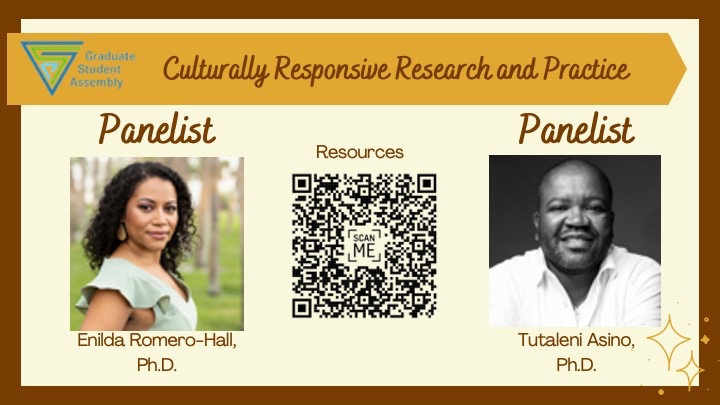
This panel was organized by members of the AECT Graduate Student Assembly (Mia Knowles, Lili Yan, and Bree Kirsch). Thank you so much for your work organizing this panel. Some of the central questions that Dr. Tutaleni Asino and I discussed during this session were:
How would you describe culturally responsive research, pedagogy, and practice? What are other relevant concepts that show up in your work?
What are your experiences in doing work with culture? Any important stories or challenges to share?
What is your favorite methodology for culturally responsive research?
How would you negotiate the cultural self and the academic self in your work?
Advice/resources for grad students doing work with culture, particularly in our field?
Mia, Lili, and Bree created this slide with a QR code that links to additional resources and readings.
2022 Early Career Symposium
This year during AECT, I was also invited to serve as a mentor as part of the Early Career Symposium. I hope the insights I shared with my mentees are beneficial to them. I also learned a great deal from their experience and knowledge. I am thankful to those who presented during the symposium because I found their presentations useful even in my current career stage as an academic. I hope AECT continues to support the Early Career Symposium. I have served as a mentor twice and was a mentee many years ago. It is truly a great way to give back to our learning design and technology community.
University Receptionand Distance Learning Award
Huge thanks to my colleague, Dr. Rachel Wong, for traveling to the AECT 2022 conference with our University of Tennessee Knoxville poster and goodies to give away during the university reception. We met many colleagues and graduate students during the university reception. Thank you to everyone that stopped by and grab some goodies. Also, thanks to the AECT Distance Learning Division for recognizing one of my recent publications with 1st Place Mixed Methods Journal Award (“Hybrid flexible instruction: Exploring faculty preparedness” published with co-author Caldeira Ripine in the Online Learning journal). Last, but not least, during the welcome reception I put my name in a raffle and won some DDL gear. I never win raffles, I was so excited.
Some academics are leaving Twitter. I have no plans to leave Twitter as of right now. I am not on Instagram or Facebook. If you join Twitter one day and do not see me there, please know that I have switched to the next big social network: The great outdoors. I do not feel motivated to join a different social network platform. So, again, if I remove myself from Twitter that just means I dedicate more time to spend outside in nature (i.e., a park, a bike ride, a short hike, a farm, kayaking).
I was already considering a Twitter break later this year. I will see how things go with over the next month or so before making a decision. But honestly, if things go South with Twitter and I just shut my profile down radically please know you can always reach out to me via:
You can also subscribe to this blog. In the main page of this blog (https://enildaromero.com), you can type your email and click subscribe to read future posts. I write professional and personal blog posts. I am not a New York Times best seller but I put a few sentences together and sometimes share some decent content (in my humble opinion).
I really miss having the option to take public transportation.
In the past I have lived in two cities with pretty amazing public transportations systems: Panama City and Toronto. Panama city’s public transportation is fairly inexpensive but it is also very chaotic. I grew up in that system so the chaos was actually fairly normal to me. The Toronto’s public transportation system is pricey and it has a high level of organization that I have not experience anywhere else I have travel to.
For many years, living in Toronto the TTC was my best friend. At that time I resided in Scarborough on the East side of the Greater Toronto Area but worked downtown so daily I would take the Cliffside (20) bus to Kennedy Station and get on the subway going West bound to Young and Bloor station where I would transfer to the South bound train towards Union Station. I would get off at the Dundas Square station.
Commuting to work in public transportation was very relaxing for me (I did not have to use it during the traditional rush hours). This was before smartphones even existed so I would bring something to read or I would listen to my CD player (ha!). If I missed a train, I could easily catch the next one in 5 or 10 minutes. The Cliffside bus would run every 15 or 20 minutes.
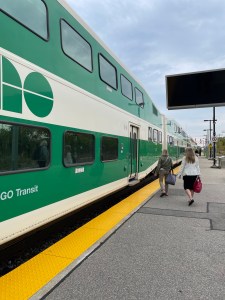
Although I have tons of experience with the TTC, I had never tried commuting into downtown Toronto using the GO Train, which is a regional commuter train serving the Greater Golden Horseshoe region of Ontario, Canada. I recently took a ride in the GO Train and it was amazing. It is a bit more costly than the TTC ride but if time and comfort are important to you then is is probably worth it.
I wonder why we cannot have the same transportation system in the United States. I lived in Tampa for 9 years and honestly the public transportation system sucked. A bus would run every hour. That makes no sense at all. I do not know if Knoxville has any public transportation system. There is a bus that runs from UTK to downtown but I am pretty sure that is all I have seen.
Having a car is a privilege. There are many people who cannot afford the cost of having a car (i.e., car insurance, car payment, repair and maintenance) or cannot drive because of many other reasons, it would be nice in the United States to have the option to use public transportation that runs regularly and that you can count on if needed. I read this article (The real reason American public transportation is such a disaster) and I think it is kind crazy to me that public transportation can be treated as a “political charge issue”.
Anyways, I do not want this to be a really long post but a reflection on some recent experiences and hopes for a better public transportation future.
Me dio mucho gusto participar en el conversatorio con las organizadores del Cafe Virtual de Learn for Improvement que ocurrió ayer. El Learn for Improvement es un grupo de diseñadores instruccionales a nivel corporativo en Latino America. Estos fueron alguno de los temas de los que hablamos durante el conversatorio:
¿Qué especializaciones de postgrado has seguido? ¿Cómo han contribuido en tu desarrollo profesional?
Master en Diseño Instruccional de la Universidad Estatal de Emporia (Emporia State University). Como a contribuido a mi desarrollo profesional:
Técnicas de Diseño Instruccional (modelos y teorías)
Conocimiento de teorías del aprendizaje y motivación
Emphasis en el desarrollo de capacitaciones para adultos
El uso de programas que se usan para el desarrollo de capacitaciones en línea y programas educativos en general
Doctorado en Educación con énfasis en Diseño Instruccional y concentración en Simulaciones para Capacitación y Aprendizaje de Old Dominion University. Como a contribuido a mi desarrollo profesional:
El enfoque fue más en mi crecimiento como investigadora.
¿Cómo se formula un proyecto de investigación?
Proponer el proyecto
Recolectar la data
Escribir el reporte o la publicación
Presentación del proyecto
Aprender a colaborar con colegas en otras áreas de estudios en proyectos que necesita la perspectiva de un diseñador instruccional
Leer para entender cómo los proyectos de investigación se pueden usar en la práctica
En tu experiencia, ¿qué ventajas te brinda contar con un postgrado especializado en aprendizaje para construir una carrera internacional en L&D?
Conocimiento de la teoría que es muy importantes (diseño instruccional, psicologia, comunicacion, etc.)
Aprender a conectar los resultados de las investigaciones con la práctica (que funciona? Que no funciona? Y porque?)
Distinguir entre el uso de “programas” y importante conocimientos de pedagogía (para adultos o sistemas digitales)
Estar más al tanto de las últimas tendencias en diseño instruccional y tecnología y sus aplicaciones en diferentes niveles.
La realidad es que muchas posiciones requieren un postgrado
¿Qué alternativas de especialización-postgrado a nivel internacional recomiendan para los que trabajamos en L&D?
Ahora mismo hay un gran emphasis en conocimiento de:
Diseño instruccional para desarrollo de capacitaciones en línea
¿Qué recomendaciones deberíamos tener presente antes de elegir un postgrado?
Fijense en la página de Internet del programa
¿Quiénes son los profesores y cuales son sus áreas de interés?
¿Qué cursos se ofrecen? ¿Te interesan a ti estos cursos?
El program esta enfocado en preparar profesionales para el área que te interesa: educación secundario, área corporativa, universidades o instituciones del gobierno
Si el programa es en línea o presencial
Qué apoyo brinda al estudiante para hacer la transición a la fuerza de trabajo
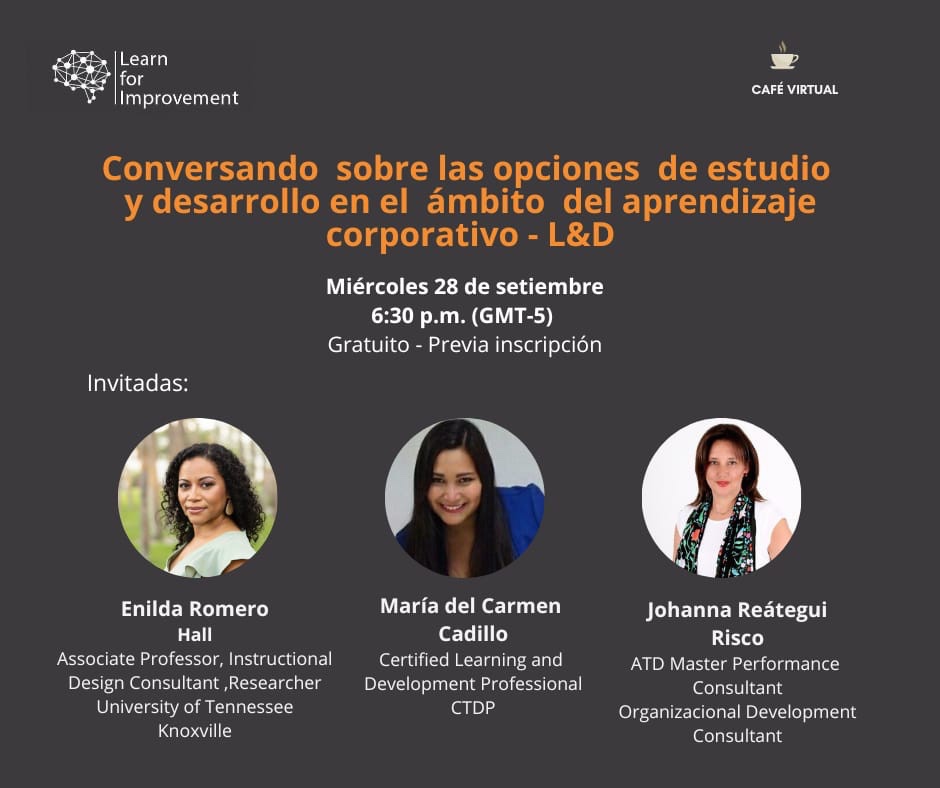
This event is for Spanish speakers, who more than likely live in Latin America but anyone is welcome. If you are interested in an instructional design program or a program focused on learning and development for a corporate environment, join us! We will be talking about this topic on September 28! The organizers of this event are the Learning for Improvement group the is organized by instructional designers in Peru. I am thankful that I was invited to be part of this Cafe Virtual. Here is the link to register for the event: https://forms.gle/5sexFAfqaBM6J6jE7
Flyer for the “Cafe Virtual” organized by the Learn for Improvement group
October
On October 19, I will be doing a presentation for my alma mater, the Graduate Student Organization of the Instructional Design and Technology program at Old Dominion University. More details coming soon.
November
On Nov. 3, I will be presenting as part of the University of Tennessee Knoxville (UTK) Theory and Practice in Teacher Preparation (TPTE) STEM seminar and discussing “inclusive and equitable learning design practices”
For my Spanish speaking connections! On Wednesday, November 23 I am honored to be joining an amazing group of speakers as part of the Semana de la Innovación (Innovation Week) of the Centro de Innovación y Excelencia Docente de la Universidad Autónoma de Chile. Tema: “Inclusión e igualdad en la enseñanza en línea”. Mas detalles pronto.
December
Last but not least, for the European crowd, the ProDiGI project at the Technische Universität Braunschweig @tuBraunschweig is hosting a free & open conference in early December. I’ll be sharing more details about my presentation later on. But, in case you want to learn more about the conference or would like to join the conference here is the link: https://bit.ly/3BKcHIs
Grateful for the opportunity to participate in this events in an online format. Also, grateful that colleagues thought about me and asked me to join them in these events.
Huge thanks to all my colleagues who shared their favorite learning/instructional design podcasts as well as other podcasts that related to education or education research. If you see this blog post and have a podcast recommedation(s) that is currently not included in this list, please post it in the comments. I will update the blog post as needed.
I know I should be working on those IRB modules but, can I pause for a minute and talk about curly hair?
It was my freshman year in high school when I started straightening my hair regularly. Panamanian societal standards had taught me that straight hair was better than curly hair (in a country in which the majority of the population has curly hair). That sounds crazy right? I can go on with a list of other features of my body and face that I was told were not adequate, but I will spare you the horror! Loving me just as I am took a lot of reflection, self-discovery, and just a huge “fuck you” to societal standards.
Back to this curly hair convo! Fast forward to July of 2020, the pandemic is ragging and we are in “stay at home” orders in Florida. I had stopped straightening my hair, I was barely just trying to survive. Taking a shower, honestly, felt like like going to luxury spa appointment. I remember having a crazy curly hair day and I was complaining out loud about this “major issue” in my life. Then all of a sudden my then 4 year old comes to me and says “I love my crazy curly hair.” He has beautiful curly hair! I don’t know why but his words encouraged me to fully embrace my curly hair. So in that moment I decided, enough is enough, I am going to do this. I didn’t want to indirectly pass on the ridiciulos societal standards that I had experienced to him. I wanted him to continue loving his curly hair.
The transition to curly hair after so many years using a straightening iron was not easy. My curls had loss their shape and it was a hot mess. I have gone through so many hair products, curly hair treatments, different kinds of shampoos, and YouTube videos teaching me different techniques to protect my curly hair (Yay, informal learning!). But throughout all of these trial and errors I learned that companies creating hair products do really take into consideration the needs of people with curly hair and that made me happy. I have also started cutting my own hair. I felt nervous at first but now I am not afraid at all.
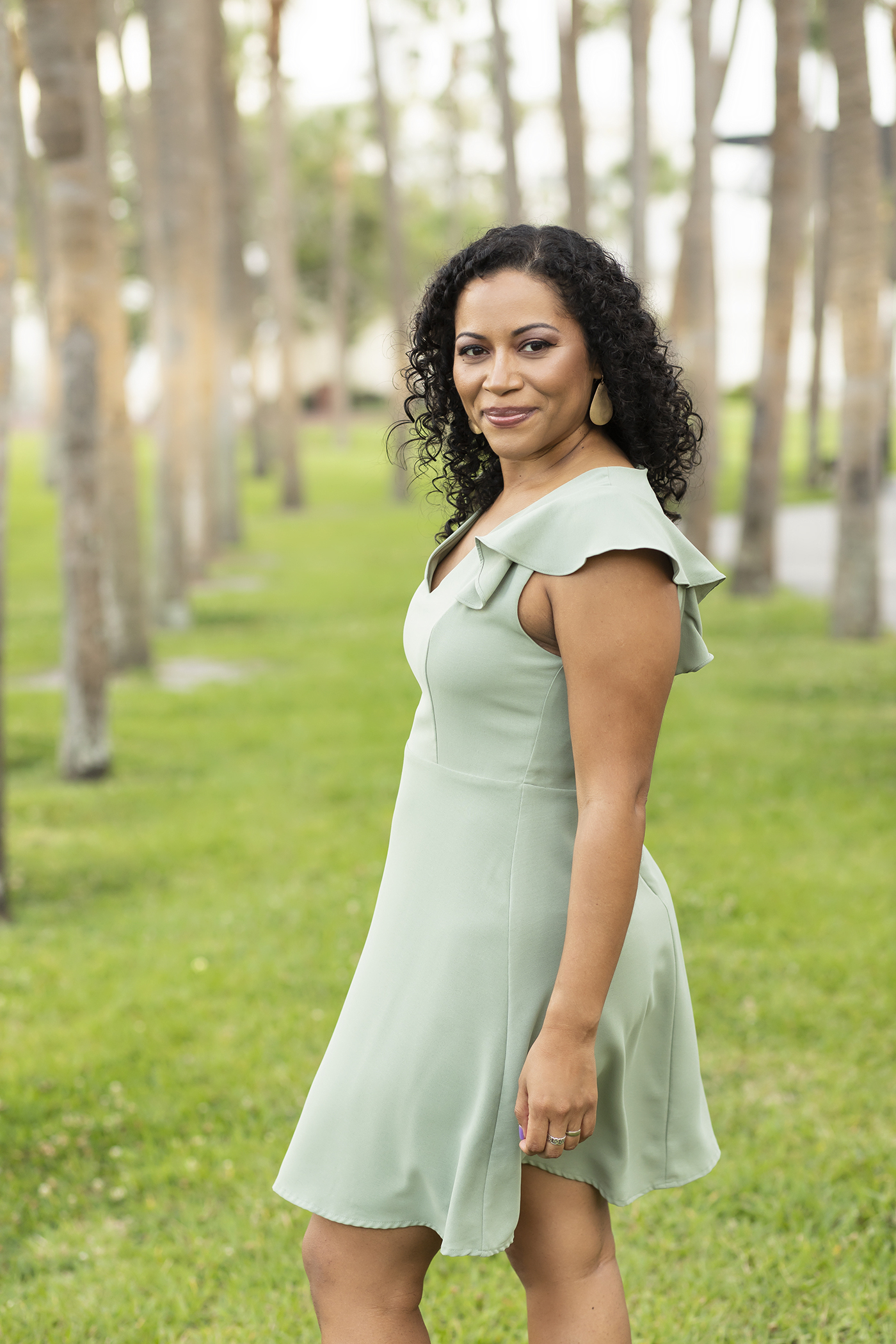
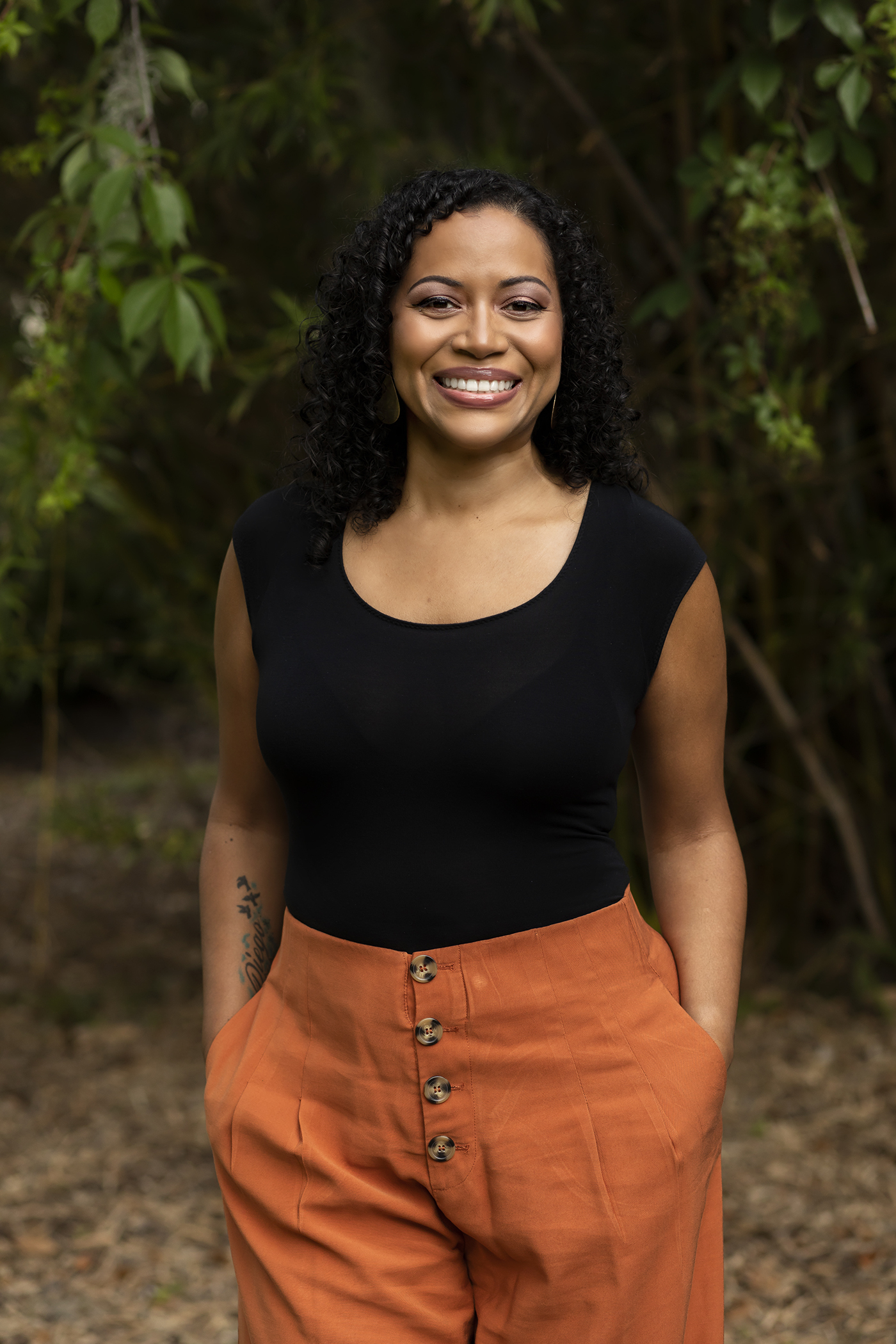
Last year I had a photo session because I wanted to start using my curly hair in professional headshots instead of the previous headshots with straighten hair. It was liberating and I love how the photos turned. I also did some casual photos just cus!






You must be logged in to post a comment.