So, I think by now everybody and their grandma knows that I have earned tenure and promotion to Associate Professor at the University of Tampa. Just in case you missed my Facebook and Twitter post, the Dean’s newsletter, and the global email send to all members of the UT community, here is photographic evidence of the good news!
Tenure and Promotion Letter
All joking aside, I feel proud of this accomplishment. I am immigrant afro-latinx women who started this journey with very little financial support or knowledge about the education system in North America.
Have you ever seen the movie “My Big Fat Greek Wedding”? One of my favorite parts is when the father of bride is sitting in the kitchen table with his daughter and they are discussing who is invited to the wedding. The father feels such pride that his daughter is getting married and he wants to invite every single one of his friends. The daughter wants to keep it intimate and then the father says: “I came to this country with 8 dollars in my pocket!” and then he goes to tell her how hard he worked and the pride feels on everything they have accomplished as a family.
I sometimes feels that as my son gets older, I will say something similar to him: “Diego, your grandparents and I came to North America with one suitcase each and very little money.” This is very true! When I was 19 years old, my parents and I left our home country (Panama) to settle as an immigrant family in Canada. It was not easy. We did not know the culture, we struggled with the language, the cost of living was high, and we knew no-one. It is a really long story with sad memories, struggles, moments of triumphs, and joy. It all let eventually to settling into our new country of residence.
I wrote before about taking a year off from school to work and save money for my education. This happened immediately after I moved to Canada. I worked many jobs, including: the maintenance person (cleaning offices in the Sears headquarter building in downtown Toronto), as a front desk person in several hotels downtown Toronto, and even did a short-term gig as an admin assistant for an administrator in the Toronto School District Board. I feel a little like that Drake song “Started from the bottom”:
“Started from the bottom, now we’re here Started from the bottom, now my whole team fuc*** here”
Sorry when you have affiliations to Toronto, you start quoting Drake! lol
It is true, we started from the bottom now we, as a family, are here. I made two phone calls as soon as I found about T&P. I called my mom in Toronto and I called my dad who is currently Panama. The joy in their voice was everything I needed to hear in that moment. Of course, I celebrated with my husband and son. They have all been part of this journey with me <smiles>.
Something else that I have not mentioned to many, just recently shared in a Twitter post, is that last fall in addition to my tenure & promotion (T&P) dossier, I also submitted an application for sabbatical. At my institution we are allowed to applied for sabbatical the same year you apply for T&P. The sabbatical application was approved both by the sabbatical committee and the Provost. I am very excited for the sabbatical and the projects that I will work on during that time. More on that later this year.
The biggest benefit I get out of FB are the groups that I belong to. They are great for sharing resources and learning from others. Recently, in one of those groups a colleague from a different institution shared a link to the Trends in ID&T Database:
The Trends in ID&T Database is now live! You can access information from more than 80 resources pertaining to the innovations employed and valued in K-12 schools, higher education, and business and industry. We also welcome contributors to help keep the database current. Additionally, please feel free to use this resource within your classes! Find out more at trendsandissues.org
Several weeks ago I was lurking around Twitter and came across tweets that mentioned a scholar. Someone had created a hashtag and asked others to share their memories related to this scholar (and to include the hashtag in the tweets). I was curious to know who this person was and why people in Twitter were sharing these stories. I quickly learned that the name of the scholar was Dr. Erik Olin Wright. After following a few twitter threads, I found out that he was very ill and the tweets from others were a way to honor what he had done as a scholar, advisor, and as a person. In the mist of the different Twitter posts, I came across a link to his online journal (https://www.caringbridge.org/visit/erikolinwright/journal). In it, Dr. Wright was documenting his illness and life after his cancer diagnosis. The very first post that I read, in his journal, was titled “Strange State of Existence” posted on Jan 5th in which he discussed having three weeks to live. This is a portion of Dr. Wright’s post on Jan 5th:
After reading his initial post, I continued to silently follow his journey. Every couple of days, I would click on the link and read his new entries. One of the most emotional and wonderful parts of the journal were the comments left by hundred of individuals who had been touched by Dr. Wright in one way or another. This is just one of hundreds of comments shared in his journal:
If you did not clicked on the link to the online journal, I am sad to share that Dr. Wright passed away on Jan. 23. Reading his journal and the comments made by others has made me reflect tremendously.
The reality that we have a limited time in this planet.
The reality that as scholars the impact of our work goes far beyond metrics that are often used to rank, classify us, or give us “status.”
The beauty of Dr. Wright’s thoughts and humanness in his journal, as well as, the comments by others reminded me that there are still individuals who are genuine, sincere, and candid.
I hope that others find his online journal and continue to read it.
TRAVEL COURSE ALERT! Prof. Merrie Tankersley will be leading a group of students to study abroad in Belgium next May 2019. Dr. Enilda Romero-Hall will participate as a assistant coordinator. This program is open to ALL UT students. The program includes potential side trips Ghent (Belgium) & Amsterdam (Netherlands)! For info on dates and cost, please see flyer. Also, feel free to email us. Never too early to start planning for next year 🇧🇪 ✈️
I feel like I have neglected my blog a bit this summer but I have to be honest it has been a busy summer (just like every summer — this is starting be a trend in my life). Anywho, this post in going to be nice, sweet, and short post because its going live today (enough of neglecting my blog).
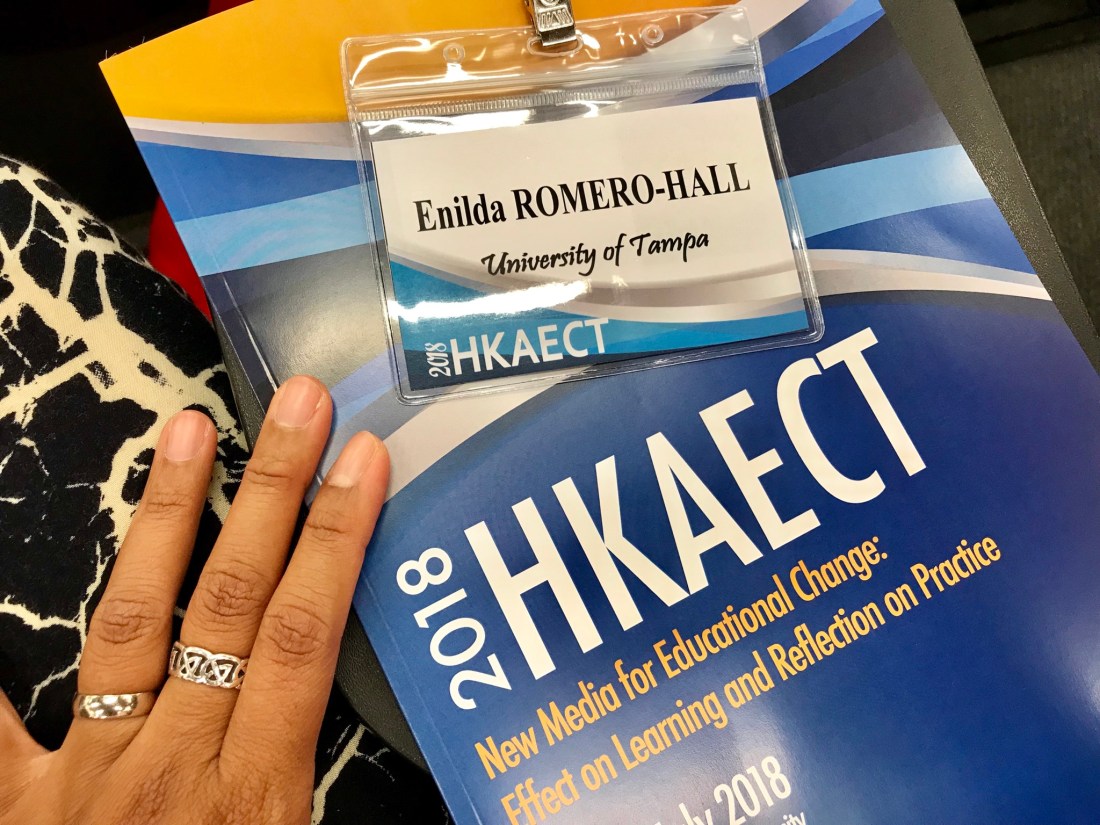
I attended the Hong Kong AECT conference a few weeks ago. It was amazing! I mean this very honestly. I like learning from others and connecting with different people. I know for a fact that I will experience this (learning from others and connecting with colleagues) at the conferences that I attend regularly, AERA and AECT (this is why I go back to those conferences every year). But I also like to put myself in uncomfortable situations that force me to talk and meet people who I have never connected with in the past. So I made a promise to myself that I would aim to attend a conference that I have never attended before because: a) I want to know what others, who are outside my network, are researching and b) because I think it will expose me to topics that are new to me.
With this in mind, last year I attended the Social Media and Society conference in Toronto which by the way was an absolutely fantastic experience (if I had the budget, the time, and the energy, I would have gone to Copenhagen this year — where the conference was held — and then to Hong Kong to attend HKAECT). This year, I decided to attend HKAECT18 conference. I saw that a friend and colleague attended last year (Dr. Ana Paula Correia) so I reached out to her to ask about her experience. I also saw that the theme of the conference which aligned well with my research interested so I submitted a conference proposal. It was accepted and a few months later I was on a plane to Hong Kong.
I wish I could put into this blog everything that I experienced and the topics we discussed but since I have other things I should be writing, I am instead going to share the link to conference program: http://www.hkaect.org/hkaect2018/programme.html (some
A few things I do want to mention:
All sessions were well attended and we had some really good discussions about the topics presented
Presenters were prepared, addressed questions, and engaged with the audience
There were several social aspects to the conference that allowed us to continue conversations outside the presentation rooms in a more informal manner (coffee breaks, lunch, and dinner)
Final thoughts and message from our official study abroad blogger: Marquis Holley. Love how Marquis captured complete and totally random moments, objects, scenes, and people from our study abroad experience in his photos. I think his writing and images show his background in communication and instructional design. It fills my heart with joy to know that this short experience will have a lasting effect in him as a participant in the program.
It’s hard to believe, but this week will mark two weeks since we’ve all returned from Switzerland. What a journey it was. Here are a few more images to provide a closure of sorts for our trip. We’re truly thankful for you following us, as well as your commentary. Please know that education was the reason we as students decided to study abroad, and we learned more than we could imagine on this trip. Special thanks to the University of Tampa for allowing this trip to take place. Furthermore, the Instructors that accompanied us during this trip are to be commended. Much appreciation to Mr. Frederic Palazy, CIS representative, as a true help and guide during our stay here. And to all of the teachers, students, administrators, and people we met on this trip, much love and gratitude to you for making it one to remember for a lifetime. Once…
The study abroad program to Switzerland was everything that I expected and many things I did not expect. Just for reference on what I am taking about, here is the link to the post with info about the study abroad program: The official flyer: #UTampa Travel Course to Switzerland [Spring 2018]
Jetlag sucks and it is important to take it into consideration. When I do this again, I will plan to have very light activities on the first few days.
It is very different to travel with students that have a high interested on the theme of the program compared to students have some interest. In the group with had a 75% of students with very high interest on the theme of the program. The other 25% were participating mostly for the experience.
The leadership team of this program are very active individuals that had no problem been on-the-go. It can be challenging to accommodate for others who do things like “nap” or are not very active. If you want to participate in this type of programs or recruit students to participant, make them aware that to make the most out of the experience you will be spending very little time in the hotel room posting on Snapchat.
Just like with any group, there are students who tend to be more vocal. Therefore, they tend to drive the direction of the group. It is important to give the other students options or opportunities to voice their opinions/choices.
In making connections or plans to meet with schools, university research groups, or others, it is at times difficult to know how casual or formal the visit will be. Asking for as much information as possible before hand will help give the students context.
Good Times
I cannot say enough about my assistant coordinator for the program: Merrie Tankersley. I already miss her! Having a good traveling partner to bounce ideas will make your study abroad program an amazing experience. Merrie was an absolutely joy to be around. I will miss our time together in Switzerland and I look forward to our experience next year in Belgium.
We organized most of the logistics through a study abroad service provider, CISabroad. As part of that arrangement, we had a on-site representative all the time. We met at the airport in Zurich after arriving in Switzerland, his name is Fred. Fred was honestly the best. He was very resourceful, friendly, and extremely patient.
The weather was just perfect. We would have made the best out of rainy days in Switzerland but I am glad that every day we were blessed with good weather.
Although there were some challenges with group dynamics, I was very happy to see that the five girls in our group grew so close together. They were also very inclusive of our male student. Overall, I am glad we had each of them in the group.
Aside from an strain ankle and a student with a cold, we had no major incidents during the trip. All students were always on time, respectful of the program rules, and participated in all required activities.
Switzerland is a beautiful country (and pretty much that sums it all). Our side trip to France was a treat. I strongly recommend visiting Colmar, France.
I am EXTREMELY thankful to every individual and organization that welcomed us during our visit in Switzerland. I plan to spend a good chunk of my pre-departure time at the Zurich airport writing thank you emails.
I am sure there are other comments I want to write about this experience, but this is all I have for now. Here are some of the pictures I captured:
Almost exactly two-months ago I gave this talk at the TEDxUTampa event hosted and organized by undergraduate University of Tampa students. The video is now uploaded to the TEDx Talks YouTube channel. I am excited to share this in my blog and I welcome constructive feedback (keyword: “constructive”). Also, please feel free to share it with others if you believe in my message:
“Instead of solely focusing on the ‘bad’ or ‘thinking of social media as a waste of time’ it is imperative that we find innovative ways to use and repurpose this online social environments in a manner that is safe, ethical, and beneficial to us.”
If you have 13 minutes to spare, here is the video:
Our publication titled “Social Media Use by Instructional Design Departments” was recently published under ‘early release’ by the Australasian Journal of Educational Technology #openaccess
I am sharing the full-text of my recent talk at the #TEDxUTampa event on February 3rd, 2018 at The University of Tampa campus:
Making Social Media Work for your Educational Advantage
Enilda Romero-Hall, Ph.D.
In the year 2005, I was an undergraduate student living in a small college town in Kansas. My classmates and friends had recently started using this website called Facebook. It was: “ a better version of MySpace,” which I had never used. Of course I started using Facebook, friending others, and posting picture of my social life. It took three years but eventually, I became overwhelmed with Facebook. So, I proceeded to delete my Facebook account.
Dr. Enilda Romero-Hall, TEDxUTampa
A year later, I had moved to a different state and city, started a doctoral degree, and was volunteering as a graduate student at an international conference. I noticed in my interactions with other graduate students that I felt out of the loop. For example: many of my colleagues had participated in a MOOC (massive open online course) about statistical analysis taught by a well known scholar in our field that they found out about through a Facebook group posting. I had never heard of it. At the end of that conference, I really started to wonder if I needed to reconsider my decision and re-join facebook.
It took me about six more months but eventually, I started to use social media AGAIN and made a conscious decision to use it for both personal and professional reasons. Not only did I join Facebook, I also joined other social media platforms with online communities that allow me to exchange information with others, connect with people who have similar interest, and informally learn about the topics that interest me.
Now, let’s fastword to 2018:
Today social media is ingrained in the way our society communicates, for good or bad. There is evidence that the use of social media will continue to grow as applications expand and new ones enter the market in the near future. Users are eager to try applications that offer engaging and unique ways to communicate with others.
I bet many of you are Snapchat, Instagram, and Facebook users?
Well, if you are a Snapchat user, you are one of 166 million daily active users. According to the Pew Research Center, social media adoption in the United States has grown from 5% in 2005 to 69% percent in 2016. This adoption rates are a global trend.
The great majority of social media users access this platforms for informal, social interactions with friends, family, and acquaintances.
However, is not uncommon to see “concerning” headlines and research about social media in the news. For example:
Meghan Markle just quit social media. Here’s why you might want to as well!
Facebook admits that social media can be bad for you!
Social media is changing how we think, and not necessarily for better
Stop over-posting your vacation photos
Because we have all seen pictures of our friends and family in their amazing vacations! Everything just looks so picture perfect. The kind of vacation that you dream of. Just recently I also had a picture perfect vacation. My husband, my two-year old, and I embarked on an adventure to our sunny destination: Cartagena, Colombia. The pictures did not disappoint. But let’s be honest my husband and I were traveling with a two-year old. His behavior was not always picture perfect.
Yes, he had temper tantrums. Yes, he cried. Yes, he was loud when asked to be quiet. He is a two-year old after all!
So to some extend it is true. Social media can be harmful (and affect our mental well being), difficult to manage and overwhelming, too public, distracting, and influence and miss inform us. So I am not here to tell you that it is all rainbows and unicorns, Nor it is doom and gloom. But what I want to share with you is that we have to find ways to positively use this mediums that are not going anywhere, anytime soon. There are a large number of research efforts that hope to better understand and analyze the use of social media for teaching and learning purposes. As an educator and researcher myself, I have experienced and investigated how social media can be used for informal learning purposes.
Since 2013 the graduate students in the program in which I teach have been actively using social media online communities to informally learn more about our field, instructional design. We have both public and private online social communities. In this social media communities students exchange articles, post jobs and internship opportunities, ask questions and seek recommendations, and simply stay connected. Through my research, I found out that this online social media communities have helped keep the conversation going outside of the classroom and as one graduate students mentioned: “Some posts have triggered the students curiosity and in turn has led to exploring different topics and developing skills.”
But this informal learning experiences are not unique to the graduates students in the instructional design and technology program at the University of Tampa. As a knowledge seeker, I wanted to know if graduate students in other institutions of higher education are also using social media online communities to post, share, network, and connect. Here is what I found:
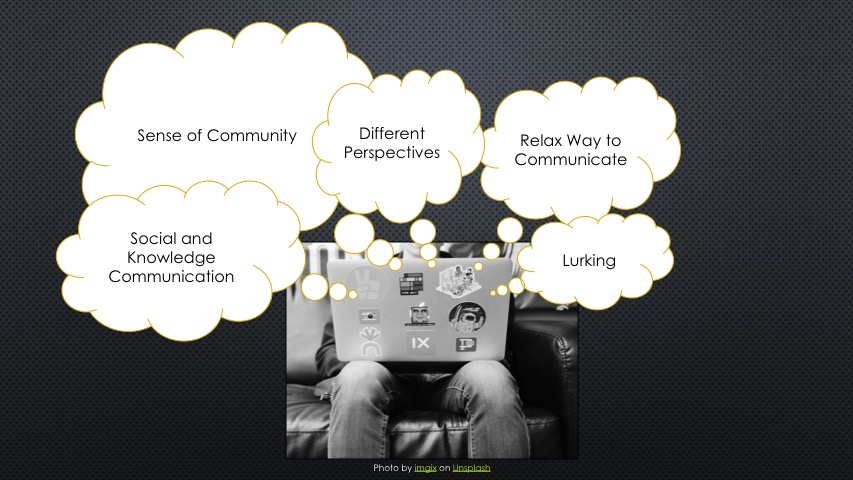
Students in other institutions perceive social media online communities as a quick method to help support social and knowledge communication
This communities help “break the ice” because it provides a relax way to communicate with others since conversations happen in a far more spontaneous and candid way
For students in fully online programs social media groups provided a sense of community… a sense of belonging…
To me what was really striking was that not only did students in this social media online communities appreciate sharing with others who have similar interest but most importantly they participated and valued the interactions with others who shared a different perspective because it challenged their views and allowed them to reflect, rethink, and in some instances re-shape their of own knowledge.
Of course, not all students are quick to post and share their thoughts with the world or their online communities. What I found is that some students enjoy lurking around and quietly participating while reading and consuming information provided by others.
So you may be wondering, why is this important? Why is it important for me to invest my time to listen to this lady talk about informal learning in social media communities?
Because, instead of solely focusing on the “bad” or “thinking of social media as a waste of time” it is imperative that we find innovative ways to use and repurpose this online social environments in a manner that is safe, ethical, and beneficial to us.
And how can you do that?
Become a self-directed learner. Use social media to gather information about trends related to your field or area of interest:What are new and emergent topics in your field?Who are leaders in your field that you should follow?
Where can you find rigours research related to your field of study?
Use social media to connect with individuals outside your networkIt is good to connect with others who have the same ideas as youBut it is also good to breakout of your network because this interaction can lead to innovation
What it boils down to: using social media to engage in transformational learning opportunities in which you:Engage in critical reflectionEngage in discourse
Take action to transform your frame of reference
Don’t get me wrong! I am not saying “stop posting your favorite funny cat videos and memes” or “stop sharing selfies of yourself.” I am also not saying that we need to overlook the challenges that social media present for our social, mental, and physical well-being. We absolutely need to find ways to deal with this challenges.
What I am saying is that there are other ways in which we can enrich social media environments. There are educational aspects that we should consider. We, as users, have the power to control: what we post, when we post, who we interact with, and how we interact with others. You cannot rely on social media developers to provide healthy ways to use this platforms. It is our responsibility to make it work for us!


 After reading his initial post, I continued to silently follow his journey. Every couple of days, I would click on the link and read his new entries. One of the most emotional and wonderful parts of the journal were the comments left by hundred of individuals who had been touched by Dr. Wright in one way or another. This is just one of hundreds of comments shared in his journal: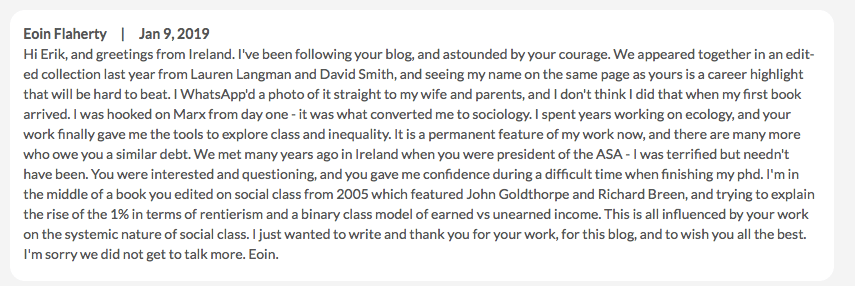




 Design Goodiness
You must be logged in to post a comment.