Inside “Learning Designers in Context”: Chapter 3

Lorena in a Global Corporation

Abstract:

Lorena, based in Puebla, Mexico has cultivated a career in graphic design but emphasizing functionality over aesthetics. Her professional journey began in advertising and marketing, designing materials for clothing and sportswear brands. Seeking growth, she transitioned to PROVIDENT, where she leads an instructional design team comprising instructional designers, multimedia specialists, and graphic designers.

My role is focused on revisions. I get to ask: Why don’t we do this differently? I tend to question a lot: Why did you choose this material? Why did you choose this resource? Why a video? Or, did you consider the target audience? So, that’s basically my role right now. The search for the best solutions for the project to meet the learning objective. 

As a team lead, Lorena manages project distribution, quality assurance, and workload balance while revising materials to meet learning objectives. Key competencies highlighted by Lorena in her interview include ADDIE framework expertise, hybrid/online format design, multimedia skills, and e-learning tools proficiency. Cultural adaptability and behavioral traits like humility and courage are also vital for addressing unique instructional design challenges.

I think that also something I look for and we look at a lot in the team is humility. Because humility allows you to know and understand that you don’t know everything, that you should always keep yourself in a constant search for learning. That, not because you already have master’s degrees or diplomas, you already know everything. 

Romero-Hall, E. (2026). Learning Designers in Context: Examining Practices Across the Global South. Routledge. https://doi.org/10.4324/9781003270591

Inside “Learning Designers in Context”: Chapter 2

Emilia in an International Financial Institution

Abstract:

Emilia, a learning design professional based in Chile and Spain, who brings a wealth of expertise to the field, supported by her academic achievements, including master’s degrees in instructional design and e-learning design. Her career spans diverse sectors such as mining, banking, energy, and public administration, where she has developed online training programs.

For me, the key to success [as a learning designer] consists of earning the client’s trust so that they let you do what you do best. I would tell people who want to get involved in this field to learn the instructional design process and to start with the basics, do not skip stages. I would recommend that the last factor that they consider is technology and for them to have a big toolbox of theories.

Emilia emphasizes the integration of instructional design theory with project management skills, advocating for tools like Gantt charts and critical path methods to enhance efficiency. She highlights the importance of evidence-based practices and clear communication to ensure meaningful design processes. Emilia also underscores the need for competencies in development, graphic production, and user experience design, aligning with research that stresses the interdisciplinary nature of effective e-learning. Additionally, she advocates for ethical decision-making in instructional design to address its value-laden nature. Her insights provide valuable guidance for learning designers navigating complex organizational contexts.

Romero-Hall, E. (2026). Learning Designers in Context: Examining Practices Across the Global South. Routledge. https://doi.org/10.4324/9781003270591

“Learning Designers in Context” is now published!

 I wanted to pass along that my latest book is now published and available!

Learning Designers in Context: Examining Practice Across the Global South examines learning design across professional sectors, local cultures, and geographic regions in the Global South, addressing the ways in which practitioners effectively draw on the knowledge, skills, and resources available to them. The book explores design and implementation in higher education, corporate, non-profit, and government sectors while attending to urgent cultural and geographic distinctions, these chapters vividly illustrate the roles, challenges, and opportunities of learning designers’ use in real-world settings home to specific demographics, traditions, socioeconomic parameters, and policy orientations. 

For more information about the book, and to order a copy (exam copies available), please visit: Learning Designers in Context (currently at a 20% discount). This file offers a brief sample of the book, including the table of contents and the concluding chapter: Book Sample including Table of Content and Chapter 15.

Please feel free to share with anyone who may find it useful.

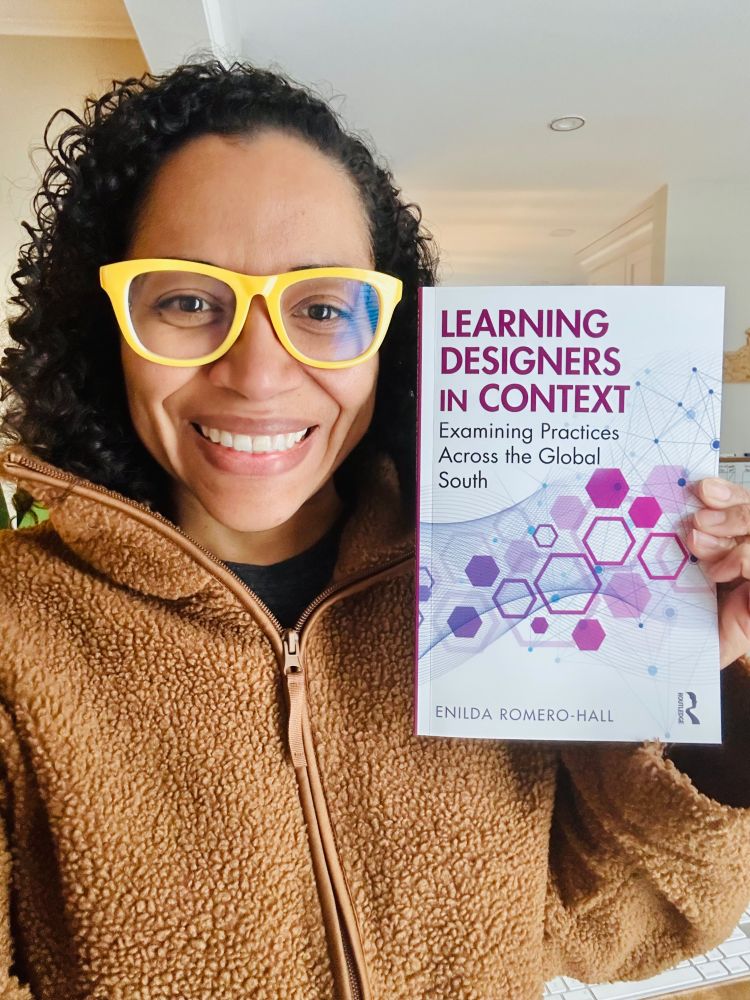
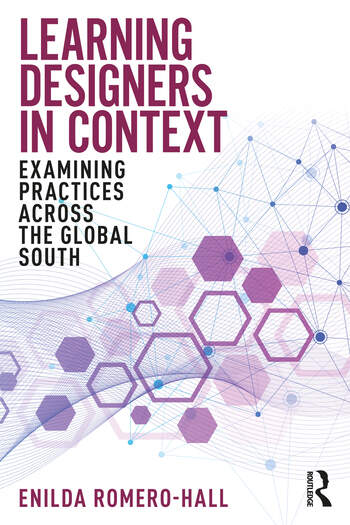
A smiling person with curly hair and bright yellow glasses holds up a book titled Learning Designers in Context: Examining Practices Across the Global South by Enilda Romero-Hall. The person is wearing a brown fleece jacket and standing indoors. The book cover features purple and pink hexagonal graphics on a white background.

The acknowledgement

Five years ago, I embarked on this book writing journey. I had the idea to write this book even before my previous book “Research Methods on Learning, Design, and Technology” was published in October 2020. The email I sent to the publisher on July 17, 2020 read:

I have an idea for a book project and I am wondering if I could chat with you to discuss it. I want to know if this is a topic that would be considered before working on the book proposal

I knew exactly what I wanted to write. I was inspired by the findings of a book chapter (titled: “Educational Technologists in Latin America and the Caribbean: Perceived Importance of Competencies for Practice”) that I co-authored with my former graduate students: Leonor Adams, Erika Petersen, and Adriana Viana. In the process of disseminating the survey for data collection we came across pockets of learning designers throughout Latin America and the Caribbean. It made me wonder how much we had yet to learn from learning designers in other parts of the world and the context of their practice. 

I would like to express my gratitude to the learning designers who took the time to meet with me and share their journeys into learning design practice. Your bravery and sincerity are truly appreciated. Your willingness to open up about your experiences, challenges, and successes has provided invaluable insights that will undoubtedly enrich the field of learning design. Your contributions have not only enhanced this work but also inspired me personally. Thank you for your dedication and for being a source of inspiration to others in the profession. 

I am beyond grateful for the support of McFadden Hall for cheering me on throughout this process, brainstorming with me when I needed a voice of reason, and holding my hand when I just wanted to give up. 

Thank you to the University of Tennessee Knoxville for providing resources and funds, which were instrumental in facilitating various aspects of this book project.

Making it through every step (i.e., writing a proposal, submitting the IRB, conducting the interviews, formatting, transcribing, translating, editing the chapters, writing, and organizing) seemed like a massive ordeal while leaving through changes in my personal and professional life. I am so incredibly thankful for those who have, in many ways, inspired and encouraged me without even knowing it. Gratitude!

“Learning Designers in Context” Now Available for Pre-Order

I do not know how many people actually read this blog, but I figured I would go ahead and share that “Learning Designers in Context” is now available for pre-order.

It also is discounted right now, when you order it directly from the publisher: Pre-Order Here

The book is scheduled for release December 5th, 2025. Copies of the book will be shipped after the released date.

I have previously published two edited books (i.e., Research Methods in Learning Design and Technology, Feminist Pedagogy for Teaching Online) and it honestly feels so different promoting a solo-authored book! In previous instances, I wanted to recognized and disseminate their work of my colleagues who had their work in the edited books, so promoting those books felt easy! However, having to promote my solo-authored book is so hard. I feel like my introverted side all of a sudden takes over!

I also wanted to add that if anyone would like to get a copy of the book, feel free to send me an email. I am happy to share a PDF.