The Last Class

Wednesday, April 20th was my last class at The University of Tampa.

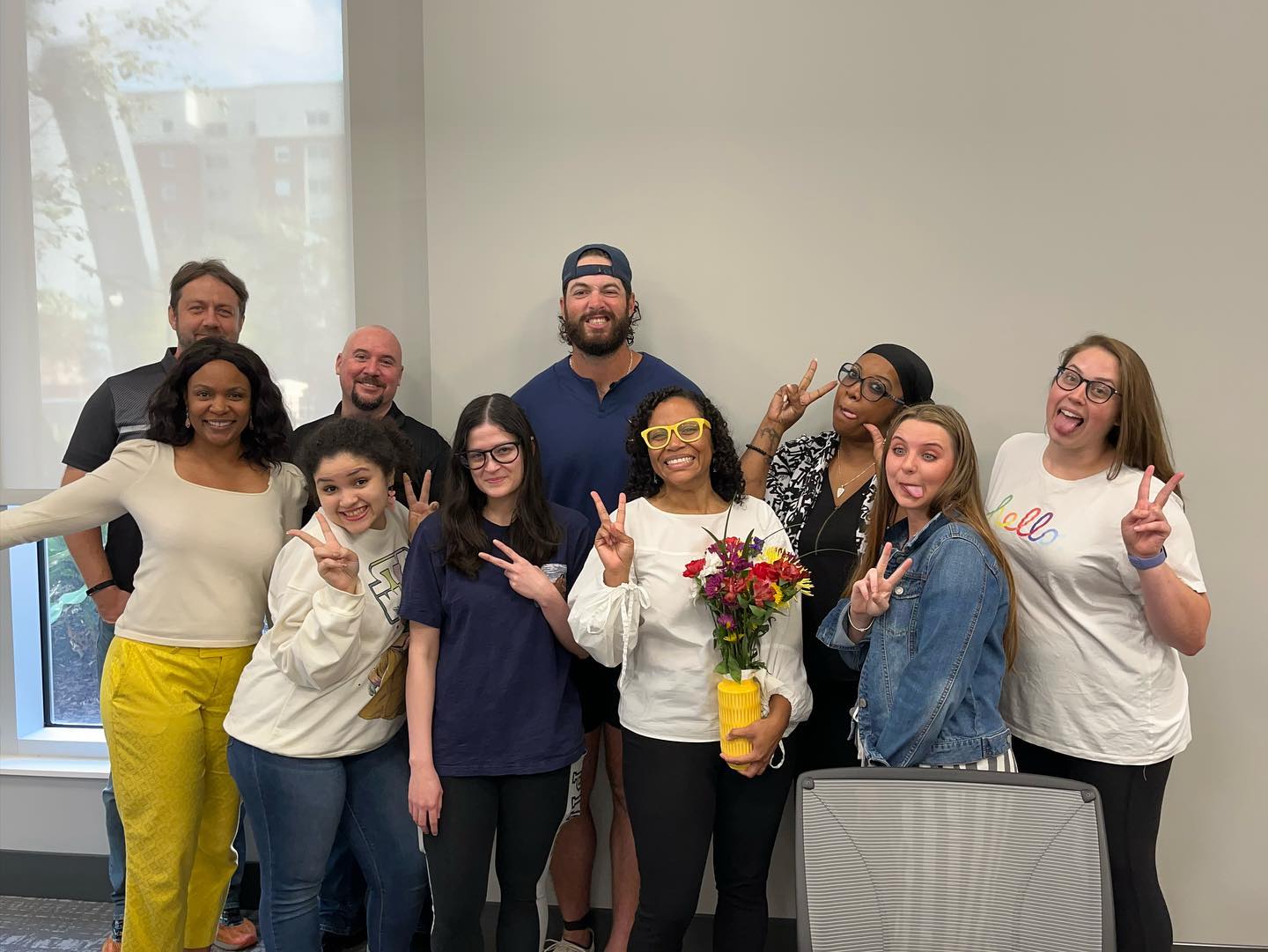
I did not know how my graduate students would respond to my resignation. I was nervous but determined to have a good end of the semester session. As I turned the corner and entered the classroom I was greeted with a surprise farewell party. I honestly felt like in the Grinch when his “heart grew three sizes.”

Their gesture was genuine and sincere. I was speechless. It just feels so amazing to know that they have my back no matter what, when, or where I am.

A few days later I posted the photos from that day in the social media of the program and even though it was not a direct message stating my resignation, they knew. The outpour of unexpected text messages and emails of support just filled my heart with love.

Thank you. To my dear students (current and former) I wish I could find better words but all I can say is thank you for letting me be part of your journey. You have made the last 9 years at The University of Tampa amazing! Cheers to New Beginnings 🥂 – Dr. Enilda Romero-Hall”

The On-Campus Interviews

After 9 years, this spring 2022, I had two on-campus interviews. One was a virtual on-campus interview and the other was an in-person on-campus interview. I want to start by saying that both groups of search committee members were amazing. In addition to the on-campus interviews, I also had two additional Zoom interviews (with other universities that did not lead to an on campus interview). Overall, great experiences with all of the search committees.

I am also here to tell you that the on-campus interview (virtual or in-person) are honestly so much work for the search committee members. Perhaps it is because I have served in a few search committees myself that I feel a great deal of empathy for those who were inviting me for interviews. I know it takes a lot of email, coordination of schedules, time, and energy. So huge thanks to everyone that takes the time to participate in a search committees and give your candidates a good experience. I consider myself lucky during this 2021-2022 job search period, I was treated with a great deal of respect.

During the virtual on campus interview, the committee divided the search into two days and that was really nice. It was an afternoon and then the following morning. It was enough time in front the computer to give the best of me, but not too long that I was Zoomed out. It was also nice that break time was incorporated in between meetings.

The on campus interview was with The University of Tennessee Knoxville (where I accepted an offer) and I have to be honest one of the highlights was flying over the Smoky Mountains on my way to Knoxville. The interview was a dinner (the day of arrival) followed by a day of meetings and a research talk. I also decided to stay an additional day to see the different neighbors and learn more about the area. I will share more in a future post about my decision to accept the offer at University of Tennessee Knoxville, but I am just going to say that I am very excited and happy!

Guest what? Even after 9 years I still followed the advice I gave back in 2013: https://enildaromero.com/2013/07/

These are a few snapshots from the UT Knoxville on-campus interview:

I attended my first in-person conference: #NSEE 2021

This past week I attended my first in person conference since February 2020. It was the Annual Conference of the National Society for Experiential Education. Back in early Summer, when I received the email from the Center for Teaching and Learning about attending the conference I felt good with attending the conference. Florida at that time was doing better with the number of COVID-19 cases but that quickly changed and I was starting to become hesitant about attending the conference. Thankfully the numbers are starting to decline after a massive spike due to the Delta variant. Another encouraging aspect was that the conference had a mask mandate for all attendees. It was sent out via email several times prior to the conference. It was also nice that the conference was in Orlando so if I didn’t feel comfortable with the COVID-19 measures, I could drive home in 45 minutes. Thankfully after I walked into the keynote session I immediately noticed that everyone was wearing their masks and wearing them properly. The conference did include a lunch but I didn’t attend because I didn’t feel comfortable attending this event so I just ordered some UBER eats.

The conference this year had an overall theme focused on social justice in experiential education. My first session was the keynote by Dr. Raja Gopal Bhattar (they/them/theirs) on Tuesday morning. As stated in the website of the conference: “Dr. Bhattar is a nationally recognized higher education leader, advocate, consultant and author. Raja will address how effective experiential learning requires intentionality and clear understanding of outcomes for our communities. Through storytelling and reflections, this keynote will offer insights and strategies on how experiential education leaders can incorporate equity, inclusion and belonging in all aspects of our work.” I loved the keynote speaker! I like it when keynote speakers make me reflect and this was a perfect example of this. Some of the questions I had to think about white listening to keynote speaker:

  • How do we show up?
  • Identity versus perception?
  • What is our role in upholding/disruptive inequitable systems?
  • How our students receive us?
  • Whose perspective is not on the table?
  • How do societal systems enhance or inhibit student success on campus?

We also had to do an identity grid that helps us reflect on “how often do we think about who we are beyond our titles? ”

Identity grid.
Identity Grid at NSEE 2021

Other sessions that I really enjoyed were:

  • Social Justice and Antiracism in Career Education and Experiential Education: Session discussed a process for creating a Call to Action with accountability measures, equity-oriented course syllabi, and a 5-step model to consider in your own work. This is a wonderful resources shared during the session: https://tinyurl.com/4j2tmxaw. This resources were used to create the Social Justice and Career Education infographic. Please see image below.
  • Providing career readiness support to female students in male dominant industries: This was a nice round table session focused on different kind of events that staff and faculty can use to create opportunities for networking, grow , and support for female students and those who identify as woman.
  • Using immersive virtual reality in higher education to facilitate authentic learning experiences: This was a very introductory session into VR and how a university had employed VR experiences into the curriculum to provide learning experiences related to manufacturing at the start of the pandemic in lieu of in person field trips. We got an opportunity to brainstorm ideas for our own curriculum.
  • Learner-centric virtual exchanges: No travel, no problem: This session related to a virtual global challenge that an institution took at the beginning of the pandemic in lieu of study abroad programs. As soon someone who has coordinated a study abroad program in the past and who is considering one next Spring I want to think of alternatives in case the pandemic requires me to make a change in plans. This session helped me think about different approaches that I can take virtually.
  • Influencers abroad: Enhancing cross-cultural awareness through social media activities: This session explored leveraging strategically designed social media learning activities to enhance cross-cultural awareness. I thought it was a creative to consider alternative assignments during study abroad experiences. Some of this assignments included: Vlogs, Instagram stories (academic versus personal accounts) every day, Instagram food related posts, and end of a program presentation/reflection.
Social justice and career education infographic

Recent Publications related to Online Teaching and Learning

In this post, as I have done in other posts, I want to share some research that I have co-authored and published so far this year related to online teaching and learning:

The three-tier design process: Streamlined guidelines for designing and developing a course in a learning management system to promote effective learning” You can access this journal article here

This is a collaboration with Weiwei Ji (Instructional Designer at Arkansas Tech University) and Pauline Salim Muljana (Doctoral Candidate at Old Dominion University). It is a design framework supported by research-based evidence and influenced by the instructional design practice of WeiWei (Will) and his experience as an instructional designer. Of course, it is also supported by the knowledge, skills, and experience of Pauline and myself. As we state in the abstract: “We propose a set of guidelines called the Three-Tier Design Process (TTDP), providing a pathway for faculty and other higher-education professionals who intend to design and develop a course in a Learning Management System and to promote learner-centered experiences. This paper includes detailed discussion about each tier of the TTDP, its subcomponents, and an example of its application. The TTDP borrows from existing theories, models, and literature in the instructional design field that focuses on key aspects that help create positive learning experiences. Tier 1 focuses on course design and serves as a foundation for the next two tiers; Tier 2 emphasizes course development; and Tier 3 concentrates on the user-experience considerations. Examples from a real course are additionally provided.” We were invited to write a blog post about the journal article for the Online Learning Research Center. Here is a link to the blog post: https://www.olrc.us/blog/designing-and-developing-courses-in-learning-management-systems-how-do-we-enhance-learners-experiences

“Hybrid flexible instruction: Exploring faculty preparedness” You can access this open access journal article here

I was excited to see this journal article finally published. This journal article is the result of a collaboration with University of Tampa undergraduate elementary education major, Caldeira Ripine. It is a research project supported by the Undergraduate Research and Inquiry Grant from the University of Tampa. The data was collected prior to the COVID-19 pandemic during Fall 2019. As the pandemic started and plans for continuity of instruction were shared by higher education institutions, I knew that the data Caldeira and I had collected needed to get publish as soon as possible. But, due to a number of factors (including lack of childcare) it took a while a to get this out into the review pipeline and of course, then it had to go through the peer review process. In any case, as stated in the abstract: “The aim of this investigation was to survey faculty members on their perceived level of preparedness to design and implement hybrid flexible (HyFlex) instruction. Participants included 121 full- and part-time faculty. Using an electronic survey, faculty members: a) rated their preparedness to engage on different HyFlex instruction competencies, b) shared which pedagogical strategies they felt prepared to use in this instructional modality, and c) listed the resources and support that they felt were needed to successfully implement their course.” The journal article is open access, you are welcome to download, read, and share.

Photo by Samantha Borges on Unsplash

Writing during “Stay at Home” Orders

How much fun was it to write manuscripts during “Stay at Home” orders without childcare? Well if you have not experience this during the last year and half of the COVID-19 pandemic then consider yourself lucky! It is not fun at all. I wrote the following in a reflection I was putting together on what April 2020 was like:


Upon our return to the U.S. we were faced with the news that, due to the pandemic, our childcare center had closed indefinitely. My partner and I had to adjust to working from home while providing childcare for our 4-year-old son. I had to quickly realize that some of the projects that I was hoping to start before the end of my sabbatical were going to be delayed or canceled. The projects that I was planning to complete were going to require a massive amount of focus and dedication. In order to accomplish all our work requirements, my partner and I had to divide our days into three “shifts.” The morning shift (8 am to 1 pm) in which I worked and he would care for our son. The afternoon shift (1 pm – 6 pm) in which my partner worked and I would provide care for our son. The evening shift (6 pm until midnight) in which were are exhausted but aimed to spend time together as a family.”


In April 2020 during a three week period during my “morning shift” I wrote a manuscript for a special issue that was published in the Educational Technology Research and Development (ETR&D) journal. The realization that I was going to have less than the estimated amount of time to write this paper stressed me so much. But I had to channel that stress into getting the work done. During the process of writing the proposal I had gathered and read most of the literature and had put together an outline. Having this things done was a lifesaver! During the three weeks of writing I had to buckle down and eloquently put the literature and my ideas into a document.

I should give a little bit of context: I initially thought I was going to have a month of full-time work hours during a term in which I was on sabbatical. But because of the lack of childcare (due to COVID-19) I actually had three weeks with 4-hours per day (during week days) to write the paper. I do not know how fast others are at writing papers but gosh I am such a tortoise. To make it more interesting, this was a solo-authored publication.

Kind of funny, I can write without problem in a busy cafe with all sorts of background noise. I pretty much wrote all of my dissertation in a Panera a few blocks from my apartment when I lived in Norfolk, VA. But it was so hard to write this paper from home while having my family members’ voices in the background. I remember putting on my headphones and close the door and still every now and then I would still hear their voices and conversations in the background.

I think that been really passionate about the topic I was writing about made a huge difference on how I approached this writing project, despite the hardship endured in the process. I am grateful for Reviewer # 1 and the editors of the special issue for such wonderful and detailed feedback. I truly helped me improve the paper during the R&R submit process. The manuscript was published “online first” this January 2021 and is titled: Current initiatives, barriers, and opportunities for networked learning in Latin America .

This was the first of many experiences like this. Our son stayed home for 6 months while we worked from home without childcare. And, even after he went back to the childcare center, there were other instances in which he has stayed home and we had to maneuver the same dynamics of still completing our work. Having the deadline of special issue submission did add more pressure in this specific instance (shared in this post)! It made it hard for me commit to any special issue submissions for almost a year (hence why I missed out on so many opportunities to submit for COVID-19 related special issues in 2020, sadly)!

Happy Monday everyone!

Your Goals

Unless you are independently wealthy or a master manipulator, you will have to work hard and make sacrifies to achieve your goals. I know to most people this may sound like a pretty obvious statement, but for some reason I get the impression that there are some who think that success just happens overnight. Trust me when I tell you I have made plenty of sacrifices to achieve pretty much everything that I have been able to accomplish including becoming a mother, purchasing materialistics things, and my professional accolades.

Right after I completed my undergraduate degree, I went on to do my master and doctoral degree. I studies non-stop for from my associates degree to my undergraduate to my master and then to my doctoral degree. Yes, I was a professional student for 12 consecutive years of my adult life. This does not include the two previous years of undergraduate studies that I did while I live in Panama (after graduating high school). By the time, I started my masters program, most of my friends (in Canada, the Unites States and Panama) were buying cars, buying houses, getting married, having kids, going on fancy vacations, and affording a lifestyle that I could not live because I was on a graduate student stipend.

But, I had a goal in mind. I knew what I wanted to do with my life. Therefore, I just stayed focus.

Why do I share this? I share this because I see graduate students comparing their journey with the journey of others. Trust me when I tell you that those who made it to the end (who earned their degree) also made sacrifices. You may not see how they worked hard or the sacrifices they made, but as someone who has been there I can honestly tell you it was not easy for them either.

It is also here where I would like to re-share a prior post I wrote called “Failure.” Here is a quote from that post:

“In academic circles, it gets really competitive. Heck, in life people get really competitive. We start looking at what others are doing and assuming that everyone is “doing things,” “going places,” and basically just “living the dream.” But the reality is that we are all working towards our goals and we all have moments of failures. That is just life.”

I would like to modify the last sentence of that quote and say: But the reality is that we are all working towards our goals and we all have moments of failure, sacrifices, and hard work. Stay focus on your goals and what you want to achieve.

By the way, sometimes I need this reminder too.

CFP: Feminist Pedagogy for Teaching Online

The curators of the Feminist Pedagogy for Teaching Online guide (Jacquelyne Thoni Howard, Clare Daniel, Niya Bond, Liv Newman, and myself) are putting together a new edited collection on this topic. A list of potential topics is included in the call.

Please consider submitting a book chapter proposal by July 2nd, 2021. The book will be proposed to the Distance Education series at Athabasca University Press for publication in an open-access format.

For more information about the CFP or to submit a proposal visit: http://tiny.cc/FemTeachOnline

Recent AECT Interactions Post about #FeministPedagogy

I was recently invited to write a post for the newly established AECT Interactions digital publication. I welcomed the opportunity to write about a topic of my choice and was honored to be amongst those invited (which included colleagues who I deeply admired and whose work I value). Since I am starting to explore and write about feminist theories in various ways in my work, I decided that I wanted to write a short practical piece about feminist pedagogy. The lead of this new AECT initiative, Dr. Michael Grant, encourages us to write pieces that serve as a reflection of our own teaching experience and/or research outcomes. It seemed natural to me to write about my own experience embracing feminist pedagogies in my teaching. You can read my published post in AECT Interactions here: How to Embrace Feminist Pedagogies in your Courses

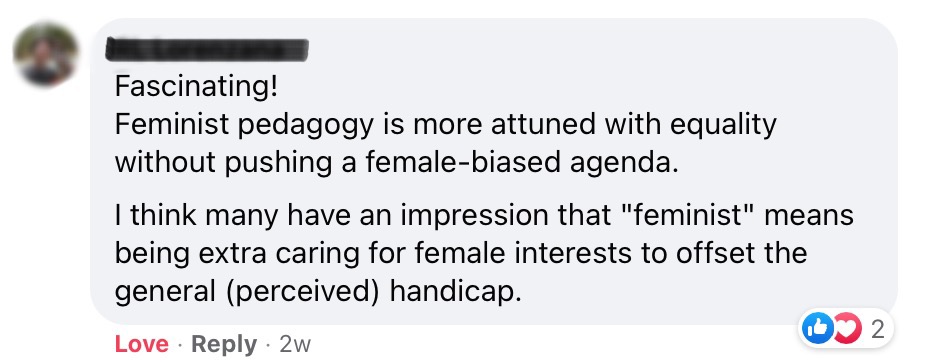
I shared the post widely online in different social media outlets and received fairly positive feedback on the topic and content covered. One of my favorite comments was shared in a Facebook group. It put a smile on my face. Below is a screenshot of the comment.

Facebook Comment’s Screenshot

I know that AECT is looking for authors who would be interested in contributing posts for this new publication. To learn more about AECT Interactions or how to submit a post for publication, click this link: Launching a digital publication to impact educators and learning professionals.

#AERA21: Session Info, iPoster, and Published Paper

It is that time of the year! The American Educational Research Association (AERA) conference is here. However, this year it is a virtual conference. I will miss getting to learn from, connect with, and meet 15,000 other educational researchers from around the world. I don’t want to make this post about the AERA21 virtual setting experience. Perhaps I can write about that topic in a future post. Also, I am sure someone is already collecting tweets for a paper about it! I do want to share our session info, link to our iPoster, and link to the published paper.

Session Information

Presentation Date:
Sunday, April 11, 2021  [10:40 AM ET – 11:40 AM ET

Instructional Technology SIG Poster Session:
Instructional Technology in Higher Education and Corporate Settings

Title of our Presentation:
Critical Competencies for Practice Among Educational Technologists in Latin America and the Caribbean

Event Link: https://aera21am.simcita.net/fast/evt36972

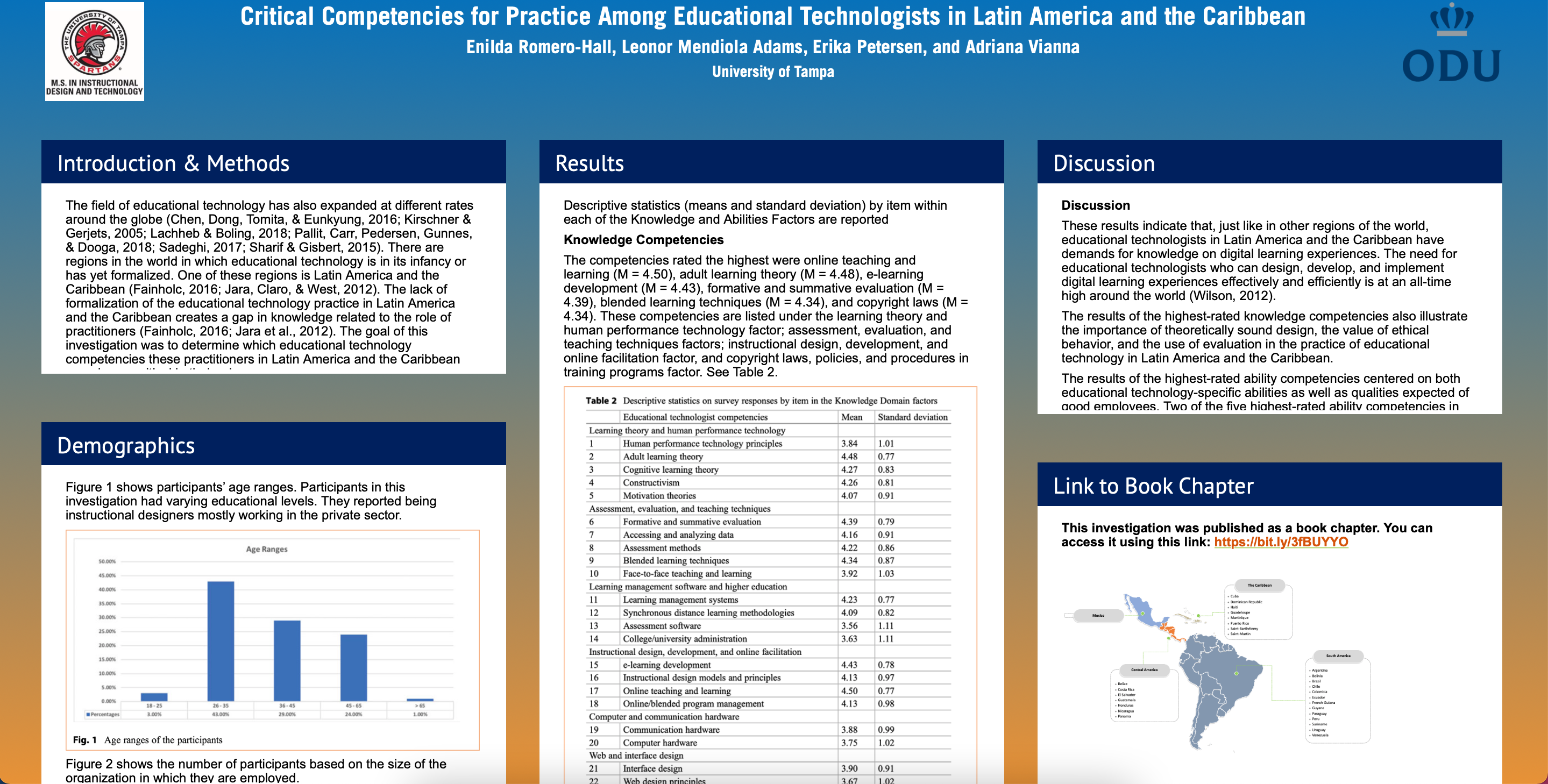
iPoster

Use this link to explore and read our iPoster: https://bit.ly/32236Kc

iPoster Presentation Screenshot

Published Paper

If you want to learn more about this topic. We published a book chapter discussing our research project and findings. This is the citation and link to our book chapter:

Romero-Hall E., Adams L., Petersen E., Vianna A. (2020) Educational Technologists in Latin America and the Caribbean: Perceived Importance of Competencies for Practice. In: Spector M.J., Lockee B.B., Childress M.D. (eds) Learning, Design, and Technology. Springer, Cham. https://doi.org/10.1007/978-3-319-17727-4_169-1

Hope everyone has a good conference and hope to “see” you next year!

Let’s talk about ID Project Management

For the last few years, I have taught an ID Project Management course. I normally teach this course during the Summer term, which is a 6-week intensive session (and I mean truly intensive!). However, the rotation of electives in our program now allows me to teach the course during the regular 14-week term. This meant, that I now have room in the course for guest speakers who share their experiences related to project management in instructional design in various settings.

This semester, I was able to record the guest speaker sessions and share them with the students who are not enrolled in the course. These recordings are now uploaded to YouTube. Apologies in advance if YouTube is unavailable in your area due to Internet restrictions.

Guest Speaker: Camille Dickson-Deane, Ph.D., PMP.


Guest Speaker: Adriana McKinnon


Guest Speaker: Kiran Budhrani