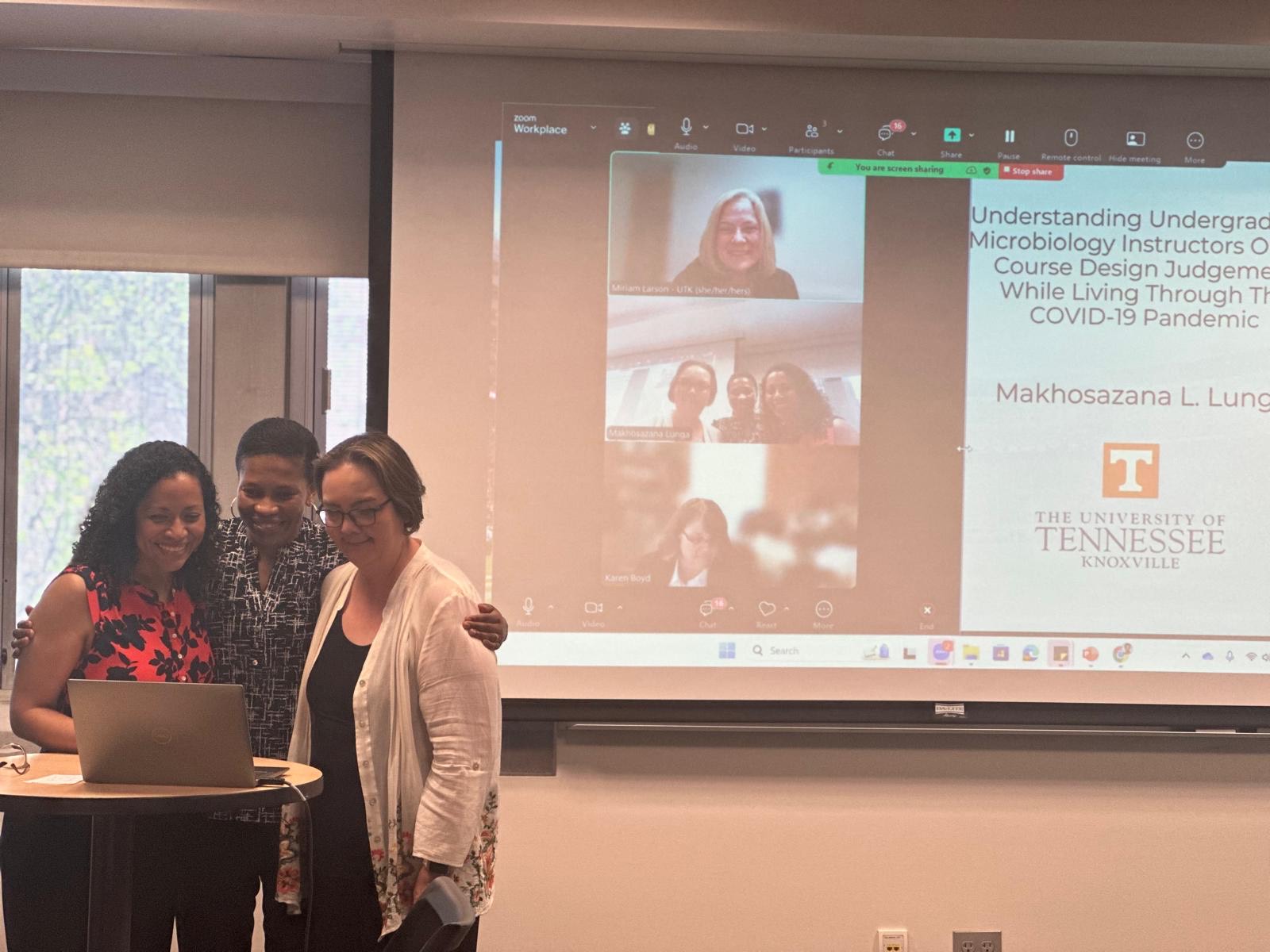
Congratulations to Dr. Afnan Alyanbaawi, completing a Doctor of Philosophy degree in Education with a concentration in Learning Design and Technology at The University of Tennessee Knoxville, who today defended her dissertation titled “Higher Education Faculty Perceptions and Implementation of Mobile Learning in Graduate Education”! #GoVols
Committee Members: Dr. Enilda Romero-Hall (Chair), Dr. Rachel Wong, Dr. Elizabeth MacTavish, Dr. Miriam Larson
Abstract:
Mobile learning (M-Learning) technology has emerged to enhance teaching and learning experiences, especially in higher education. This research aims to investigate graduate faculty perceptions of M-Learning. Also, the study investigates how faculty implement M-Learning in graduate education. There are three main research questions addressed in this dissertation study: (1) what are the graduate faculty perceptions of using M-Learning in graduate learning experiences? (2) Do the graduate faculty perceptions toward M-Learning differ according to demographic (i.e., age, gender, years of teaching experience, and area of expertise)? (3) How are graduate faculty implementing M-Learning in graduate education?
Data were collected using an electronic survey and individual interviews. One-way ANOVA was used to analyze the data from the electronic survey demographic. Inductive thematic analysis was used to analyze the interview data and the open-ended survey questions. The electronic survey results indicate that there are significant differences in the perceptions of M-Learning among graduate faculty based on their (a) age groups and (b) area of expertise. However, there are no significant differences in the perceptions of M-Learning among graduate faculty based on their (a) gender and (b) years of teaching experience. However, based on the electronic survey results, overall faculty are neutral on their perceptions about the use of M-Learning in graduate education. Faculty interviews indicate a wide range of specific views on M-Learning. Some graduate faculty have prior experience with M-Learning, while others have never considered usingit in their teaching. The research concludes that graduate faculty primarily considers M-Learning as hardware or software that can be used to fulfill basic course requirements such as accessing the learning management system (LMS) and the video conferencing software. The results suggest that graduate faculty members are interested in attending M-Learning professional development to better understand how to use M-Learning in graduate education.
Keywords: mobile learning, faculty perceptions, graduate education, implementation.
Huge congrats to Dr. Hongyan Yang, completing a Doctor of Philosophy degree in Education with a concentration in Learning Design and Technology at The University of Tennessee Knoxville, who yesterday defended her dissertation titled “Interactions in Asynchronous Courses: Students Perspectives and Instructors Design Strategies”! #GoVols
Committee members: Dr. Rachel Wong (Chair), Dr. Enilda Romero-Hall, Dr. Jennifer Morrow, Dr. Miriam Larson
Abstract:
Asynchronous learning is becoming increasingly prevalent, making it essential to ensure its effectiveness for the academic success and satisfaction of distance learners. Designing interactive engagement in asynchronous courses is a challenge for many asynchronous instructors. This study aims to investigate students’ perspectives and experiences regarding interactions within asynchronous courses and explore effective instructional design strategies to integrate meaningful interactions to foster students’ learning.
This dissertation research addresses three primary questions: (1) What is the relationship between students’ general satisfaction and diverse types of interactions, including learner-learner, learner-content, learner-instructor, and learner-interface interactions? (2) How do students rank the importance of these interactions? (3) What strategies do instructors use to facilitate these interactions?
Data were collected from 378 students using an online survey, and from 14 experienced asynchronous course instructors through qualitative interviews conducted via Zoom. For the survey quantitative data, correlations and multiple regression analysis were performed using SPSS, while interview qualitative data was analyzed using NVivo with descriptive coding.
The results of this study reveal that learner-content interaction is the strongest predictor of student satisfaction in asynchronous courses, highlighting the importance of high-quality, multimedia-rich, and well-organized course materials. While learner-instructor interaction also significantly influences satisfaction, the study emphasizes the need for timely communication, clear guidance, and a strong instructor presence. Additionally, the findings underscore the role of user-friendly technological platforms and the integration of peer interaction to foster a supportive learning community. Furthermore, the interviews with experienced instructors indicate that strategies such as the use of instructional videos, guided learning paths, and collaborative platforms, etc. are vital for improving learner engagement and success.
The findings suggest that enhancing student satisfaction and learning outcomes in asynchronous learning environments requires a balanced approach that prioritizes content quality, effective instructor support, and accessible technology. These insights contribute to the ongoing development of best practices in asynchronous course design, providing actionable recommendations that educators and instructional designers can implement to optimize the effectiveness of their courses.
This seems like the perfect time to come back to write a blog post again, after recently returning from the 2024 AECT International Convention. I am worried that if I share everything that I want to share, this blog post would be super lengthy. So, I going to do my best to it keep short and sweet!
I first joined AECT in 2009 and that year I attended my first AECT conference. I had ZERO funds to attend the conference but a classmates of mine offered to let me crash in her hotel (at no extra cost) and share her per diem with me (our plan was to live off pizza for a a few days). The organization she worked for was paying for her trip and she wanted to support me. I am never going to forget that. Thank you Dr. Sonya Bland-Williams!
Back to #AECT24.
This year the AECT International Convention was special in many ways. First, the conference was returning to Kansas City. A place that is very special to my heart:
In the spirit of sharing stories, which is the theme of AECT 2024, I thought I would share a short but special story with all of you: Exactly twenty years ago, I embarked in my higher education studies in the United States. I was accepted into an International Business program at Emporia State University in Emporia, KS. I left the safety of home and started my own journey. The first stop on that journey was Kansas City and very specifically this hotel, The Kansas City Marriott Downtown. So, in many ways, getting to do this AECT keynote here, in Kansas City and in this hotel, feels to me like I have come full circle. So, for that I am very thankful!
Also, conferences in Kansas City are wonderful opportunity to meet with my college roommate, Mikelle. There is something about sharing a college dorm with someone else, you either become really close or you may never want to see each other again. Mikelle and I have been friends from the moment we met, 20 years ago! She is such a kind soul! Her and her family were so incredible welcoming of me when I was in college. Mikelle was living in the dorm just for fun, because her family actually lived in our college town. So I was able to spend time with them (her family) regularly!
Another aspect that made this conference so special was that I was attending #AECT24 with my doctoral advisees: Wei Wang, Ashley King, and Yuexin (Jennifer) Duan. We have been working on projects for some time but we were finally able to start sharing some of the findings from our research with the AECT community this year. Wei is a force to be reckoned with! He is making moves as a researcher and a graduate assistant for the Digital Learning team at UTK. This year, Wei and his colleagues from Digital Learning presented “Implementing Generative AI in Practice: Designing Assessments and Learning Activities in Faculty Development Programs“. This work focuses on professional development that Digital Learning has been doing in the UTK campus to engage in conversations with faculty about the use of generative AI in higher education and its implications.
Ashley and Jennifer presented on a “work in progress project”. As a research team, we have been working a on a range of different systematic reviews. The project that Ashley and Jennifer shared related to “small group dynamics in asynchronous online learning”. The presentation primarily focused on the introduction of the topic up until the process of analysis of the journal articles for inclusion in the systematic review. We will continue to move forward with data extraction and the remainder of the process. Also, quick shout to all the members of our team who were not able to attend but have worked with us on this project!
The best way I can describe this experience is that: I am a proud advisor and that I am lucky to work with such an amazing team!
Then there is Dr. Lucy Santos Green! What else do I need to say! Lucy is the mastermind behind this project called “Online Ready”. Long story short, Online Ready is a federally funded project that aims to equips school librarians to deploy effective practices for culturally competent and inclusive K-12 online instruction. Having Lucy at AECT to speak about this project with me, was definitely a highlight! We have been working on this project for the last 3 years virtually and getting to see her and feed off her energy is just so amazing! Here are our slides. Our presentation at AECT 2024 focused on the implementation of Online Ready with school librarian with the goal of receiving feedback during Summer 2023. Online Ready will be available open access for anyone to use and share by next spring! More on this coming soon!
This is getting long! Yikes!
This year, it was such a humbling experience to also be the closing keynote for the conference. When the organizer of AECT 2024, Drs. Tonia Dousay, Tutaleni Asino, andRebecca Reese reach out early this year, I was so incredibly honored! I know that we have a wide range of colleagues who are doing impactful work, so it meant a lot to be considered for this role. What made it even more special was that a dear friend and colleague was also going to be a keynote speaker, Dr. George Veletsianos. George’s keynote, as expected “delivered”! It already had a major impact on my advisees and their career goals. So, I am very grateful for his message!
Technology, Imagination, and Education Futures: Education systems worldwide face profound economic, demographic, political, environmental, and social challenges. Traditionally, our field has responded by either embracing the latest technological advancements or striving to make instruction more effective, efficient, and engaging. However, these approaches are not enough. They are limiting and insufficient. They constrain our imagination and curtail our ability to create better educational futures for ourselves, our students, and our societies. In this talk, I will explore how speculative methods can offer creative, exploratory, and fruitful ways to examine, produce, and rethink the learning environments we are developing and supporting.
As George’s colleague, Dr. Bruna Damiana Heisfeld mentioned: “great minds think alike.” Because both keynote discussed how we can move forward as a field considering ways in which we can humanize learning design research and practice. Here are the slides from my closing keynote and my abstract:
(Re)Igniting Empowered Actions: Over the last few years, we have seen many political, social, and educational shifts that have impacted how we live, work, and learn. We have also experienced a global pandemic that changed us. In many ways we have spent a great deal of time simply surviving. All of these experiences have shaped who we are as individuals, but also as learning designers, educators, and researchers. Today, as we move forward, it is even more important than ever before that we critically reignite our purpose with empowered actions. This talk reflects on why and how we connect with the world around us in intentional empathetic ways that at the core aim to humanize learning design practice and the use of emerging technologies in education. Let’s tap into the power of our stories to share the narratives that often go untold. For good reason, there is a strong focus on the reimagining of our educational futures. Yet, we need to be cognizant that our actions today already shape those visions of tomorrow. Today, equitable and ethical learning design practices and research are not just a “good idea,” they must be the norm. The reality is that efficient, effective, and engaging in not enough to fully capture the socio-cultural context of the world we live in.
Thank you AECT for such a memorable experience!
Also because I always take a million photos: Here you go! Also, thanks to those who shared photos with me!
Every year the College of Education, Health, and Human Services organizes a Graduate Student Research Colloquium. Of course, when the notification for the graduate colloquium was shared with faculty, I encouraged all the Learning, Design, and Technology (LDT) graduate students to submit their research to the colloquium. I was extremely excited to find out that three of our LDT students were accepted to present! Unfortunately one of the students was unable present due to another commitment. Ashley King and Wei Wang were there to share their projects with attendees of the colloquium.
Ashley King is a lecturer at University of Tennessee Knoxville in the College of Business. She is a LDT Ph.D. candidate. I am her advisor and dissertation chair. She is also a research team collaborator! Wei Wang is an LDT first year doctoral student and I serve as his co-advisor (along with Dr. Josh Rosenberg). He recently presented at AERA 2024 in one of the graduate students research-in-progress roundtables!
Session: “Politic Born of Necessity”: Latina and Latinx Feminists Remembering Genealogies, Imagining Futures
Lugones, Maria A. 2003. Peregrinajes/pilgrimages: Theorizing coalitions against multiple oppressions. Lanham, Md.: Rowman and Littlefield. Google Scholar
Session: “Rupturing the White Gaze: Centering Chicana/Latina Feminista Methodologies and Epistemologies in Qualitative Research” Symposium Resources
You are welcome to pre-order it via Amazon. You also can wait until it is released because it will be available open access! As the date gets closers and we find out more information, I will be sharing more about the book. So excited!
I should add that Athabasca University Press has stated that it is possible that the book could be release Fall 2024. More than anything just know that the book is coming either later this year or early 2025 we will have the pleasure of sharing with you!
Today I had the opportunity to participate in a panel presentation at the 2nd Annual XR Symposium organized by the Oak Ridge Enhanced Technology and Training Center (ORETTC). The specific panel that I was invited to join was focus on Diversity, Equity, & Inclusion specifically on Inclusive Technologies related to XR research & development.
The panel addressed the following questions:
What are some new advancements you have seen in regards to diversity and inclusion in XR?
What are some obstacles within XR technologies? What are the long-term consequences if we ignore D&I?
What would you say is the most difficult part of implementing D&I especially in a world that persistently changes?
In order to encourage accessible and inclusive practices within our workplace and everyday lives; how can we authentically address these topics?
Can you share some valuable resources that we should all be aware of?
It was a great conversation! I am specially gratefully for my fellow panelist and the insights shared:
Huge thanks to Mary Lin, Ed.D. (Senior Manager, Knowledge Acquisition and Performance Studies ) and Austin Arnwine (Instructional Technology Lead, Knowledge Acquisition and Performance Studies) for the invite to participate in the panel.
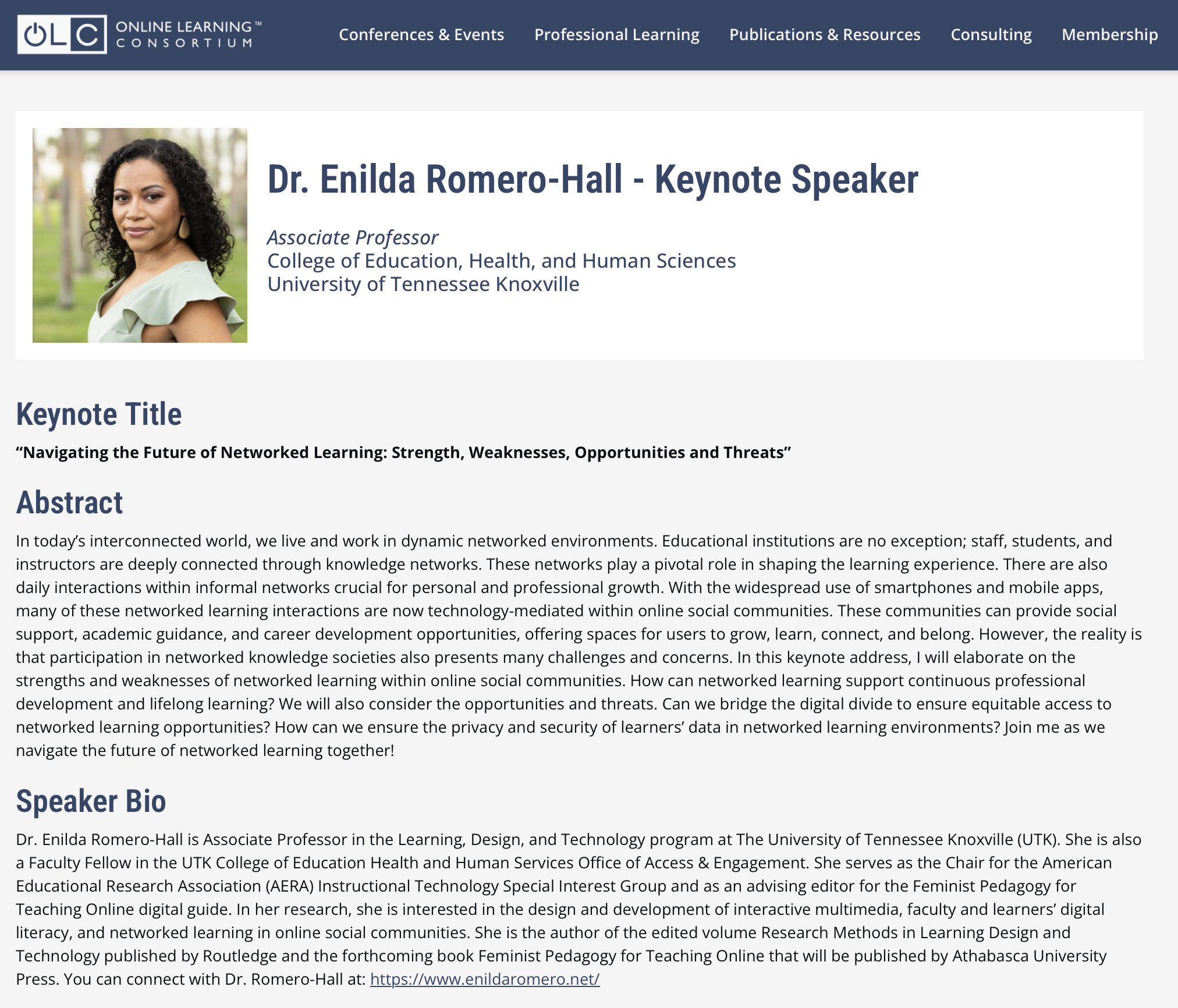
First and foremost, it has been a pleasure serving as the AERA SIG Instructional Technology Program Chair. Huge thanks to everyone who submitted proposals to our SIG. It was very exciting to see the range of topics covered in the proposals submitted. I was also deeply impressed with the quality of the proposal submitted, which made for a difficult peer review process for our reviewers. Speaking of reviewers! I am profoundly grateful for our 94 reviewers who took on the very meaningful tasks of providing feedback and recommending proposals for our SIG Instructional Technology program. Huge thanks to all that have volunteered as Session Chairs, you are a critical component for a smooth conference session! Gratitude!
I can humbly say that we have an amazing AERA 2024 program for the SIG! Each session was carefully designed to ideally create a cohesive line up of presentations. I look forward to meeting you in Philadelphia and to your presentations! I am excited for all of us to engage in academic discourse, professional development, and informal social conversations. See you soon! Go Vols!
Enilda Romero-Hall, Ph.D., Associate Professor, University of Tennessee Knoxville
These quote is a section of the AERA Special Interest Group Instructional Technology Spring 2024 Newsletter recently shared with our members. Below is a copy of the complete AERA Special Interest Group Instructional Technology Spring 2024 Newsletter compiled, formatted, & organized by the 2023-2024 board members of the SIG Instructional Technology:
Last year, I received an invitation from my colleague, Clare Daniel, to present in a panel to discuss the Feminist Pedagogy for Teaching Online digital guide and other scholarly efforts related to the digital guide in person at Tulane University. The invitation to travel to New Orleans was extended to Niya Bond and myself (Clare, Jacque, and Liv live in New Orleans). The goal was for all the five editors of the digital guide to join in the panel.
Fast forward to February 2024, Niya and I travelled to New Orleans for the in-person panel. Meeting my colleagues in-person for the very first time was a joyous occasion. I have been personally interacting and collaborating with the FTPO editors for the last 3 years and we had only met through Zoom. It was so nice to fully interact outside the Zoom software and engage in informal convos that allowed us to learn more about each other personally and professionally.
“We want to acknowledge that this panel discussion is part of a lecture series dedicated to Adele Ramos Salzer (NC ’40). Her interest in academic programs focusing on women’s experiences led to the establishment of the Salzer lecture series. Her donation endowing the series has been generously strengthened through gifts in her memory from her family, friends, and classmates.”
Clare Daniel
During our visit to Tulane, we all got to have an short meeting to discuss panel, have dinner to talk about every under the sun (also, celebrate Clare’s new promotion at Tulane University), and have the panel at the Tulane University’s Newcomb Institute for students, faculty, and staff.
The editors of the FPTO digital guideThe editors of the FPTO after the panel presentation
During the panel we:
Provided a brief explanation of the origins of the digital guide and the idea for the forthcoming book
Shared why and how we expanded our team of editors
Shared a brief description of the forthcoming book
Discussed how and why we expanded the guide to include annotated assignments
Shared an explanation of the blog and the collaborative editing process
Allowed for Q & A
It was really nice to have such a strong presence of students during the panel session. The students were very curious about of opinions on online learning, now past the COVID-19 pandemic. We also had some good questions and conversations with faculty who attended the event. I am very thankful for the invite to participate in this panel. I am also grateful for the opportunity to meet my colleagues in-person for the first-time. Online environments, synchronous and asynchronous, have allowed is the opportunity to genuinely connect and communicate. However, it is always nice to further engage in-person to deeper our understanding of each other (personally & professionally), converse about the future of the digital guide, and discuss upcoming projects.
You must be logged in to post a comment.