Congratulations Dr. Makhosazana Lunga! #GoVols #GBO

Congrats to Dr. Makhosazana (Khosi) Lunga, completing a Doctor of Philosophy degree in Education with a concentration in Learning Design and Technology at The University of Tennessee Knoxville, for successfully defending your dissertation titled “Understanding Undergraduate Microbiology Instructors Online Course Design Judgement while Living Through the COVID-19 Pandemic”! #GoVols
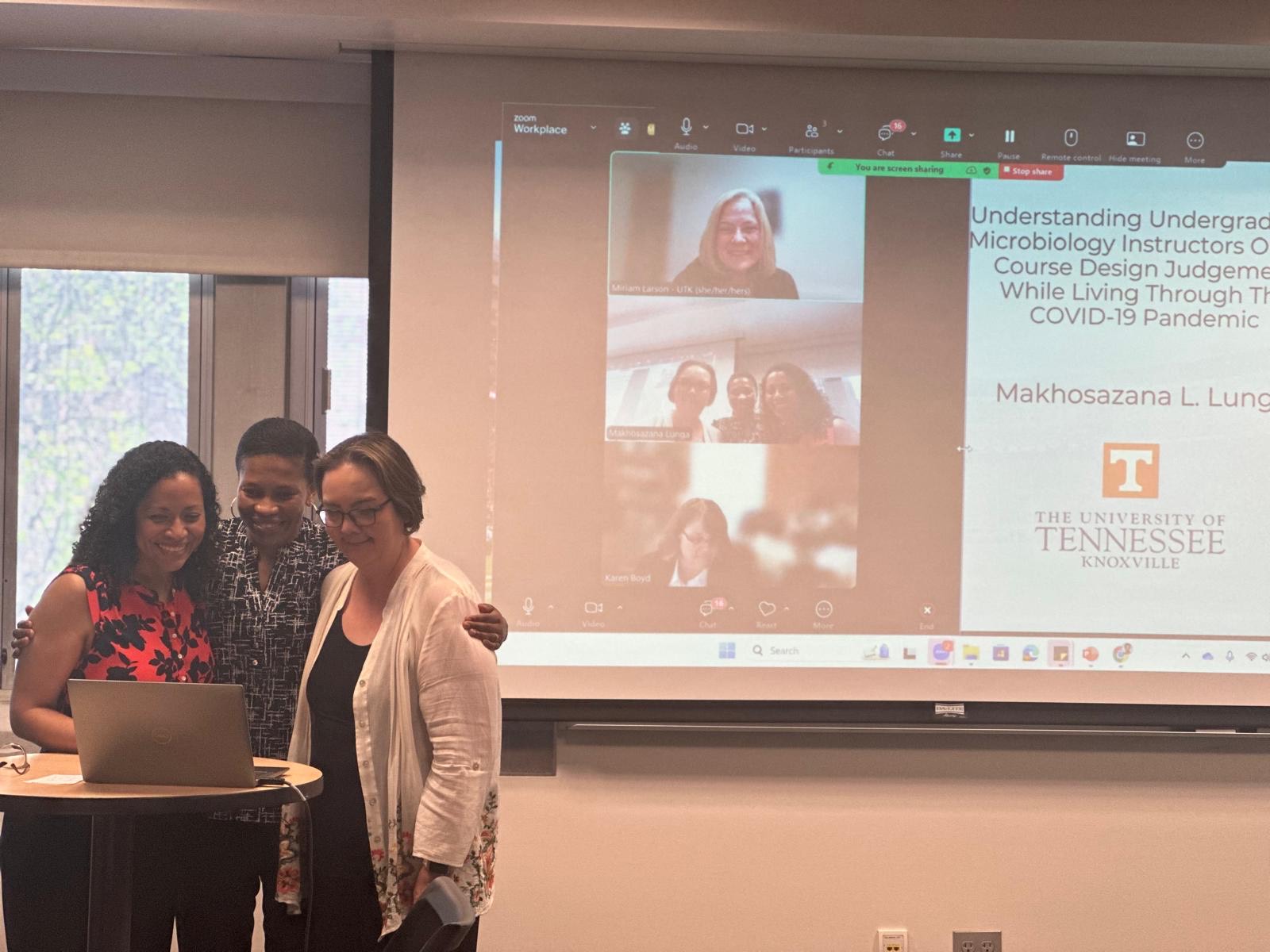
Committee Members: Dr. Lisa Yamagata-Lynch (Chair), Dr. Boyd, Dr. Larson, and Dr. Romero-Hall

Abstract:

This qualitative, descriptive multiple-case study investigates the online teaching experiences of seven undergraduate microbiology instructors at public universities in South Africa and the United States during the COVID-19 pandemic. This study investigated instructors unfamiliar with online course development to (a) describe how they designed online courses during the COVID-19 pandemic, (b) discover what influenced how they designed those courses, and (c) detail why they made the respective design decisions. It leans into the theoretical tenets of social constructivism and follows a multiple case study approach, relying on interviews and document analysis. Instructors were recruited through criterion-based convenience sampling and snowball methods. They are faculty who traditionally taught in-person large-sized microbiology courses prior to the COVID-19 pandemic. They transitioned to an online learning modality during the pandemic. Despite the differences in these countries’ economies and educational systems, the study findings revealed that participant instructors exercised similar overlapping design judgments as they redesigned their courses during the COVID-19 pandemic. Participants indicated that they developed courses within the institution’s learning management systems, integrated open educational resources, and utilized various teaching tools, including digital games. They encouraged students to interact and work in teams, enabling them to co-construct their learning. However, instructors wrestled with balancing many teaching demands against anxious students’ expectations. Instructors also grappled with ways to accommodate diverse students’ needs while promoting equity, diversity, accessibility, and inclusion in an online learning environment. Most notably, there was tension between finding efficient ways to maintain rigor and protect assessment integrity while empathizing with students. As demand for online learning increases, the study’s findings aim to make explicit the connection between design judgment research and practice. The goal of this study is to draw attention to instructors’ unconscious assumptions, behaviors, attitudes, thoughts, experiences, beliefs, culture, goals, and skills that influence design decisions, particularly during disruptive events such as the COVID-19 pandemic. It aims to empower the instructional design community members with awareness and sensitivity to what instructors bring with them to the collaborative design process. 

Keywords: Authentic Learning Environment, Design Decisions, Design Judgments, Online Learning Environment, Social Constructivism Theory

Congratulations Dr. Afnan Alyanbaawi! #GoVols #GBO

It is defense season!

Congratulations to Dr. Afnan Alyanbaawi, completing a Doctor of Philosophy degree in Education with a concentration in Learning Design and Technology at The University of Tennessee Knoxville, who today defended her dissertation titled “Higher Education Faculty Perceptions and Implementation of Mobile Learning in Graduate Education”! #GoVols

Committee Members: Dr. Enilda Romero-Hall (Chair), Dr. Rachel Wong, Dr. Elizabeth MacTavish, Dr. Miriam Larson

Abstract:

Mobile learning (M-Learning) technology has emerged to enhance teaching and learning experiences, especially in higher education. This research aims to investigate graduate faculty perceptions of M-Learning. Also, the study investigates how faculty implement M-Learning in graduate education. There are three main research questions addressed in this dissertation study: (1) what are the graduate faculty perceptions of using M-Learning in graduate learning experiences? (2) Do the graduate faculty perceptions toward M-Learning differ according to demographic (i.e., age, gender, years of teaching experience, and area of expertise)? (3) How are graduate faculty implementing M-Learning in graduate education?

Data were collected using an electronic survey and individual interviews. One-way ANOVA was used to analyze the data from the electronic survey demographic. Inductive thematic analysis was used to analyze the interview data and the open-ended survey questions. The electronic survey results indicate that there are significant differences in the perceptions of M-Learning among graduate faculty based on their (a) age groups and (b) area of expertise. However, there are no significant differences in the perceptions of M-Learning among graduate faculty based on their (a) gender and (b) years of teaching experience. However, based on the electronic survey results, overall faculty are neutral on their perceptions about the use of M-Learning in graduate education. Faculty interviews indicate a wide range of specific views on M-Learning. Some graduate faculty have prior experience with M-Learning, while others have never considered usingit in their teaching. The research concludes that graduate faculty primarily considers M-Learning as hardware or software that can be used to fulfill basic course requirements such as accessing the learning management system (LMS) and the video conferencing software. The results suggest that graduate faculty members are interested in attending M-Learning professional development to better understand how to use M-Learning in graduate education.

Keywords: mobile learning, faculty perceptions, graduate education, implementation. 

The FPTO Editors First In-Person Meeting!

Last year, I received an invitation from my colleague, Clare Daniel, to present in a panel to discuss the Feminist Pedagogy for Teaching Online digital guide and other scholarly efforts related to the digital guide in person at Tulane University. The invitation to travel to New Orleans was extended to Niya Bond and myself (Clare, Jacque, and Liv live in New Orleans). The goal was for all the five editors of the digital guide to join in the panel.

Fast forward to February 2024, Niya and I travelled to New Orleans for the in-person panel. Meeting my colleagues in-person for the very first time was a joyous occasion. I have been personally interacting and collaborating with the FTPO editors for the last 3 years and we had only met through Zoom. It was so nice to fully interact outside the Zoom software and engage in informal convos that allowed us to learn more about each other personally and professionally.

“We want to acknowledge that this panel discussion is part of a lecture series dedicated to Adele Ramos Salzer (NC ’40). Her interest in academic programs focusing on women’s experiences led to the establishment of the Salzer lecture series. Her donation endowing the series has been generously strengthened through gifts in her memory from her family, friends, and classmates.”

Clare Daniel

During our visit to Tulane, we all got to have an short meeting to discuss panel, have dinner to talk about every under the sun (also, celebrate Clare’s new promotion at Tulane University), and have the panel at the Tulane University’s Newcomb Institute for students, faculty, and staff.

The editors of the FPTO digital guide
The editors of the FPTO after the panel presentation

During the panel we:

  • Provided a brief explanation of the origins of the digital guide and the idea for the forthcoming book
  • Shared why and how we expanded our team of editors
  • Shared a brief description of the forthcoming book
  • Discussed how and why we expanded the guide to include annotated assignments
  • Shared an explanation of the blog and the collaborative editing process
  • Allowed for Q & A

It was really nice to have such a strong presence of students during the panel session. The students were very curious about of opinions on online learning, now past the COVID-19 pandemic. We also had some good questions and conversations with faculty who attended the event. I am very thankful for the invite to participate in this panel. I am also grateful for the opportunity to meet my colleagues in-person for the first-time. Online environments, synchronous and asynchronous, have allowed is the opportunity to genuinely connect and communicate. However, it is always nice to further engage in-person to deeper our understanding of each other (personally & professionally), converse about the future of the digital guide, and discuss upcoming projects.