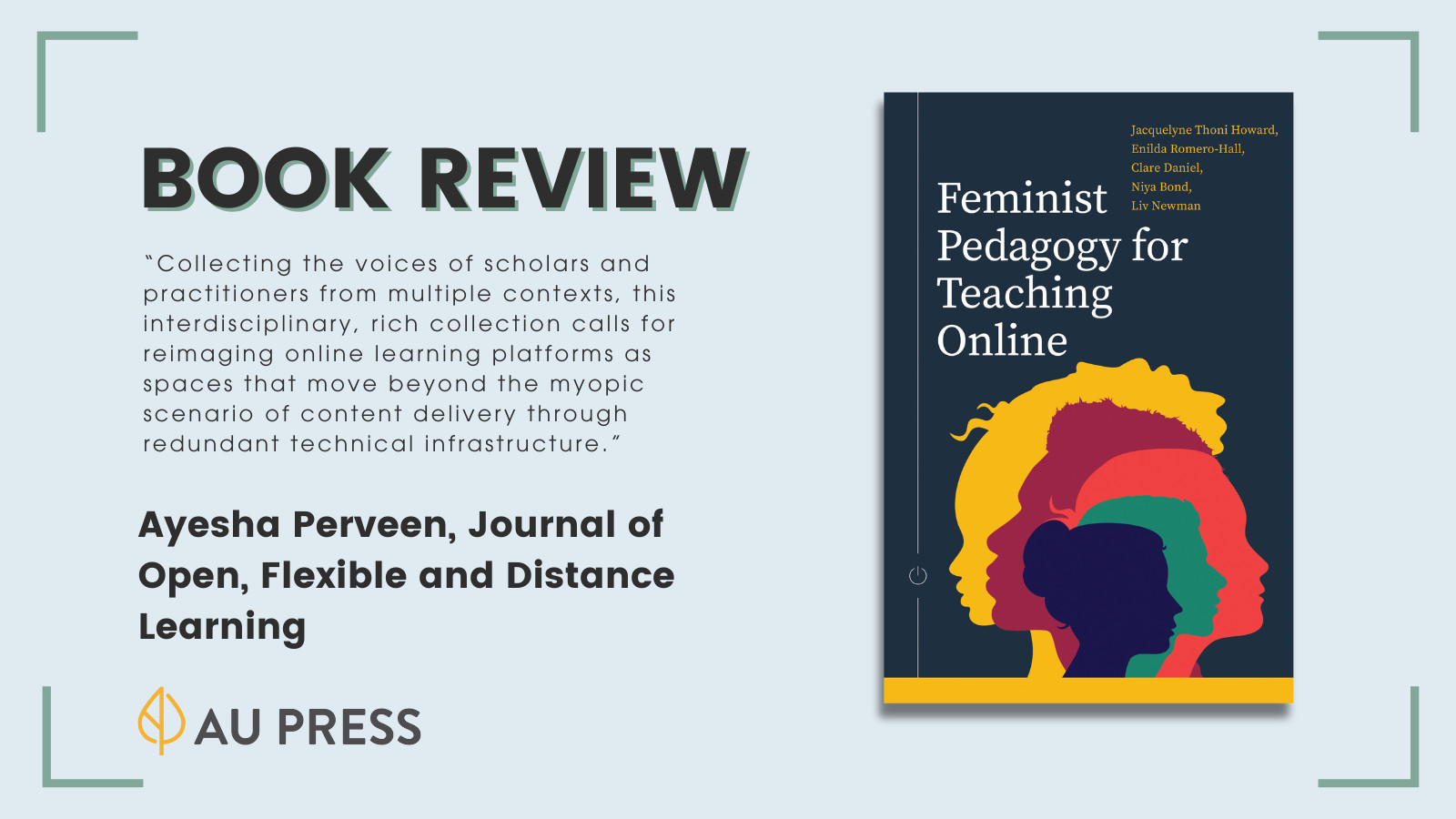
A book review of Feminist Pedagogy for Teaching Online authored by Dr. Ayesha Perveen was published in the Journal of Open, Flexible and Distance Learning. Thank you Dr. Perveen for taking the time to review our book and your praise as well as thoughtful feedback!
The abstract: “This book review critically examines Feminist Pedagogy for Teaching Online (Howard et al., 2025), identifying it as a crucial intervention that bridges a significant gap in contemporary scholarship by envisioning online learning through the lens of feminist pedagogy. The collection challenges dominant instructional design norms and technological culture, underscoring fundamental values of care, equity, reflexivity, and social justice.
Structured into four thematic parts, the book consistently emphasises praxis, showcasing practical tools like social annotation and cryptoparties to foster equity and collaboration in e-spaces. Its primary strength lies in modelling feminist pedagogical principles through collaborative and student-centred approaches. While praised for its diverse contributions, the review notes some chapters could benefit from more analytical engagement with structural barriers to feminist agency in institutional settings. It acknowledges potential conceptual repetitions for novice readers. Nevertheless, the book is considered a vital resource for all e-learning stakeholders, promoting value-driven, ethical, and transformative online learning environments.”
The review is available open access and you can read it here:
Perveen, A. (2025). Book Review: Feminist Pedagogy for Teaching Online. Journal of Open, Flexible and Distance Learning, 29(1), 151–158.https://doi.org/10.61468/jofdl.v29i1.731
This post was originally published on AECT Interactions but is no longer available there. However, an archived version can be accessed via the Wayback Machine using this link. As the original author, I wanted to make sure this content remains accessible to ensure continued access to its insights and discussions. If you have any questions or concerns, please feel free to reach out.
Feminist pedagogies belong in academia, whether incorporated into onsite or online curricula. If this term is new to you, or if you’d like to find out how you might bring feminist pedagogies into your teaching, I welcome you to read on.
I’ll start here: I consider myself an intersectional feminist. As thoroughly discussed by Rosemary Tong, in her book Feminist Thought, feminist theories aim to describe women’s experiences through analyzing patriarchy, sexuality, or other ideologies. Yet it often overlooks the role of race and class. Therefore, feminist theory remains White and its potential to broaden and deepen its analysis by addressing non-privileged women remains unrealized (Crenshaw, 1989). Intersectional feminism views identities as consisting of multiple social dimensions including gender, race, sexuality, and class. As a woman of color—an Afro-Latinx woman—intersectional feminism fully embraces my experiences.
As I learned more about the feminist movement and how some colleagues have embraced feminism in their teaching practice, I quickly realized that because of my intersectional feminist tendencies I had adopted a feminist pedagogy. According to Shrewsbury (1987), feminist pedagogy is a philosophy of teaching/learning processes that guides our choice of classroom practices in which a community of learners is empowered to act responsibly towards one another and the subject matter. Feminist pedagogy also encourages us to apply what we learn to social action.
Intersectional feminism views identities as consisting of multiple social dimensions, including gender, race, sexuality, and class. As a woman of color, an Afro-Latinx woman, intersectional feminism fully embraces my experiences.— Enilda Romero-Hall
FEMINIST PEDAGOGIES IN TEACHING
Here are some ways in which I have embraced intersectional feminist pedagogies in my teaching:
Construction of Knowledge: In my classroom, I view learners as equal contributors to knowledge construction. I encourage my students to reflect on prior experiences and share them during our discussions. The aim is to decentralize knowledge.
Put it into practice: The learners in my courses are empowered and the ‘learner-instructor’ relationship is transformed (e.g. creating an open access book authored by graduate students in a course). I also aim to decolonize knowledge by acknowledging the existence of multiple epistemological frameworks from scholars around the world. Examples of decolonization of knowledge include having a variety of guest speakers, sharing reading lists of non-White authors, and/or amplifying colleagues with global perspectives.
Course Design: When designing a course, I am open to being flexible, recalibrating, and redesigning based on learner inputs. There is a balance in the instructor and learner input to help inform curriculum and classroom practices.
Put it into practice: On the first day of classes, I always state that “the syllabus is not written in stone.” Therefore, it is not uncommon to have changes in the course schedule to provide learners with additional time to work on a project or explore a topic. Also, I aim to identify authentic evidence of learning. Rather than engaging learners in regurgitation of content, I use generative strategies and authentic assessments, enabling learners to show genuine and valid evidence of learning (e.g., a short writing assignment).
Power and Authority: One of the key tenets of feminist theory is to be critical of power: Who has power? Why are they in a position of power? It is important to challenge normalized notions of dominant culture because they often serve to oppress the “others.” The idea is not to give the “façade of equality,” but instead to recognize how power structures are represented in the course and take action to correct it.
Put it into practice: In my HyFlex courses, I have observed this power imbalance, noticing that my synchronous online students may not be able to interject during discussions in the same way onsite students do. Therefore, I make a point to facilitate the discussion in a manner that opens moments in which online students can interject and make a contribution to the discussion.
Dealing with Differences: In this element, the ‘intersectional’ element of feminist theory is critical. Dealing with differences encourages dialogue that helps learners come to realize their own privilege and stereotypes they may have (i.e., race, class, gender, and others). Learners also get to know their classmates and the many different views each person holds.
Put it into practice: For an onsite course, this may be an open conversation between the learners and the instructor at the beginning of the course. In an online course, it’s important to highlight this in course ‘netiquette.’ This is one of the netiquette points I like to include on the main page of my course: “Be sensitive to the fact that online participants represent a wide variety of different political and religious beliefs, as well as cultural and linguistic backgrounds. Disagreeing is fine and even encouraged, but remember that you should aim for rational discourse.”
Community Building: Embracing community-building following a feminist pedagogy framework means valuing solidarity and shared power. The idea emphasizes to the learners how collective action can help empower a group of individuals just like it can empower groups to address inequalities and discrimination faced as individuals in society.
Put it into practice: Community building can be implemented by building equitable learning communities for students who are studying in person or online (Bali, 2021).
I recently joined the curation team of the Feminist Pedagogy for Teaching Online guide (co-curators include: Clare Daniel, Jacquelyne Thoni Howard, Niya Bond, and Liv Newman). The initial founders created it as a resource to assist faculty with the mass transition to remote learning due to the COVID-19 pandemic, as feminist pedagogies are equally important in online teaching and learning. The guide includes a range of readings, podcasts, and teaching tools that embrace the tenets of feminist pedagogy.
ADDITIONAL RESOURCES
Here are additional resources and readings that can also benefit you as you consider feminist pedagogies in your own teaching practice:
Campbell, K. (2015). The feminist instructional designer: An autoethnography. In B. Hokanson, G. Clinton, & M. Tracey (Eds.) The design of learning experience. Educational communications and technology: Issues and innovations. Springer, Cham. https://doi.org/10.1007/978-3-319-16504-2_16
You are welcome to pre-order it via Amazon. You also can wait until it is released because it will be available open access! As the date gets closers and we find out more information, I will be sharing more about the book. So excited!
I should add that Athabasca University Press has stated that it is possible that the book could be release Fall 2024. More than anything just know that the book is coming either later this year or early 2025 we will have the pleasure of sharing with you!
Last year, I received an invitation from my colleague, Clare Daniel, to present in a panel to discuss the Feminist Pedagogy for Teaching Online digital guide and other scholarly efforts related to the digital guide in person at Tulane University. The invitation to travel to New Orleans was extended to Niya Bond and myself (Clare, Jacque, and Liv live in New Orleans). The goal was for all the five editors of the digital guide to join in the panel.
Fast forward to February 2024, Niya and I travelled to New Orleans for the in-person panel. Meeting my colleagues in-person for the very first time was a joyous occasion. I have been personally interacting and collaborating with the FTPO editors for the last 3 years and we had only met through Zoom. It was so nice to fully interact outside the Zoom software and engage in informal convos that allowed us to learn more about each other personally and professionally.
“We want to acknowledge that this panel discussion is part of a lecture series dedicated to Adele Ramos Salzer (NC ’40). Her interest in academic programs focusing on women’s experiences led to the establishment of the Salzer lecture series. Her donation endowing the series has been generously strengthened through gifts in her memory from her family, friends, and classmates.”
Clare Daniel
During our visit to Tulane, we all got to have an short meeting to discuss panel, have dinner to talk about every under the sun (also, celebrate Clare’s new promotion at Tulane University), and have the panel at the Tulane University’s Newcomb Institute for students, faculty, and staff.
The editors of the FPTO digital guideThe editors of the FPTO after the panel presentation
During the panel we:
Provided a brief explanation of the origins of the digital guide and the idea for the forthcoming book
Shared why and how we expanded our team of editors
Shared a brief description of the forthcoming book
Discussed how and why we expanded the guide to include annotated assignments
Shared an explanation of the blog and the collaborative editing process
Allowed for Q & A
It was really nice to have such a strong presence of students during the panel session. The students were very curious about of opinions on online learning, now past the COVID-19 pandemic. We also had some good questions and conversations with faculty who attended the event. I am very thankful for the invite to participate in this panel. I am also grateful for the opportunity to meet my colleagues in-person for the first-time. Online environments, synchronous and asynchronous, have allowed is the opportunity to genuinely connect and communicate. However, it is always nice to further engage in-person to deeper our understanding of each other (personally & professionally), converse about the future of the digital guide, and discuss upcoming projects.
The curators of the Feminist Pedagogy for Teaching Online guide (Jacquelyne Thoni Howard, Clare Daniel, Niya Bond, Liv Newman, and myself) are putting together a new edited collection on this topic. A list of potential topics is included in the call.
Please consider submitting a book chapter proposal by July 2nd, 2021. The book will be proposed to the Distance Education series at Athabasca University Press for publication in an open-access format.
I was recently invited to write a post for the newly established AECT Interactions digital publication. I welcomed the opportunity to write about a topic of my choice and was honored to be amongst those invited (which included colleagues who I deeply admired and whose work I value). Since I am starting to explore and write about feminist theories in various ways in my work, I decided that I wanted to write a short practical piece about feminist pedagogy. The lead of this new AECT initiative, Dr. Michael Grant, encourages us to write pieces that serve as a reflection of our own teaching experience and/or research outcomes. It seemed natural to me to write about my own experience embracing feminist pedagogies in my teaching. You can read my published post in AECT Interactions here: How to Embrace Feminist Pedagogies in your Courses
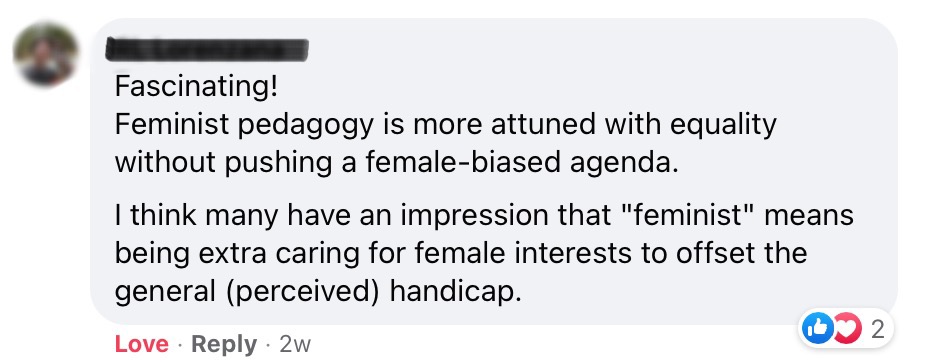
I shared the post widely online in different social media outlets and received fairly positive feedback on the topic and content covered. One of my favorite comments was shared in a Facebook group. It put a smile on my face. Below is a screenshot of the comment.



 Design Goodiness
You must be logged in to post a comment.