The #AECT Tenure and Promotion Guide

I was browsing the AECT website this morning to access a chapter from the Handbook of Research for Educational Communications and Technology and came across this publication titled: “The AECT Tenure and Promotion Guide.”

The_AECT_Tenure_and_Promotion_Guide

The purpose and scope of the document are described as:

“AECT is dedicated to serving its members, and one of the services provided is this basic tenure and promotion guide. Its purpose is to provide a point of departure and a general set of guidelines for those being considered for tenure or promotion. This guide is intended to help orient faculty seeking tenure or promotion and to direct them to other resources pertinent to their specific situations. In all cases, a faculty member seeking tenure and promotion should become familiar with local procedures and expectations and seek the advice of local mentors. A general guide such as this cannot possible address all of the relevant issues and concerns that exist at any particular institution.

Contributors to this document included Mike Spector, Chuck Hodges, Andy Gibbons, Jan Elen, Elizabeth Boling. Others involved in the effort are working on an expanded version to be published separately. It is available at no cost to members of AECT. The copyright belongs to AECT (2014). Use of the document for non-monetary academic use is granted so long as this acknowledgement citing the source is included in what is shared: The AECT Tenure and Promotion (T&P) Guide, first published online by AECT in 2014 – see www.aect.org.”

If you are going through tenure and promotion in your institution this should be a good source of guidance and resources. Good luck!

ERH

Reflecting on the 2013 – 2014 Academic Year

It is officially the end of the 2013 – 2014 academic year (well except for the summer course I am teaching) and it is time for me to reflect on this academic year.

It has been an interesting year! First I should say that, I felt welcomed into my new position at the University of Tampa (special thanks to the EDU faculty and admin staff). I was a bit worried that after spending five years at Old Dominion University I was not going to feel that same level of comfort. Thankfully, I was able to settle in the fifth floor of Plant Hall and have great office neighbors. I also met a great group of ladies during my new faculty orientation and we made an effort to get together for lunch throughout the academic year. It is great to have cohort buddies that can relate to the new faculty experience. Last, but definitely not least, I am very thankful to the amazing students that I have in my classes. They definitely make it easy for me to enjoy the work that I do.

I remember reading a post by a colleague my last year in the doctoral program in which she mentioned that been a faculty member at a university was a “24/7” job. I though that was a bit too much but the reality is that she was 100% correct. It is a career choice that requires a significant amount of commitment and dedication. I do it because I love my profession and I am passionate about it. I do recommend taking time to “take a break” and enjoy life, when possible, otherwise it can be overwhelming. Do take time to stop and smell the roses!

A few updates:

  • This year I taught several courses in the ID&T program. I think I underestimated the amount of time and energy it takes for me to complete a “new prep” for each of my courses — every week. Wow! It was a massive undertaking.
  • On the research side, things are going well. I have research projects in different stages: accepted for publication, under review, in preparation and in data collection. I also have a few projects and collaborations that will be starting in the next few months. Some of this projects will be with colleagues and others will be with students. I am pretty excited!
  • I am participating in a panel session later this year at AECT titled: First-year experience, tenure, and scholarship: Supporting international faculty in instructional technology programs; so I am putting together a list of suggestions/recommendations for new faculty. I will upload my slides closer to the presentation day.

I hope everyone has a productive as well as relaxing summer! Saludos!

AERA2014 — The Power of Education Research

Unfortunately, I do not have the time needed to write everything that I experienced and learned at AERA 2014 (end of the semester is here!) but I did wanted to share some quick highlights:

20140423-105209.jpg

The SIG TICL business meeting provided an opportunity to review and learn more about “Instructional Design Research on Complex Learning: Past, Present and Future” with keynote from Jeroen van Merrienboer.

20140423-105228.jpg

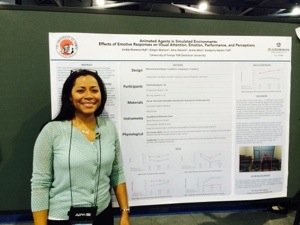
Of course, I presented my research on emotive animated agent in simulation-based training. Had a significant number of conference participants stop by to learn more about it (Thanks to all the ODU faculty and students!). I did have a journal editor recommend his journal for publication. I am still considering my options but I am happy to say that this manuscript should be out in a few weeks!

20140423-105244.jpg

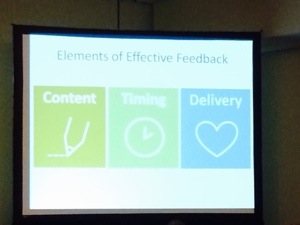
The following graphics caught my attention as I sat in the audience listening to the presentations. The first graphic was from a presentation by Jered Borup (GMU) about the use of feedback  in asynchronous video communication. It applied to feedback in general and I though it was worth sharing. Sometimes as educators we forget how to give effective feedback and how important it is for the learners. The second graphic was from a presentation related to research on different levels of e-learning. We are currently implementing some changes in the use of hybrid education at my current institution and I thought this graphic would help illustrate that there are many models of blended learning that can be considered.

20140423-105311.jpg20140423-105321.jpg

I was pleasantly surprised by Philly. The people are friendly and the city has a lot to offer! Having good restaurant is also a bonus. I enjoyed attending AERA 2014 and hoping to attend again next year!


20140423-105351.jpg

EERA 2014 Annual Conference: Disseminating Educational Research

20140223-000614.jpg

This past week I had the opportunity to attend the EERA Annual Conference in Jacksonville, Florida. I was excited about this conference because it was my first time attending it and I was curious to see the presentation topics that others would cover during the conference. Since EERA is a educational research conference it provides the opportunity to have a mix of academics with different backgrounds, which is always good for discussion (everyone brings their own perspective).

In the first session that I attended (I was very happy to see another alum from the ID&T program at Old Dominion University, Chris Nickels) the presentation topics related to organizational behavior (i.e., manager motivation, virtual moderation in online meetings, decision making models). I immediately started thinking about the instructional design courses that I teach and how my graduate students would really enjoy the presentations. Some of the topics related to their instructional design projects, especially those in the EME620 course (working in their Systematic Instructional Design project).

I also attended a session related to technology in education, in which several doctoral graduate students from the University of Georgia presented their research projects (dissertation projects and other collaborations). It was nice to meet them in person because I had exchange emails with a few of them for activities related to AECT. The presentation topics included: Blogs in Education (Firat), Technology Integration (Missy) and Learn by Designing Games (Daisy). This was a well attended session with other instructional designers. Very interesting data from all participants. The “Learn by Designing Games” presentation solidified what has been echoed by many others in the instructional design field: “designers learn more when they do (design) something rather than just sitting in the classroom and talking about it.” Another takeaway from this session, from Firat’s presentation, is that currently there is research hoping to create instruments that help assess the importance of blogging in education. Potentially, future research will also help gain knowledge on the use of social media tools for educational purposes (i.e., Facebook, Instagram, etc. ). Firat mentioned that the instrument is currently in Turkish but his collaborators and him are working on an English version.

20140223-102822.jpg 20140223-102835.jpg

The last session I attended was a great presentation on “how to handle distractions on the age of the screenagers.” The presentation provided good theoretical background on multitasking literature and our misconceptions of what is multitasking. The author also provided great tips on how to handle those “screenagers” in the classroom and good practices for instructor. One really good takeaway is to add students in the decision making process for rules on “laptops in the classroom.”

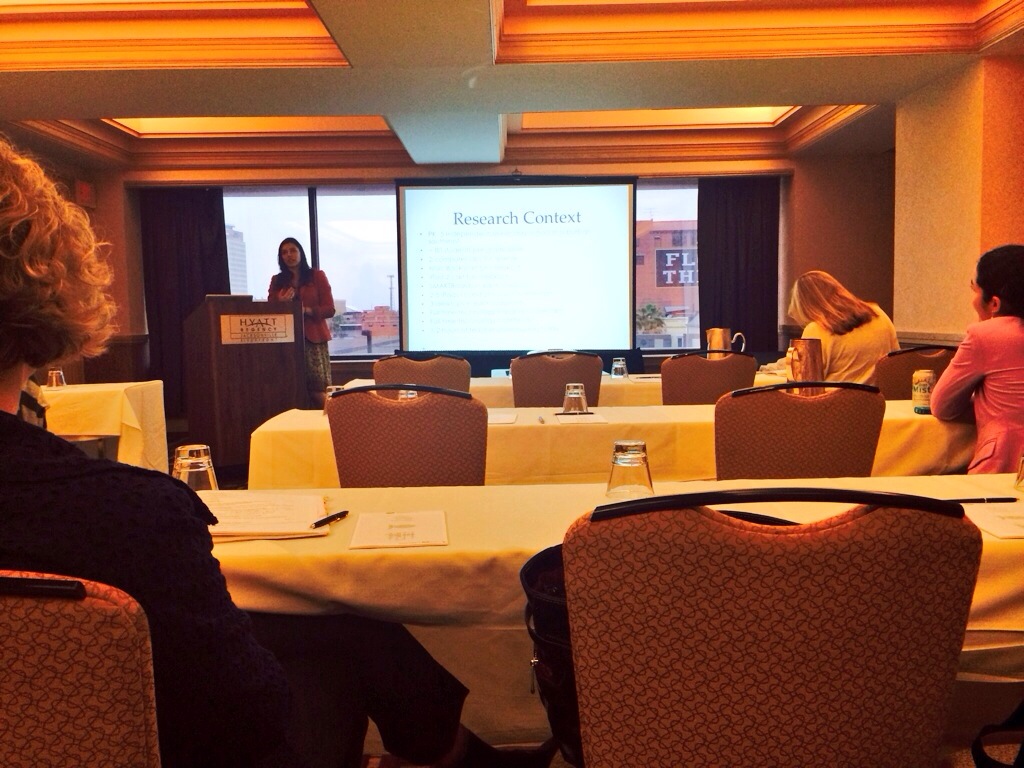
In addition to attending different sessions, I was also presenting a session on the use of visual attention measures to investigate multimedia design and development. This sessions was a result of the research that I conducted during my last research project in which I used visual attention measures (eye tracking) and other psychological measures  to investigate the differences between novices and expert nurses interacting with a 3D simulation. The presentation at EERA was more than anything a collection of theoretical and empirical evidence that helps support the use of visual attention measures (eye tracking) in the instructional design field to better understand the difference between neutral and emotional stimuli presented to the learners in multimedia environments. I was specifically discussing the importance of visual attention measures to investigate the design of emotionally expressive animated agents. The discussion during the session was interesting and very informative for the audience and for me (as presenter). One colleague that joined the discussion mentioned that her husband was in the marketing industry and she shared some of the research that they do when they use eye tracking to investigate the design of marketing ads.

I have to say that although it is smaller than the other conferences I normally attend, EERA was a great conference. The sessions were well attended, their was a great conversations/discussion about topics related to the instructional design field, and I had the opportunity to sit down and meet other faculty and grad students to learn about their research. A huge bonus is that is it normally hosted in the Southeast part of the U.S. and that is fairly convenient for my current location. Next year the conference will be in Sarasota (Florida) and I highly encourage others to attend and join the EERA Annual Conference.

I survived my first semester as a faculty member!

Hard to believe it is already December!

Before starting the Fall 2013 semester I was told by many colleagues that the semester would go by so fast, it was going to feel like a blur at the end of the semester. I was a bit reluctant! But now that is all said and done, I have to say that it went by faster than expected.

One of the things that was a bit harder to do in this new academic environment was the adjustment to teaching night-time classes. In all honesty, I am all about cooking dinner with my significant other, decompressing at the dinner table, a nice evening walk and then some work. I have managed to figure it out. I combined working from home, working from the office, teaching a few classes in a hybrid format and teaching other classes completely face to face. I figured that if most of my students were able to do a 8 hour job and then make it to a 6 to 9 pm class, then I could do it too. It does make the days I have nights off and weekends even more special.

Another adjustment this past semester was the amount of email that I had to manage and all the work that comes with it. While I was in the doctoral program, I received a moderate amount of email related mostly to my dissertation. I also received email related to service at my professional organization. But between the students, the department, the college, the university, professional organizations, and every one else that decided to email me at some point in time, email was at times a major consumption of productivity. I am starting to think it should be part of self evaluations (how much time did you spend replying to emails during the semester?). I guess I have improved my emailing skills and management of emails.

Of course, the biggest adjustment is finding the balance between research, teaching, and service. I am not going to claim that I found it because I would be lying. I had, as recommended by several colleagues, designated a writing day for the week. However, I was not able to keep up with it. I still managed to get conferences proposals written and a few manuscript to a decent level. But I really wish I could immerse myself in writing a bit more. It is still “work in progress.”

A few other things to keep in mind if you are going into your first semester as a faculty member are:

  • Meetings take a chunk of your time: Days in which I had meetings (that were longer than an hour) were the most challenging. I tried hard to prepare in advance but I always was catching up after the meetings right until the 6 pm class. This had mainly to do with my personal and class schedule. Since most meeting started around 11:30 am , I would have to cut short work time in the morning and catch up with work in the afternoons.  Although, I am glad that the meetings are mainly around 11am since I have stay around campus for 6pm classes.
  • Be prepare to explain your grading criteria and assigned grades: We need to create a culture of “constructive feedback” in the classroom. I know that grades and points are important but what I really like is a focus on creativity, higher order thinking skills and problem solving. I like to see assignments in two ways: what was done correctly and what can be improved. I remember that when I was working on my dissertation I would asked my significant other to just criticize my work as if I was his worst enemy. But I know that sometimes it difficult to received that constructive feedback. After all, that student just spent a few sleepless nights working on it. I do have to say that once I explain my grading criteria students see it with a very different mindset.

Overall, reflecting on my first semester, I am still learning how the academic systems works. But, I am happy to be part of the UT family and to be a Floridian (the sunshine state!). One of the nicest comments I received at the end of the semester on a one on one meetings was when I student said “Dr. Romero-Hall you are a great addition to the UT IDT program, I want to take the rest of the classes with you! I really appreciate your honest feedback.” So, I guess I must be doing something right 🙂